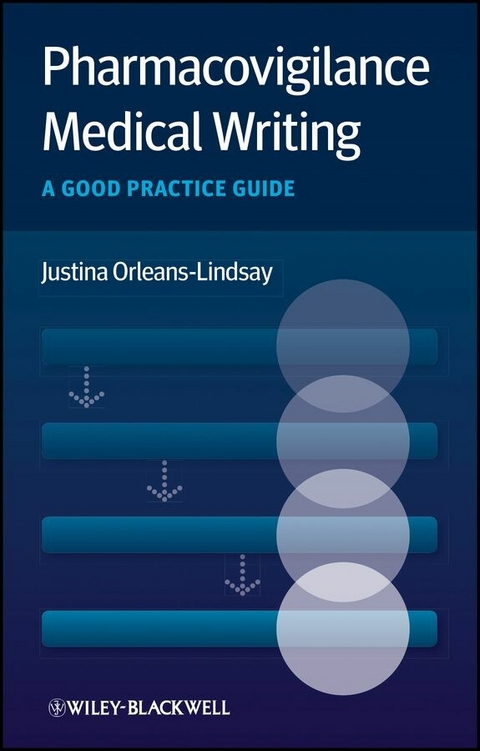
Pharmacovigilance Medical Writing (eBook)
John Wiley & Sons (Verlag)
978-1-118-30206-4 (ISBN)
Justina Orleans-Lindsay BSc, MSc, PhD is a Director of Acadustri (Medical Writing) Limited and Visiting Lecturer in pharmacovigilance at the University of Hertfordshire, UK.
Pharmacovigilance Medical Writing covers the preparation of pharmacovigilance documents for all stages of the drug development process (i.e. from clinical development through to applications for marketing authorisations to the post-marketing stage). For each document, the book presents a review of the regulatory framework that governs the content of the document, followed by practical guidance (e.g. scheduling, source data, department/functions involved in document preparation/review, appropriate timelines and planning activities), ending with a generic model document compliant with the current guidelines, which can be modified to meet specific company and product requirements.
Justina Orleans-Lindsay BSc, MSc, PhD is a Director of Acadustri (Medical Writing) Limited and Visiting Lecturer in pharmacovigilance at the University of Hertfordshire, UK.
Preface - Pharmacovigilance Medical Writing Comes of Age ix
Acknowledgements xiii
Abbreviations xv
1 Pharmacovigilance Medical Writing - An Overview Across the Drug Development Process 1
2 Pharmacovigilance Medical Writing for Clinical Trials 5
2.1 Introduction 5
2.2 The EU Annual Safety Report and US IND Annual Report - A Historical Look at Reporting from Clinical Studies 6
2.3 The Development Safety Update Report 9
2.4 References 30
3 Pharmacovigilance Medical Writing for Marketing Authorization 33
3.1 Introduction 33
3.2 The Summary of Clinical Safety 34
3.3 The Integrated Summary of Safety 60
3.4 The 120-Day Safety Update Report 73
3.5 References 74
4 Pharmacovigilance Medical Writing in Risk Evaluation and Management 75
4.1 Introduction 75
4.2 The EU Risk Management Plan 76
4.3 The Risk Evaluation and Mitigation Strategies Report 96
4.4 The Benefit-Risk Evaluation Report 106
4.5 References 114
5 Pharmacovigilance Medical Writing for Marketed Products 117
5.1 Introduction 117
5.2 The EU Periodic Safety Update Report 119
5.3 The US Periodic Adverse Drug Experience Report 147
5.4 The PSUR Addendum Report 157
5.5 The Summary Bridging Report 163
5.6 References 169
6 The Ad-Hoc Safety Review and Response to Questions Document 171
6.1 Introduction 171
6.2 The Ad-Hoc Safety Review 172
6.3 The Response to Questions Document 179
7 The Rest of the World 185
7.1 Introduction 185
7.2 Japan 186
7.3 Canada 188
7.4 Australia and New Zealand 188
7.5 India 189
7.6 Singapore and Taiwan 190
7.7 References 191
Appendices Appendix 1: Sample Line Listing 193
Appendix 2: Sample Summary Tabulation 197
Appendix 3: Another Look at the US IND Annual Report 199
Appendix 4: The New Pharmacovigilance Legislation in the EU 211
Appendix 5: The New EU Risk Management Plan 215
Appendix 6: The New EU Periodic Safety Update Report/Periodic Benefit-Risk Evaluation Report 227
Glossary 253
Index 259
"This book is well structured and should prove useful for
pharmacovigilance scientists and writers to have a reference text
and checklist for regulatory pharmacovigilance documentation
requirements." (Pharmaceutical Journal, 9
February 2013)
Chapter 3
Pharmacovigilance Medical Writing for Marketing Authorization
3.1 Introduction
The process of pre-authorization clinical development is considered complete when the sponsor has collated sufficient evidence of efficacy and safety for the investigated medicinal product. Thereafter, it is time to compile all the accrued non-clinical and clinical data into dossiers for submission to the regulatory authorities responsible for granting marketing authorization.
In the EU and US regions, dossiers prepared in pursuit of marketing authorization (referred to as Marketing Authorization Application [MAA] and New Drug Application [NDA] in the EU and US, respectively) use a standardized format known as the Common Technical Documentation (CTD). This comprises a set of documents devoted to the analysis of data relating to the quality, safety, and efficacy of the medicinal product.
Documents dedicated to safety analyses represent a significant component of the CTD dossier. Routinely, qualified personnel at the regulatory authority meticulously review all the safety data collated in the course of the clinical development program, to ensure that the medicinal product has an acceptable safety profile and is well tolerated in the proposed indication, treatment dose(s), route(s) of administration, and treatment population.
Whereas the Summary of Clinical Safety (SCS), also referred to as CTD Module 2.7.4, is the main analysis of safety for the EU region, submissions to the US require the SCS and two other documents not mandated in the EU, namely, the Integrated Summary of Safety (ISS) and the 120-Day Safety Update Report.
Although the SCS and ISS both present analyses of safety data gathered during the clinical development program, they differ in that the SCS is a clinical summary, in which summaries of safety data can be presented by pooling studies (if study designs are sufficiently similar to permit pooling) or by individual study. As such, the SCS can be prepared without pooling studies but by simply relying on data as presented in the individual clinical study reports. In contrast, the ISS is not a clinical summary but an integrated overall analysis, which presents safety data that has undergone statistical analysis after data from the individual studies have been pooled into a single database. The rationale for this is that analysis from a pooled database increases the likelihood of detecting potential treatment-related adverse effects that may occur at low frequencies. Thus, the ISS summarizes the same data that are presented in the SCS, but affords a level of scrutiny greater than that achieved through analysis of individual study data. Evaluation of data from a single integrated database also permits better comparison of treatment-emergent adverse event (TEAE) rates between placebo-treated subjects and actively-treated subjects to determine the TEAEs that represent adverse drug reactions (ADRs) (i.e. related TEAEs). This therefore reduces reliance on the investigator's opinion of causality.
Safety data presented in the SCS and/or ISS are of critical importance, as this forms the basis for the medicinal product's labeling in the Summary of Product Characteristics (SmPC) (for the EU) and United States Package Insert (USPI) (for the US), representing the information provided to prescribers and other healthcare professionals in respect of the safe and recommended use of the product.
As the name implies, the 120-day Safety Update Report is mandated for submission to the Food and Drug Administration (FDA) 120 days after submission of the NDA, and is intended to provide a summary update of any new safety data gathered by the sponsor since the data cut-off for the NDA submission documents, which could have been as far back as 6 months prior to the NDA submission date. In effect, the 120-day Safety Update Report could represent almost 1 year's worth of new safety data, which needs to be reviewed by the authorities to ensure there has been no change in the product's recorded safety profile. This is particularly important for medications intended for long-term treatment.
In summary, the following pharmacovigilance documents are required for marketing authorisation (see Figure 3.1):
- SCS (EU and US);
- ISS (US only);
- 120-day Safety Update Report (US only).
3.2 The Summary of Clinical Safety
3.2.1 Regulatory Guidelines and General Principles
The purpose of the SCS is to present safety data clearly describing the safety profile of the medicinal product for which the sponsor seeks marketing approval. Guidance on the required content and format of the SCS is provided in the Notice to Applicants – Medicinal Products for Human Use [1]. The general principles underlying presentation of safety data in the SCS are summarized in Table 3.1.
Figure 3.1 Example timeline for preparation of the SCS
Table 3.1 General principles for the SCS.
| Principle | Description |
| Scope of Data | The SCS comprises safety data from the following: – All studies for the medicinal product undertaken in the clinical development program – Global post-marketing data (if the investigated medicinal product is also marketed) – Published literature |
| Safety Population | As with ICH E3 clinical study reports, the safety population includes all subjects exposed to at least one dose of the investigated medicinal product in the clinical studies. Exclusion of any subject exposed to study treatment from the safety population must be justified. |
| TEAEs | TEAEs are defined as AEs that were not present at study baseline and occurred after administration of the medicinal product, or AEs that were present at study baseline but increased in intensity/severity after administration of the medicinal product. |
| AE = adverse event; ICH = International Conference on Harmonisation; SCS = Summary of Clinical Safety; TEAE = treatment-emergent adverse event |
3.2.2 Data Sources for the SCS
Source data required by the PV Medical Writer before preparation of the SCS can commence is presented in Table 3.2, with details of the departments/functions usually tasked with responsibility for provision of such data to the PV Medical Writer.
Table 3.2 Source data for the SCS.
| SCS Data | Data Source |
| Safety Data from the Clinical Development Program | Medical Writing – All clinical study reports for studies undertaken in the clinical program – Tables, figures, and listings from any pooled studies (if applicable) – Study reports relating to PK and PD studies – Study reports relating to reproductive toxicology, etc. |
| Post-Marketing Safety Data | Drug Safety (Pharmacovigilance) – ICH E2C line listings – Summary tabulations – CIOMS reports for all reported cases |
| Post-Marketing Sales Data | Sales and Marketing |
| Literature | Medical Information/Scientific Information Services |
| CIOMS = Council for International Organizations of Medical Sciences; ICH = International Conference on Harmonisation; PD = pharmacodynamic; PK = pharmacokinetic; R&D = Research and Development; SCS = Summary of Clinical Safety |
3.2.3 Review of the SCS
As with all safety documents, preparation of the SCS is a team effort requiring contribution (i.e. in terms of data provision as well as document review and approval) from a number of different departments. It is important to remember that the specific designation of these departments will vary from company to company. Again, the PV Medical Writer's role in the project is central, as responsibility for coordinating the entire process and ensuring that all participants fulfil their roles rests squarely on his/her shoulders.
A typical team involved in the preparation of the SCS is presented in Table 3.3.
Table 3.3 The SCS review team.
| Reviewer | Key Areas of Responsibility |
| Statistics and Data Management | Ensures correct interpretation of statistical data (either pooled or non-pooled) are used. |
| Regulatory Affairs | Ensure that conclusions reached in the SCS with respect to the medicinal product's safety profile are consistent with the product's labeling, whether draft labeling in preparation (for pre-authorized products) or existing labeling (for marketed products) that may also be undergoing simultaneous updating. |
| Drug Safety Physician | Ensure that data is presented objectively and appropriate conclusions are drawn from the presented safety data. |
| Qualified Person (EU)/Director of Drug Safety | Ensure that data is presented objectively and... |
| Erscheint lt. Verlag | 22.6.2012 |
|---|---|
| Sprache | englisch |
| Themenwelt | Medizin / Pharmazie ► Gesundheitsfachberufe |
| Medizin / Pharmazie ► Medizinische Fachgebiete ► Pharmakologie / Pharmakotherapie | |
| Schlagworte | Abbreviations • across • Age • Annual • Arzneimittelüberwachung • Arzneimittelüberwachung • authorization • Clinical • Clinical Pharmacology & Therapeutics • clinical safety • day safety • Drug • EU • Historical • IND • Integrated • Ix • Klinische Pharmakologie u. Therapie • Medical • Medical Science • Medizin • Overview • pharmacovigilance • references pharmacovigilance medical • Reporting • Safety • Studies • US |
| ISBN-10 | 1-118-30206-0 / 1118302060 |
| ISBN-13 | 978-1-118-30206-4 / 9781118302064 |
| Informationen gemäß Produktsicherheitsverordnung (GPSR) | |
| Haben Sie eine Frage zum Produkt? |
 EPUB (Adobe DRM)
Kopierschutz: Adobe-DRM
Adobe-DRM ist ein Kopierschutz, der das eBook vor Mißbrauch schützen soll. Dabei wird das eBook bereits beim Download auf Ihre persönliche Adobe-ID autorisiert. Lesen können Sie das eBook dann nur auf den Geräten, welche ebenfalls auf Ihre Adobe-ID registriert sind.
Details zum Adobe-DRM
Dateiformat: EPUB (Electronic Publication)
EPUB ist ein offener Standard für eBooks und eignet sich besonders zur Darstellung von Belletristik und Sachbüchern. Der Fließtext wird dynamisch an die Display- und Schriftgröße angepasst. Auch für mobile Lesegeräte ist EPUB daher gut geeignet.
Systemvoraussetzungen:
PC/Mac: Mit einem PC oder Mac können Sie dieses eBook lesen. Sie benötigen eine
eReader: Dieses eBook kann mit (fast) allen eBook-Readern gelesen werden. Mit dem amazon-Kindle ist es aber nicht kompatibel.
Smartphone/Tablet: Egal ob Apple oder Android, dieses eBook können Sie lesen. Sie benötigen eine
Geräteliste und zusätzliche Hinweise
Buying eBooks from abroad
For tax law reasons we can sell eBooks just within Germany and Switzerland. Regrettably we cannot fulfill eBook-orders from other countries.
aus dem Bereich