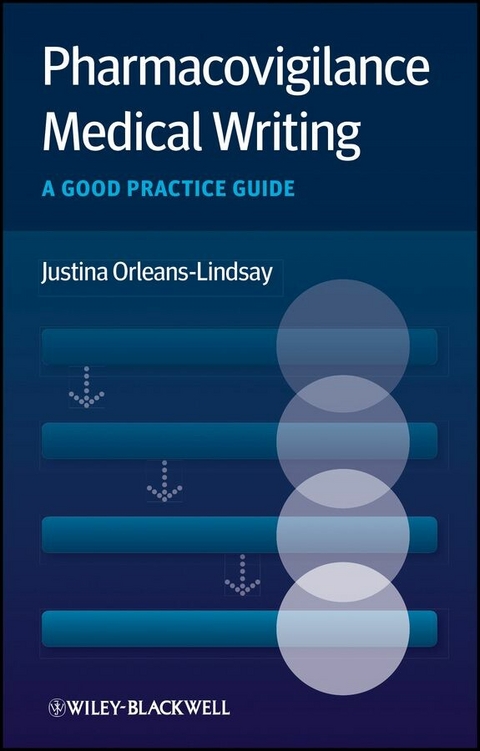
Pharmacovigilance Medical Writing (eBook)
John Wiley & Sons (Verlag)
978-1-118-30205-7 (ISBN)
Justina Orleans-Lindsay BSc, MSc, PhD is a Director of Acadustri (Medical Writing) Limited and Visiting Lecturer in pharmacovigilance at the University of Hertfordshire, UK.
Justina Orleans-Lindsay BSc, MSc, PhD is a Director of Acadustri (Medical Writing) Limited and Visiting Lecturer in pharmacovigilance at the University of Hertfordshire, UK.
Pharmacovigilance Medical Writing: A GOOD PRACTICE GUIDE 1
Contents 9
Preface 11
Acknowledgements 15
Abbreviations 17
1 Pharmacovigilance Medical Writing – An Overview Across the Drug Development Process 19
2 Pharmacovigilance Medical Writing for Clinical Trials 23
2.1 Introduction 23
2.2 The EU Annual Safety Report and US IND Annual Report – A Historical Look at Reporting from Clinical Studies 24
2.2.1 The EU annual safety report 24
2.2.2 The US IND annual report 25
2.3 The Development Safety Update Report 27
2.3.1 The DSUR – regulatory guidelines and general principles 27
2.3.2 Scheduling and periodicity – when are DSURs prepared? 29
2.3.3 Data sources for the DSUR 29
2.3.4 Review of the DSUR 29
2.3.5 A timeline – planning for the DSUR 30
2.3.6 Generic model of the DSUR 33
2.4 References 48
3 Pharmacovigilance Medical Writing for Marketing Authorization 51
3.1 Introduction 51
3.2 The Summary of Clinical Safety 52
3.2.1 Regulatory guidelines and general principles 52
3.2.2 Data sources for the SCS 53
3.2.3 Review of the SCS 53
3.2.4 A timeline – planning for the SCS 54
3.2.4.1 Planning for the SCS and collation of source data 55
3.2.4.2 Writing and reviewing of the draft SCS 56
3.2.5 Generic model of the SCS 57
3.3 The Integrated Summary of Safety 78
3.3.1 Regulatory guidelines and general principles 78
3.3.2 Data sources for the ISS 78
3.3.3 Review of the ISS 79
3.3.4 A timeline – planning for the ISS 79
3.3.5 Generic model of the ISS 79
3.4 The 120-Day Safety Update Report 91
3.5 References 92
4 Pharmacovigilance Medical Writing in Risk Evaluation and Management 93
4.1 Introduction 93
4.2 The EU Risk Management Plan 94
4.2.1 Regulatory guidelines and general principles 94
4.2.2 When are EU risk management plans prepared? 95
4.2.3 Data sources for the EU risk management plan 96
4.2.4 Review of the EU risk management plan 96
4.2.5 A timeline – planning for the EU risk management plan 96
4.2.6 Generic model of the EU risk management plan 97
4.3 The Risk Evaluation and Mitigation Strategies Report 114
4.3.1 Regulatory guidelines and general principles 114
4.3.2 When are REMS reports prepared? 115
4.3.3 Data sources for the REMS reports 115
4.3.4 A timeline – planning for the REMS report 115
4.3.5 Generic model of the REMS report 116
4.4 The Benefit-Risk Evaluation Report 124
4.4.1 Regulatory guidelines and general principles 124
4.4.2 When are benefit-risk evaluation reports prepared? 125
4.4.3 Data sources for the benefit-risk evaluation report 125
4.4.4 Review of the benefit-risk evaluation report 125
4.4.5 A timeline – planning for the benefit-risk evaluation report 125
4.4.6 Generic model of the benefit-risk valuation report 126
4.5 References 132
5 Pharmacovigilance Medical Writing for Marketed Products 135
5.1 Introduction 135
5.2 The EU Periodic Safety Update Report 137
5.2.1 Regulatory guidelines and general principles 137
5.2.2 Scheduling and periodicity – when are EU PSURs prepared? 139
5.2.2.1 Exceptions to standard EU PSUR scheduling 139
5.2.3 Data sources for the EU PSUR 139
5.2.4 Review of EU PSURs 141
5.2.5 A timeline – planning for the EU PSUR 142
5.2.5.1 PSUR planning and collation of source data 142
5.2.5.2 Writing of the draft PSUR 143
5.2.5.3 Review of the draft PSUR 143
5.2.5.4 QC activities and PSUR finalization 144
5.2.6 Generic model of an EU PSUR 144
5.2.7 Upcoming developments for the EU PSUR 164
5.3 The US Periodic Adverse Drug Experience Report 165
5.3.1 Regulatory guidelines and general principles 165
5.3.2 Scheduling and periodicity – when are US PADERs prepared? 166
5.3.3 Data sources for the US PADER 166
5.3.4 Review of US PADERs 166
5.3.5 A timeline – planning for the US PADER 166
5.3.6 Generic model of a US PADER 169
5.4 The PSUR Addendum Report 175
5.5 The Summary Bridging Report 181
5.6 References 187
6 The Ad-Hoc Safety Review and Response to Questions Document 189
6.1 Introduction 189
6.2 The Ad-Hoc Safety Review 190
6.2.1 Data sources for the ad-hoc safety review 190
6.2.2 Review of the ad-hoc safety document 190
6.2.3 A timeline – planning for the ad-hoc safety review 190
6.3 The Response to Questions Document 197
6.3.1 Data sources for the response to questions document 197
6.3.2 Review of the response to questions document 197
6.3.3 A timeline – planning for the response to questions document 198
6.3.4 Generic model of the response to questions document 198
7 The Rest of the World 203
7.1 Introduction 203
7.2 Japan 204
7.2.1 Pharmacovigilance medical writing for clinical trials 204
7.2.2 Pharmacovigilance medical writing for marketed products 205
7.3 Canada 206
7.3.1 Pharmacovigilance medical writing for clinical trials 206
7.3.2 Pharmacovigilance medical writing for marketed products 206
7.4 Australia and New Zealand 206
7.4.1 Pharmacovigilance medical writing for clinical trials 207
7.4.2 Pharmacovigilance medical writing for marketed products 207
7.5 India 207
7.5.1 Pharmacovigilance medical writing for clinical trials 207
7.5.2 Pharmacovigilance medical writing for marketed products 208
7.6 Singapore and Taiwan 208
7.6.1 Pharmacovigilance medical writing for clinical trials 208
7.6.2 Pharmacovigilance medical writing for marketed products 208
7.7 References 209
Appendices 211
Appendix 1: Sample Line Listing 211
Appendix 2: Sample Summary Tabulation 215
Appendix 3: Another Look at the US IND Annual Report 217
A3.1 Regulatory guidelines and general principles 217
A3.2 Scheduling and periodicity – When are US IND annual reports prepared? 218
A3.3 Data sources for the US IND annual report 218
A3.4 Review of the US IND annual report 218
A3.5 A Timeline - Planning for the US IND annual report 219
A3.6 US IND annual report planning and collation of source data 219
A3.7 Writing of the draft US IND Annual Report 219
A3.8 Review of the draft US IND Annual Report 219
A3.9 QC activities and finalization 220
A3.10 Generic model of US IND annual report 220
References 227
Appendix 4: The New Pharmacovigilance Legislation in the EU 229
References 231
Appendix 5: The New EU Risk Management Plan 233
A5.1 The new EU risk management plan 233
A5.1.1 Regulatory guidelines and general principles 233
A5.1.2 When is the new EU risk management plan prepared? 234
A5.1.2.1 Generic medicinal products 235
A5.1.2.2 Hybrid and fixed combination products 235
A5.1.2.3 New indications 236
A5.1.2.4 InitialRMPfor products marketed in the EU for 10 years 236
A5.1.2.5 Products with well established medicinal use 236
A5.1.2.6 Informed consent applications 236
A5.1.3 Data sources for the new EU risk management plan 236
A5.1.4 Review of the new EU risk management plan 237
A5.1.5 A timeline – planning for the new EU risk management plan 237
A5.1.6 Generic model of the new EU risk management plan 237
References 243
Appendix 6: The New EU Periodic Safety Update Report/Periodic Benefit-Risk Evaluation Report 245
A6.1 The new EU periodic safety update report/periodic benefit-risk evaluation report 245
A6.1.1 The EU PSUR/PBRER – regulatory guidelines and general principles 245
A6.1.1.1 What remains the same in the EU PSUR/PBRER? 246
A6.1.1.2 What is new in the EU PSUR/PBRER? 247
A6.1.2 Scheduling and periodicity – when are EU PSUR/PBRERs prepared? 247
A6.1.3 Data sources for the EU PSUR/PBRER 248
A6.1.4 Review of the EU PSUR/PBRER 248
A6.1.5 A timeline – planning for the EU PSUR/PBRER 248
A6.1.6 Generic model of an EU PSUR/PBRER 249
References 269
Glossary 271
Index 277
"This book is well structured and should prove useful for
pharmacovigilance scientists and writers to have a reference text
and checklist for regulatory pharmacovigilance documentation
requirements." (Pharmaceutical Journal, 9
February 2013)
| Erscheint lt. Verlag | 22.6.2012 |
|---|---|
| Sprache | englisch |
| Themenwelt | Medizin / Pharmazie ► Gesundheitsfachberufe |
| Medizin / Pharmazie ► Medizinische Fachgebiete ► Pharmakologie / Pharmakotherapie | |
| Schlagworte | Abbreviations • across • Age • Annual • Arzneimittelüberwachung • Arzneimittelüberwachung • authorization • Clinical • Clinical Pharmacology & Therapeutics • clinical safety • day safety • Drug • EU • Historical • IND • Integrated • Ix • Klinische Pharmakologie u. Therapie • Medical • Medical Science • Medizin • Overview • pharmacovigilance • references pharmacovigilance medical • Reporting • Safety • Studies • US |
| ISBN-10 | 1-118-30205-2 / 1118302052 |
| ISBN-13 | 978-1-118-30205-7 / 9781118302057 |
| Informationen gemäß Produktsicherheitsverordnung (GPSR) | |
| Haben Sie eine Frage zum Produkt? |
 PDF (Adobe DRM)
Kopierschutz: Adobe-DRM
Adobe-DRM ist ein Kopierschutz, der das eBook vor Mißbrauch schützen soll. Dabei wird das eBook bereits beim Download auf Ihre persönliche Adobe-ID autorisiert. Lesen können Sie das eBook dann nur auf den Geräten, welche ebenfalls auf Ihre Adobe-ID registriert sind.
Details zum Adobe-DRM
Dateiformat: PDF (Portable Document Format)
Mit einem festen Seitenlayout eignet sich die PDF besonders für Fachbücher mit Spalten, Tabellen und Abbildungen. Eine PDF kann auf fast allen Geräten angezeigt werden, ist aber für kleine Displays (Smartphone, eReader) nur eingeschränkt geeignet.
Systemvoraussetzungen:
PC/Mac: Mit einem PC oder Mac können Sie dieses eBook lesen. Sie benötigen eine
eReader: Dieses eBook kann mit (fast) allen eBook-Readern gelesen werden. Mit dem amazon-Kindle ist es aber nicht kompatibel.
Smartphone/Tablet: Egal ob Apple oder Android, dieses eBook können Sie lesen. Sie benötigen eine
Geräteliste und zusätzliche Hinweise
Buying eBooks from abroad
For tax law reasons we can sell eBooks just within Germany and Switzerland. Regrettably we cannot fulfill eBook-orders from other countries.
aus dem Bereich