


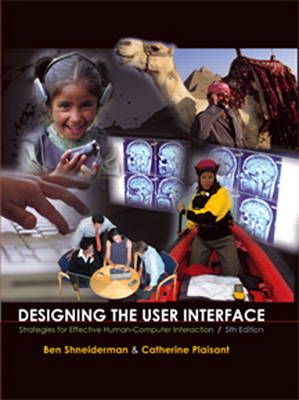
Designing the User Interface
Pearson
978-0-321-53735-5 (ISBN)
- Titel erscheint in neuer Auflage
- Artikel merken
Ben Shneiderman is a Professor in the Department of Computer Science, Founding Director (1983-2000) of the Human-Computer Interaction Laboratory (http://www.cs.umd.edu/hcil), and Member of the Institute for Advanced Computer Studies and the Institute for Systems Research, all at the University of Maryland at College Park. He is a Fellow of the ACM and AAAS and received the ACM CHI (Computer Human Interaction) Lifetime Achievement Award. His books, research papers, and frequent lectures have made him an international leader in this emerging discipline. For relaxation he likes biking, hiking, skiing, and travel. Catherine Plaisant is Associate Research Scientist at the Human-Computer Interaction Laboratory of the University of Maryland Institute for Advanced Computer Studies. She earned a Doctorat d'Ingenieur degree in France in 1982 and has been conducting research in the field of human-computer interaction since then. In 1987, she joined Professor Shneiderman at the University of Maryland, where she has worked with students and members of the lab, throughout the growth of the field of human-computer interaction. Her research contributions range from focused interaction techniques to innovative visualizations validated with user studies to practical applications developed with industrial partners. Maxine S. Cohen is a Professor in the Graduate School of Computer and Information Sciences at Nova Southeastern University in Fort Lauderdale, Florida where she teaches graduate courses in Human-Computer Interaction (HCI). Before joining NSU, she worked at IBM in the User Centered Design department. Prior to IBM, she was a faculty member in the Computer Science department, in the Watson School of Engineering at the State University of New York at Binghamton. She has been teaching and working in the HCI field for over 20 years. She received a B.A. in Mathematics from the University of Vermont, a M.S. (specialization Computer Science) and a Ph.D. (specialization Systems Science) from the State University of New York at Binghamton. Steven M. Jacobs recently retired from the aerospace industry and is now a lecturer at Northern Arizona University, Flagstaff, Arizona. He was formerly with Northrop Grumman Mission Systems in Carson, California. Mr. Jacobs managed engineers developing user interface and web applications software for various government and commercial applications. He was also Adjunct Assistant Professor at the University of Southern California for 17 years, where he developed and taught their graduate computer science courses in user interface design and human performance engineering. He has also taught short courses in similar topics for UCLA Extension and ACM. He received his M.S.C.S. from UCLA, B.A. in Mathematics from Monmouth University (N.J.).
Part I: Introduction
CH 1 Usability of Interactive Systems
1.1 Introduction
1.2 Usability Measures
1.3 Usability Motivations
1.4 Universal Usability
1.5 Goals for Our Profession
CH 2 Guidelines, Principles, and Theories
2.1 Introduction
2.2 Guidelines
2.3 Principles
2.4 Theories
Part II: Development Processes
CH 3 Managing Design Processes
3.1 Introduction
3.2 Organizational Design to Support Usability
3.3 The Four Pillars of Design
3.4 Development Methodologies
3.5 Ethnographic Observation
3.6 Participatory Design
3.7 Scenario Development
3.8 Social Impact Statement for Early Design Review
3.9 Legal Issues
CH 4 Evaluating Interface Designs
4.1 Introduction
4.2 Expert Reviews
4.3 Usability Testing and Laboratories
4.4 Survey Instruments
4.5 Acceptance Tests
4.6 Evaluation During Active Use
4.7 Controlled Psychologically Oriented Experiments
Part III: Interaction Styles
CH 5 Direct Manipulation and Virtual Environments
5.1 Introduction
5.2 Examples of Direct Manipulation
5.3 Discussion of Direct Manipulation
5.4 3D Interfaces
5.5 Teleoperation
5.6 Virtual and Augmented Reality
CH 6 Menu Selection, Form Fillin, and Dialog Boxes
6.1 Introduction
6.2 Task-Related Menu Organization
6.3 Single Menus
6.4 Combinations of Multiple Menus
6.5 Content Organization
6.6 Fast Movement through Menus
6.7 Data Entry with Menus: Form Fillin, Dialog Boxes and Alternatives
6.8 Audio Menus and Menus for Small Displays
CH 7 Command and Natural Languages
7.1 Introduction
7.2 Command-Organization Functionality, Strategies, and Structure
7.3 Naming and Abbreviations
7.4 Natural Language in Computing
CH 8 Interaction Devices
8.1 Introduction
8.2 Keyboards and Keypads
8.3 Pointing Devices
8.4 Speech and Auditory Interfaces
8.5 Displays - Small and Large
CH 9 Collaboration and Social Media Participation
9.1 Introduction
9.2 Goals of Collaboration and Participation
9.3 Asynchronous Distributed Interfaces: Different Place, Different Time
9.4 Synchronous Distributed Interfaces: Different Place, Same Time
9.5 Face-to-Face Interfaces: Same Place, Same Time
Part IV: Design Issues
CH 10 Quality of Service
10.1 Introduction
10.2 Models of Response Time Impacts
10.3 Expectations and Attitudes
10.4 User Productivity
10.5 Variability in Response Time
10.6 Frustrating Experiences
CH 11 Balancing Function and Fashion
11.1 Introduction
11.2 Error Messages
11.3 Nonanthropomorphic Design
11.4 Display Design
11.5 Web Page Design
11.6 Window Design
11.7 Color
CH 12 User Documentation and Online Help
12.1 Introduction
12.2 Online versus Paper Documentation
12.3 Reading from Paper versus from Displays
12.4 Shaping the Content of the Documentation
12.5 Accessing the Documentation
12.6 Online Tutorials and Animated Demonstrations
12.7 Online Communities for User Assistance
12.8 The Development Process
CH 13 Information Search
13.1 Introduction
13.2 Searching in Textual Documents and Database Querying
13.3 Multimedia Document Searches
13.4 Advanced Filtering and Search Interface
CH 14 Information Visualization
14.1 Introduction
14.2 Data Type by Task Taxonomy
14.3 Challenges for Information Visualization
Afterword: Societal and Individual Impact of User Interfaces
A.1 Future Interfaces
A.2 Ten Plagues of the Information Age
A.3 Continuing Controversies
| Erscheint lt. Verlag | 26.2.2009 |
|---|---|
| Sprache | englisch |
| Maße | 10 x 10 mm |
| Gewicht | 1100 g |
| Themenwelt | Informatik ► Software Entwicklung ► User Interfaces (HCI) |
| ISBN-10 | 0-321-53735-1 / 0321537351 |
| ISBN-13 | 978-0-321-53735-5 / 9780321537355 |
| Zustand | Neuware |
| Informationen gemäß Produktsicherheitsverordnung (GPSR) | |
| Haben Sie eine Frage zum Produkt? |


