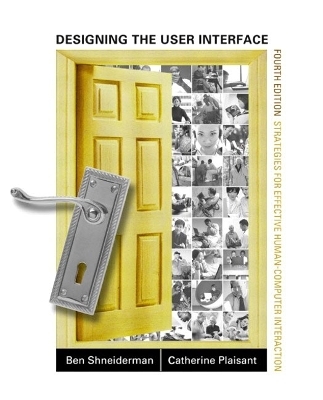
Designing the User Interface
Pearson (Verlag)
978-0-321-19786-3 (ISBN)
- Titel erscheint in neuer Auflage
- Artikel merken
The much-anticipated fourth edition of Designing the User Interface provides a comprehensive, authoritative introduction to the dynamic field of human-computer interaction (HCI). Students and professionals learn practical principles and guidelines needed to develop high quality interface designs—ones that users can understand, predict, and control. It covers theoretical foundations, and design processes such as expert reviews and usability testing. Numerous examples of direct manipulation, menu selection, and form fill-in give readers an understanding of excellence in design. Recent innovations in collaborative interfaces, online help, and information visualization receive special attention. A major change in this edition is the integration of the World Wide Web and mobile devices throughout the book. Chapters have examples from cell phones, consumer electronics, desktop displays, and Web interfaces.
I. INTRODUCTION.
1. Usability of Interactive Systems.
Introduction.
Usability Requirements.
Usability Measures.
Usability Motivations.
Universal Usability.
Goals for Our Profession.
Practitioner's Summary.
Researcher's Agenda.
2. Guidelines, Principles, and Theories.
Introduction.
Guidelines.
Principles.
Theories.
Object-Action Interface Model.
Practitioner's Summary.
Researcher's Agenda.
II. DEVELOPMENT PROCESSES.
3. Managing Design Processes.
Introduction.
Organizational Design to Support Usability.
The Three Pillars of Design.
Development Methodologies.
Ethnographic Observation.
Participatory Design.
Scenario Development.
Social Impact Statement for Early Design Review.
Legal Issues.
Practitioner's Summary.
Researcher's Agenda.
4. Evaluating Interface Designs.
Introduction.
Expert Reviews.
Usability Testing and Laboratories.
Survey Instruments.
Acceptance Tests.
Evaluation During Active Use.
Controlled Psychologically Oriented Experiments.
Practitioner's Summary.
Researcher's Agenda.
5. Software Tools.
Introduction.
Specification Methods.
Interface-Building Tools.
Evaluation and Critiquing Tools.
Practitioner's Summary.
Researcher's Agenda.
III. INTERACTION STYLES.
6. Direct Manipulation and Virtual Environments.
Introduction.
Examples of Direct-Manipulation.
Discussion of Direct Manipulation.
3D Interfaces.
Teleoperation.
Virtual and Augmented Reality.
Practitioner's Summary.
Researcher's Agenda.
7. Menu Selection, Form Fillin, and Dialog Boxes.
Introduction.
Task-Related Menu Organization.
Single Menus.
Combinations of Multiple Menus.
Content Organization.
Data Entry with Menus: Form Fillin, Dialog Boxes and Alternatives.
Audio Menus and Menus for Small Displays.
Practitioner's Summary.
Researcher's Agenda.
8. Command and Natural Languages.
Introduction.
Functionality to Support Users' Tasks.
Command-Organization Strategies.
The Benefits of Structure.
Naming and Abbreviations.
Natural Language in Computing.
Practitioner's Summary.
Researcher's Agenda.
9. Interaction Devices.
Introduction.
Keyboards and Keypads.
Pointing Devices.
Speech and Auditory Interfaces.
Displays - Small and Large.
Printers.
Practitioner's Summary.
Researcher's Agenda.
10. Collaboration.
Introduction.
Goals of Cooperation.
Asynchronous Distributed Interfaces: Different Time, Different Place.
Synchronous Distributed Interfaces: Different Place, Same Time.
Face-to-Face Interfaces: Same Place, Same Tim.
Practitioner's Summary.
Researcher's Agenda.
IV. DESIGN ISSUES.
11. Quality of Service.
Introduction.
Models of Response Time Impacts.
Expectations and Attitudes.
User Productivity.
Variability in Response Time.
Frustrating Experiences.
Practitioner's Summary.
Researcher's Agenda.
12. Balancing Function and Fashion.
Introduction.
Error Messages.
Nonanthropomorphic Design.
Display Design.
Window Design.
Color.
Practitioner's Summar.
Researcher's Agenda.
13. User Manuals, Online Help, and Tutorials.
Introduction.
Paper versus Online Manuals.
Reading from Paper versus from Displays.
Shaping the Content of the Manuals.
Online Manuals and Help.
Online Tutorials.
Online Communities for User Assistance.
Development Process.
Practitioner's Summary.
Researcher's Agenda.
14. Information Search and Visualization.
Introduction.
Search in Textual Documents and Database Query.
Multimedia Document Searches.
Advanced Filtering and Search Interface.
Information Visualization.
Practitioner's Summary.
Researcher's Agenda.
Afterword Societal and Individual Impact of User Interfaces.
| Erscheint lt. Verlag | 7.5.2004 |
|---|---|
| Sprache | englisch |
| Maße | 188 x 234 mm |
| Gewicht | 1208 g |
| Themenwelt | Mathematik / Informatik ► Informatik ► Betriebssysteme / Server |
| Informatik ► Software Entwicklung ► User Interfaces (HCI) | |
| ISBN-10 | 0-321-19786-0 / 0321197860 |
| ISBN-13 | 978-0-321-19786-3 / 9780321197863 |
| Zustand | Neuware |
| Informationen gemäß Produktsicherheitsverordnung (GPSR) | |
| Haben Sie eine Frage zum Produkt? |
aus dem Bereich