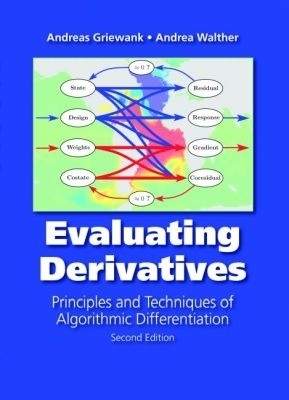
Evaluating Derivatives
Society for Industrial & Applied Mathematics,U.S. (Verlag)
978-0-89871-659-7 (ISBN)
Algorithmic, or automatic, differentiation (AD) is a growing area of theoretical research and software development concerned with the accurate and efficient evaluation of derivatives for function evaluations given as computer programs. The resulting derivative values are useful for all scientific computations that are based on linear, quadratic, or higher order approximations to nonlinear scalar or vector functions.
This second edition covers recent developments in applications and theory, including an elegant NP completeness argument and an introduction to scarcity. There is also added material on checkpointing and iterative differentiation. To improve readability the more detailed analysis of memory and complexity bounds has been relegated to separate, optional chapters.
The book consists of: a stand-alone introduction to the fundamentals of AD and its software; a thorough treatment of methods for sparse problems; and final chapters on program-reversal schedules, higher derivatives, nonsmooth problems and iterative processes.
Andreas Griewank is a former senior scientist of Argonne National Laboratory and authored the first edition of this book in 2000. He holds a Ph.D. from the Australian National University and is currently Deputy Director of the Institute of Mathematics at Humboldt University Berlin and a member of the DFG Research Center Matheon, Mathematics for Key Technologies. His main research interests are nonlinear optimization and scientific computing. Andrea Walther studied mathematics and economy at the University of Bayreuth. She holds a doctorate degree from the Technische Universität Dresden. Since 2003 Andrea Walther has been Juniorprofessor for the analysis and optimization of computer models at the Technische Universität Dresden. Her main research interests are scientific computing and nonlinear optimization.
Rules
Preface
Prologue
Mathematical Symbols
Chapter 1: Introduction
Chapter 2: A Framework for Evaluating Functions
Chapter 3: Fundamentals of Forward and Reverse
Chapter 4: Memory Issues and Complexity Bounds
Chapter 5: Repeating and Extending Reverse
Chapter 6: Implementation and Software
Chapter 7: Sparse Forward and Reverse
Chapter 8: Exploiting Sparsity by Compression
Chapter 9: Going beyond Forward and Reverse
Chapter 10: Jacobian and Hessian Accumulation
Chapter 11: Observations on Efficiency
Chapter 12: Reversal Schedules and Checkpointing
Chapter 13: Taylor and Tensor Coefficients
Chapter 14: Differentiation without Differentiability
Chapter 15: Implicit and Iterative Differentiation
Epilogue
List of Figures
List of Tables
Assumptions and Definitions
Propositions, Corollaries, and Lemmas
Bibliography
Index
| Erscheint lt. Verlag | 6.11.2008 |
|---|---|
| Verlagsort | New York |
| Sprache | englisch |
| Maße | 152 x 229 mm |
| Gewicht | 982 g |
| Themenwelt | Mathematik / Informatik ► Mathematik ► Analysis |
| Mathematik / Informatik ► Mathematik ► Angewandte Mathematik | |
| ISBN-10 | 0-89871-659-4 / 0898716594 |
| ISBN-13 | 978-0-89871-659-7 / 9780898716597 |
| Zustand | Neuware |
| Informationen gemäß Produktsicherheitsverordnung (GPSR) | |
| Haben Sie eine Frage zum Produkt? |
aus dem Bereich