


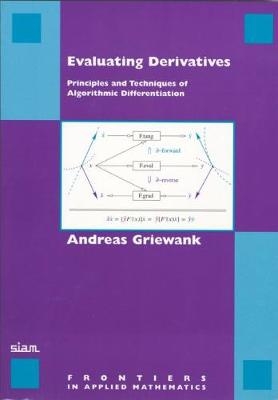
Evaluating Derivatives
Principles and Techniques of Algorithmic Differentiation
Seiten
1987
Society for Industrial & Applied Mathematics,U.S. (Verlag)
978-0-89871-451-7 (ISBN)
Society for Industrial & Applied Mathematics,U.S. (Verlag)
978-0-89871-451-7 (ISBN)
- Titel erscheint in neuer Auflage
- Artikel merken
Zu diesem Artikel existiert eine Nachauflage
Covers the fundamentals of AD and its software, methods for sparse problems, higher derivatives, nonsmooth problems, and program reversal schedules.
Algorithmic, or automatic, differentiation (AD) is concerned with the accurate and efficient evaluation of derivatives for functions defined by computer programs. No truncation errors are incurred, and the resulting numerical derivative values can be used for all scientific computations that are based on linear, quadratic, or even higher order approximations to nonlinear scalar or vector functions. In particular, AD has been applied to optimization, parameter identification, equation solving, the numerical integration of differential equations, and combinations thereof. Apart from quantifying sensitivities numerically, AD techniques can also provide structural information, e.g., sparsity pattern and generic rank of Jacobian matrices.
Algorithmic, or automatic, differentiation (AD) is concerned with the accurate and efficient evaluation of derivatives for functions defined by computer programs. No truncation errors are incurred, and the resulting numerical derivative values can be used for all scientific computations that are based on linear, quadratic, or even higher order approximations to nonlinear scalar or vector functions. In particular, AD has been applied to optimization, parameter identification, equation solving, the numerical integration of differential equations, and combinations thereof. Apart from quantifying sensitivities numerically, AD techniques can also provide structural information, e.g., sparsity pattern and generic rank of Jacobian matrices.
Preface; Prologue; Introduction; Part I. Tangents and Gradients. A Framework for Evaluating Functions; Fundamentals of Forward and Reverse; Repeating and Extending Reverse; Implementation and Software; Part II. Jacobians and Hessians. Sparse Forward and Reverse; Exploiting Sparsity by Compression; Going Beyond Forward and Reverse; Observations on Efficiency; Part III. Advances and Reversals. Taylor and Tensor Coefficients; Differentiation without Differentiability; Serial and Parallel Reversal Schedules; Bibliography; Index.
| Reihe/Serie | Frontiers in Applied Mathematics ; 19 |
|---|---|
| Verlagsort | New York |
| Sprache | englisch |
| Maße | 176 x 254 mm |
| Gewicht | 684 g |
| Themenwelt | Informatik ► Theorie / Studium ► Algorithmen |
| Mathematik / Informatik ► Mathematik ► Analysis | |
| Mathematik / Informatik ► Mathematik ► Angewandte Mathematik | |
| ISBN-10 | 0-89871-451-6 / 0898714516 |
| ISBN-13 | 978-0-89871-451-7 / 9780898714517 |
| Zustand | Neuware |
| Informationen gemäß Produktsicherheitsverordnung (GPSR) | |
| Haben Sie eine Frage zum Produkt? |
Mehr entdecken
aus dem Bereich



aus dem Bereich
Buch | Softcover (2025)
Lehmanns Media (Verlag)
CHF 62,95
die Welt der generativen KI verstehen
Buch | Hardcover (2025)
Hanser (Verlag)
CHF 48,95


