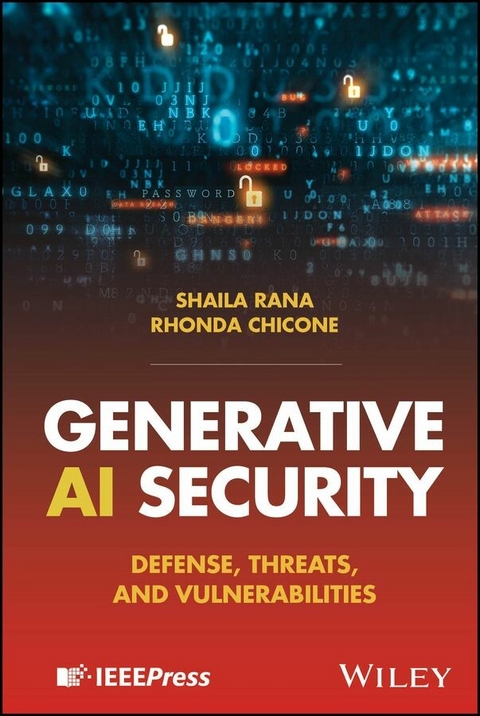
Generative AI Security (eBook)
806 Seiten
Wiley-IEEE Press (Verlag)
978-1-394-36850-1 (ISBN)
Up-to-date reference enabling readers to address the full spectrum of AI security challenges while maintaining model utility
Generative AI Security: Defense, Threats, and Vulnerabilities delivers a technical framework for securing generative AI systems, building on established standards while focusing specifically on emerging threats to large language models and other generative AI systems. Moving beyond treating AI security as a dual-use technology, this book provides detailed technical analysis of three critical dimensions: implementing AI-powered security tools, defending against AI-enhanced attacks, and protecting AI systems from compromise through attacks like prompt injection, model poisoning, and data extraction.
The book provides concrete technical implementations supported by real-world case studies of actual AI system compromises, examining documented cases like the DeepSeek breaches, Llama vulnerabilities, and Google's CaMeL security defenses to demonstrate attack methodologies and defense strategies while emphasizing foundational security principles that remain relevant despite technological shifts. Each chapter progresses from theoretical foundations to practical applications.
The book also includes an implementation guide and hands-on exercises focusing on specific vulnerabilities in generative AI architectures, security control implementation, and compliance frameworks.
Generative AI Security: Defense, Threats, and Vulnerabilities discusses topics including:
- Machine learning fundamentals, including supervised, unsupervised, and reinforcement learning and feature engineering and selection
- Intelligent Security Information and Event Management (SIEM), covering AI-enhanced log analysis, predictive vulnerability assessment, and automated patch generation
- Deepfakes and synthetic media, covering image and video manipulation, voice cloning, audio deepfakes, and AI's greater impact on information integrity
- Security attacks on generative AI, including jailbreaking, adversarial, backdoor, and data poisoning attacks
- Privacy-preserving AI techniques including federated learning and homomorphic encryption
Generative AI Security: Defense, Threats, and Vulnerabilities is an essential resource for cybersecurity professionals and architects, engineers, IT professionals, and organization leaders seeking integrated strategies that address the full spectrum of Generative AI security challenges while maintaining model utility.
Shaila Rana, PhD, is a professor of Cybersecurity, co-founder of the ACT Research Institute, a cybersecurity, AI, and technology think tank, and serves as the Chair of the IEEE Standards Association initiative on Zero Trust Cybersecurity for Health Technology, Tools, Services, and Devices.
Rhonda Chicone, PhD, is a retired professor and the co-founder of the ACT Research Institute. A former CSO, CTO, and Director of Software Development, she brings decades of experience in software product development and cybersecurity.
Up-to-date reference enabling readers to address the full spectrum of AI security challenges while maintaining model utility Generative AI Security: Defense, Threats, and Vulnerabilities delivers a technical framework for securing generative AI systems, building on established standards while focusing specifically on emerging threats to large language models and other generative AI systems. Moving beyond treating AI security as a dual-use technology, this book provides detailed technical analysis of three critical dimensions: implementing AI-powered security tools, defending against AI-enhanced attacks, and protecting AI systems from compromise through attacks like prompt injection, model poisoning, and data extraction. The book provides concrete technical implementations supported by real-world case studies of actual AI system compromises, examining documented cases like the DeepSeek breaches, Llama vulnerabilities, and Google s CaMeL security defenses to demonstrate attack methodologies and defense strategies while emphasizing foundational security principles that remain relevant despite technological shifts. Each chapter progresses from theoretical foundations to practical applications. The book also includes an implementation guide and hands-on exercises focusing on specific vulnerabilities in generative AI architectures, security control implementation, and compliance frameworks. Generative AI Security: Defense, Threats, and Vulnerabilities discusses topics including: Machine learning fundamentals, including supervised, unsupervised, and reinforcement learning and feature engineering and selection Intelligent Security Information and Event Management (SIEM), covering AI-enhanced log analysis, predictive vulnerability assessment, and automated patch generation Deepfakes and synthetic media, covering image and video manipulation, voice cloning, audio deepfakes, and AI s greater impact on information integrity Security attacks on generative AI, including jailbreaking, adversarial, backdoor, and data poisoning attacks Privacy-preserving AI techniques including federated learning and homomorphic encryption Generative AI Security: Defense, Threats, and Vulnerabilities is an essential resource for cybersecurity professionals and architects, engineers, IT professionals, and organization leaders seeking integrated strategies that address the full spectrum of Generative AI security challenges while maintaining model utility.
1
Generative AI in Cybersecurity
The rapid rise of generative artificial intelligence (GAI) has fundamentally transformed the cybersecurity landscape. From crafting convincing phishing emails to detecting complex attack patterns, GAI is both an unprecedented challenge and a powerful tool in the ongoing battle to secure our digital systems. As we enter this new era, security professionals must develop a deep understanding of these technologies to effectively protect their organizations. This chapter lays the groundwork for understanding GAI and its complex relationship with cybersecurity. We begin by exploring the fundamental concepts of GAI, examining how these systems learn to create new content and the various types of models that drive this innovation.
We'll then trace the evolution of AI in cybersecurity, from its early applications in malware detection to today's sophisticated AI‐driven security systems. This historical context is crucial for understanding how we arrived at our current security landscape and where we might be heading. The chapter concludes by examining the dual nature of GAI in security—its potential as both a defensive tool and a security threat—while exploring its current applications across various sectors. As we navigate through this chapter, you'll develop a foundational understanding of GAI that will serve as a basis for the more technical and strategic discussions in subsequent chapters. Whether you're a seasoned security professional or new to the field of AI security, this chapter will equip you with the essential context needed to understand the opportunities and challenges that lie ahead.
1.1 What Is Generative AI?
We've heard of ChatGPT (probably extensively at this point), we've heard of Claude, we've heard of DALL‐E, and we've heard of so many GAI tools. But, what exactly is GAI? GAI encompasses a class of AI systems designed to create new content, ranging from text and images to code and synthetic data. At its core, GAI learns patterns from existing data and uses these patterns to generate novel outputs that maintain the statistical properties and characteristics of the training data (Cohan, 2024). Unlike traditional AI systems that focus on classification or prediction tasks, GAI models can produce entirely new content that has never existed before, while maintaining coherence and relevance to their training (Palo Alto Networks, n.d.).
The landscape of GAI models is diverse, with several key architectures dominating the field. Large Language Models (LLMs) (Alto, 2023), like GPT‐4 and Claude, specialize in text generation and understanding, while Generative Adversarial Networks (GANs) excel at creating realistic images and videos. Diffusion models, exemplified by DALL‐E and Stable Diffusion, have revolutionized image generation through their ability to gradually transform random noise into coherent images (Ali et al., 2021). Variational Autoencoders (VAEs) offer another approach, focusing on learning compact representations of data that can be used to generate new samples (Doersch, 2016). Moreover, the applications of GAI span across numerous industries and use cases. In software development, AI assistants help write and debug code, potentially increasing developer productivity by 30–40% according to recent studies (Hendrich, 2024). In creative industries, GAI tools are being used for content creation, with platforms like Midjourney generating millions of images daily (Kumar, 2024). The healthcare sector employs generative models to synthesize medical images for training and research, while financial institutions use them for fraud detection and risk analysis (Avacharmal et al., 2023).
It is one of the fastest‐growing consumer applications in history. The CEO of Amazon, Andy Jassy, recently said that “Generative AI may be the largest technology transformation since the cloud” (Resinger, 2024). Fortune 500 companies have already leveraged AI and are setting a new global standard, especially when it comes to AI‐driven supply chain optimization (Lundberg, 2024). The global GAI market is projected to reach $200 billion by 2025, reflecting an extraordinary compound annual growth rate (Alfa People, 2024). In terms of user adoption, platforms like ChatGPT reached 100 million users within just two months of launch, making it one of the fastest‐growing consumer applications in history (Mahajan, 2024).
This widespread adoption has significant implications for cybersecurity, as organizations must now consider both the opportunities and risks presented by these powerful technologies. These adoption rates and market projections paint a clear picture: GAI is not just a technological trend but a fundamental shift in how we create, process, and interact with digital content. It is not going away anytime soon and becoming a forgotten technology (like 3D televisions). For cybersecurity professionals, understanding this technology and its capabilities is crucial for protecting organizations against emerging threats while leveraging its potential for enhanced security measures. However, the rapid evolution and adoption of GAI bring us to a critical juncture where we must consider its future trajectory and implications. As we look ahead, several key trends and developments are likely to shape the landscape of GAI. First, we're seeing increasing convergence between different types of GAI models. While early systems specialized in specific domains like text or images, newer architectures are becoming more versatile, capable of handling multiple modalities simultaneously (Chen et al., 2024). This convergence suggests a future where GAI systems become more comprehensive and integrated, potentially leading to more sophisticated and nuanced applications across industries.
The role of GAI in cybersecurity reveals a triangular dynamic that reshapes our understanding of digital defense. Organizations are now navigating a three‐dimensional landscape where GAI simultaneously serves as a powerful security tool, presents itself as a potential weapon in the wrong hands, and emerges as a target with its own unique vulnerabilities. As security teams deploy AI to enhance threat detection, automate response procedures, and proactively identify weaknesses, malicious actors are exploring how these same technologies can be weaponized to create increasingly sophisticated attacks. Meanwhile, the AI systems themselves harbor vulnerabilities that require protection, creating a complex security matrix where defenders must not only leverage AI capabilities but also defend the very tools they rely upon from exploitation or compromise.
Moreover, the democratization of generative AI technology presents opportunities, challenges, and a target. As these tools become more accessible, we're seeing unprecedented levels of innovation and creativity across various sectors. Small businesses and individual developers can now leverage capabilities that were previously available only to large organizations with substantial resources. However, this democratization also raises concerns about potential misuse, emphasizing the need for robust governance frameworks and security measures. Another significant trend is the increasing focus on efficiency and optimization in GAI systems. While early models required substantial computational resources, newer approaches are exploring ways to achieve similar or better results with reduced processing power and energy consumption. This trend toward “green AI” reflects growing awareness of the environmental impact of AI systems and could lead to more sustainable approaches to AI development and deployment (Bolón‐Canedo et al., 2024). The integration of GAI with other emerging technologies is also shaping its evolution. The combination of GAI and quantum computing (which we will discuss in Chapter 8), for instance, could lead to breakthrough capabilities in areas like drug discovery, materials science, and complex system simulation (Kumar et al., 2024). Similarly, the intersection of GAI with edge computing could enable more sophisticated real‐time applications while addressing privacy and latency concerns (Ale et al., 2024). Looking ahead, we can expect GAI to become increasingly embedded in our digital infrastructure, moving from standalone applications to integrated systems that enhance various aspects of our technological landscape. This integration will likely lead to new challenges in security, privacy, and governance, requiring ongoing adaptation of our regulatory and ethical frameworks.
The impact of GAI on workforce dynamics and skill requirements cannot be overlooked (hence, one of the reasons for this book). As these systems become more sophisticated, there's a growing need for professionals who can effectively work alongside AI systems, understanding both their capabilities and limitations. This suggests a future where human expertise becomes even more valuable, especially in areas requiring judgment, creativity, and ethical consideration. Overall, this rapid evolution and widespread adoption of GAI technologies underscore the importance of maintaining a balanced perspective—one that recognizes both the transformative potential of these technologies and the need for responsible development and deployment.
1.2 The Evolution of AI in Cybersecurity
The integration of AI into cybersecurity has evolved dramatically over the past several decades, transforming from simple...
| Erscheint lt. Verlag | 31.10.2025 |
|---|---|
| Sprache | englisch |
| Themenwelt | Mathematik / Informatik ► Informatik ► Theorie / Studium |
| Schlagworte | AI-Powered Attacks • AI Security • cybersecurity • gai • generative AI • generative artificial intelligence • Intelligent Security Information and Event Management • LLM security • Machine Learning Attacks • Machine Learning Security |
| ISBN-10 | 1-394-36850-X / 139436850X |
| ISBN-13 | 978-1-394-36850-1 / 9781394368501 |
| Informationen gemäß Produktsicherheitsverordnung (GPSR) | |
| Haben Sie eine Frage zum Produkt? |
 EPUB (Adobe DRM)
Kopierschutz: Adobe-DRM
Adobe-DRM ist ein Kopierschutz, der das eBook vor Mißbrauch schützen soll. Dabei wird das eBook bereits beim Download auf Ihre persönliche Adobe-ID autorisiert. Lesen können Sie das eBook dann nur auf den Geräten, welche ebenfalls auf Ihre Adobe-ID registriert sind.
Details zum Adobe-DRM
Dateiformat: EPUB (Electronic Publication)
EPUB ist ein offener Standard für eBooks und eignet sich besonders zur Darstellung von Belletristik und Sachbüchern. Der Fließtext wird dynamisch an die Display- und Schriftgröße angepasst. Auch für mobile Lesegeräte ist EPUB daher gut geeignet.
Systemvoraussetzungen:
PC/Mac: Mit einem PC oder Mac können Sie dieses eBook lesen. Sie benötigen eine
eReader: Dieses eBook kann mit (fast) allen eBook-Readern gelesen werden. Mit dem amazon-Kindle ist es aber nicht kompatibel.
Smartphone/Tablet: Egal ob Apple oder Android, dieses eBook können Sie lesen. Sie benötigen eine
Geräteliste und zusätzliche Hinweise
Buying eBooks from abroad
For tax law reasons we can sell eBooks just within Germany and Switzerland. Regrettably we cannot fulfill eBook-orders from other countries.
aus dem Bereich