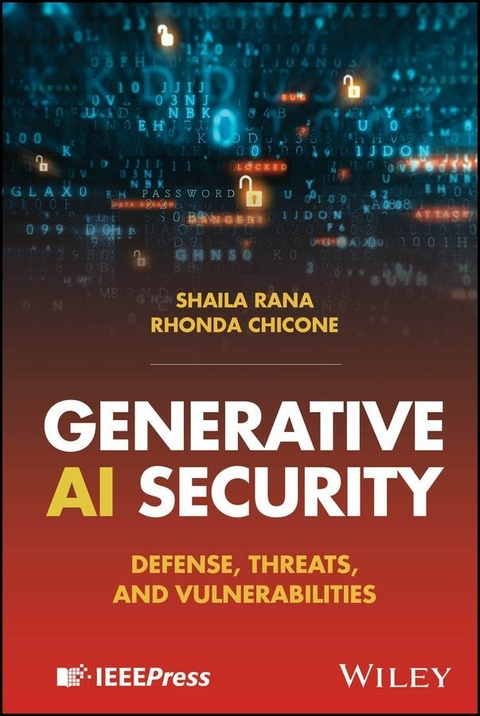
Generative AI Security (eBook)
495 Seiten
Wiley-IEEE Press (Verlag)
978-1-394-36851-8 (ISBN)
Up-to-date reference enabling readers to address the full spectrum of AI security challenges while maintaining model utility
Generative AI Security: Defense, Threats, and Vulnerabilities delivers a technical framework for securing generative AI systems, building on established standards while focusing specifically on emerging threats to large language models and other generative AI systems. Moving beyond treating AI security as a dual-use technology, this book provides detailed technical analysis of three critical dimensions: implementing AI-powered security tools, defending against AI-enhanced attacks, and protecting AI systems from compromise through attacks like prompt injection, model poisoning, and data extraction.
The book provides concrete technical implementations supported by real-world case studies of actual AI system compromises, examining documented cases like the DeepSeek breaches, Llama vulnerabilities, and Google's CaMeL security defenses to demonstrate attack methodologies and defense strategies while emphasizing foundational security principles that remain relevant despite technological shifts. Each chapter progresses from theoretical foundations to practical applications.
The book also includes an implementation guide and hands-on exercises focusing on specific vulnerabilities in generative AI architectures, security control implementation, and compliance frameworks.
Generative AI Security: Defense, Threats, and Vulnerabilities discusses topics including:
- Machine learning fundamentals, including supervised, unsupervised, and reinforcement learning and feature engineering and selection
- Intelligent Security Information and Event Management (SIEM), covering AI-enhanced log analysis, predictive vulnerability assessment, and automated patch generation
- Deepfakes and synthetic media, covering image and video manipulation, voice cloning, audio deepfakes, and AI's greater impact on information integrity
- Security attacks on generative AI, including jailbreaking, adversarial, backdoor, and data poisoning attacks
- Privacy-preserving AI techniques including federated learning and homomorphic encryption
Generative AI Security: Defense, Threats, and Vulnerabilities is an essential resource for cybersecurity professionals and architects, engineers, IT professionals, and organization leaders seeking integrated strategies that address the full spectrum of Generative AI security challenges while maintaining model utility.
Shaila Rana, PhD, is a professor of Cybersecurity, co-founder of the ACT Research Institute, a cybersecurity, AI, and technology think tank, and serves as the Chair of the IEEE Standards Association initiative on Zero Trust Cybersecurity for Health Technology, Tools, Services, and Devices.
Rhonda Chicone, PhD, is a retired professor and the co-founder of the ACT Research Institute. A former CSO, CTO, and Director of Software Development, she brings decades of experience in software product development and cybersecurity.
Up-to-date reference enabling readers to address the full spectrum of AI security challenges while maintaining model utility Generative AI Security: Defense, Threats, and Vulnerabilities delivers a technical framework for securing generative AI systems, building on established standards while focusing specifically on emerging threats to large language models and other generative AI systems. Moving beyond treating AI security as a dual-use technology, this book provides detailed technical analysis of three critical dimensions: implementing AI-powered security tools, defending against AI-enhanced attacks, and protecting AI systems from compromise through attacks like prompt injection, model poisoning, and data extraction. The book provides concrete technical implementations supported by real-world case studies of actual AI system compromises, examining documented cases like the DeepSeek breaches, Llama vulnerabilities, and Google s CaMeL security defenses to demonstrate attack methodologies and defense strategies while emphasizing foundational security principles that remain relevant despite technological shifts. Each chapter progresses from theoretical foundations to practical applications. The book also includes an implementation guide and hands-on exercises focusing on specific vulnerabilities in generative AI architectures, security control implementation, and compliance frameworks. Generative AI Security: Defense, Threats, and Vulnerabilities discusses topics including: Machine learning fundamentals, including supervised, unsupervised, and reinforcement learning and feature engineering and selection Intelligent Security Information and Event Management (SIEM), covering AI-enhanced log analysis, predictive vulnerability assessment, and automated patch generation Deepfakes and synthetic media, covering image and video manipulation, voice cloning, audio deepfakes, and AI s greater impact on information integrity Security attacks on generative AI, including jailbreaking, adversarial, backdoor, and data poisoning attacks Privacy-preserving AI techniques including federated learning and homomorphic encryption Generative AI Security: Defense, Threats, and Vulnerabilities is an essential resource for cybersecurity professionals and architects, engineers, IT professionals, and organization leaders seeking integrated strategies that address the full spectrum of Generative AI security challenges while maintaining model utility.
| Erscheint lt. Verlag | 30.10.2025 |
|---|---|
| Sprache | englisch |
| Themenwelt | Mathematik / Informatik ► Informatik ► Theorie / Studium |
| Schlagworte | AI-Powered Attacks • AI Security • cybersecurity • gai • generative AI • generative artificial intelligence • Intelligent Security Information and Event Management • LLM security • Machine Learning Attacks • Machine Learning Security |
| ISBN-10 | 1-394-36851-8 / 1394368518 |
| ISBN-13 | 978-1-394-36851-8 / 9781394368518 |
| Informationen gemäß Produktsicherheitsverordnung (GPSR) | |
| Haben Sie eine Frage zum Produkt? |
 PDF (Adobe DRM)
Kopierschutz: Adobe-DRM
Adobe-DRM ist ein Kopierschutz, der das eBook vor Mißbrauch schützen soll. Dabei wird das eBook bereits beim Download auf Ihre persönliche Adobe-ID autorisiert. Lesen können Sie das eBook dann nur auf den Geräten, welche ebenfalls auf Ihre Adobe-ID registriert sind.
Details zum Adobe-DRM
Dateiformat: PDF (Portable Document Format)
Mit einem festen Seitenlayout eignet sich die PDF besonders für Fachbücher mit Spalten, Tabellen und Abbildungen. Eine PDF kann auf fast allen Geräten angezeigt werden, ist aber für kleine Displays (Smartphone, eReader) nur eingeschränkt geeignet.
Systemvoraussetzungen:
PC/Mac: Mit einem PC oder Mac können Sie dieses eBook lesen. Sie benötigen eine
eReader: Dieses eBook kann mit (fast) allen eBook-Readern gelesen werden. Mit dem amazon-Kindle ist es aber nicht kompatibel.
Smartphone/Tablet: Egal ob Apple oder Android, dieses eBook können Sie lesen. Sie benötigen eine
Geräteliste und zusätzliche Hinweise
Buying eBooks from abroad
For tax law reasons we can sell eBooks just within Germany and Switzerland. Regrettably we cannot fulfill eBook-orders from other countries.
aus dem Bereich