


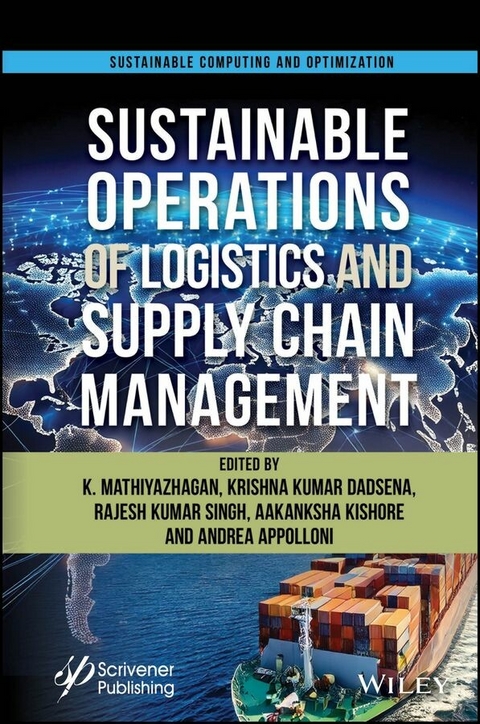
Sustainable Operations of Logistics and Supply Chain Management (eBook)
649 Seiten
Wiley-Scrivener (Verlag)
978-1-394-23852-1 (ISBN)
This essential guide provides a comprehensive overview of how to leverage cutting-edge technology and circular economy principles to create resilient, profitable, and sustainable supply chains in an era of unprecedented environmental and technological change.
In an age defined by technological breakthroughs and environmental challenges, this book delves into the transformative intersection of sustainability, logistics, and supply chain management. It offers a comprehensive exploration of how cutting-edge technologies like artificial intelligence, machine learning, and big data analytics are revolutionizing logistics operations. By optimizing routes, reducing emissions, and enhancing resource utilization, these tools empower businesses to embrace smarter, greener practices that align with today's sustainability goals.
Beyond technology, the book addresses critical challenges, such as navigating the complexities of implementing sustainable solutions, overcoming operational resistance, and ensuring economic viability. It offers actionable strategies to foster resilience in supply chains, especially in the face of global disruptions such as pandemics and disruption to global trade. With a strong focus on circular economy principles, it provides practical frameworks for integrating reuse, recycling, and efficient waste management into supply chains, all while balancing environmental consciousness with economic imperatives. Rich in insights and real-world applications, this book is an essential resource for supply chain professionals, sustainability advocates, policymakers, and researchers. Whether you're looking to innovate your operations, enhance resilience, or contribute to a sustainable future, this book equips you with the knowledge and tools to lead the way in modern logistics.
Readers will find the book: Offers a comprehensive analysis of how sustainability, artificial intelligence, and the circular economy are reshaping modern logistics and supply chain management; Provides actionable strategies to overcome challenges such as high implementation costs and operational resistance in adopting green logistics practices; Explores resilience strategies to mitigate supply chain vulnerabilities exposed by global disruptions, including pandemics; Highlights cutting-edge applications of AI, big data, and machine learning to optimize logistics operations for efficiency and reduced environmental impact; Delivers practical insights into integrating circular economy principles and fostering collaboration between industry, policymakers, and researchers.
Audience
Academics, researchers, supply chain and logistics professionals, sustainability advocates, technology specialists, and policymakers focused on sustainability and efficiency in the supply chain.
K. Mathiyazhagan, PhD is a professor at the Thigarajar School of Management, Madurai, India. He is an associate editor for several journals and has over 7000 citations to his credit. His research interests include green and sustainable supply chain management, multi-criteria decision making, sustainable lean manufacturing, public distribution systems, and lean six sigma.
Krishna Kumar Dadsena, PhD is an assistant professor at the Indian Institute of Management, Ranchi. He has over ten publications in international journals and conferences. His current research areas are sustainable transportation management, digital supply chain, risk management, and the circular economy.
Rajesh Kumar Singh, PhD is a professor at the Management Development Institute in Gurgaon, India. He has over 250 publications in reputed international journals and conferences, as well as book chapters. His areas of interest include operations management, supply chain management, lean and agile systems, and operations strategy.
Aakanksha Kishore, PhD is an assistant professor of Operations Management at the Foundation for Organizational Research and Education's School of Management, New Delhi, India. She has over ten articles in international research publications. Her research focuses on inventory management, imperfect items, supply chain management, and business statistics.
Andrea Appolloni, PhD is an Associate Professor of Operations Management and Sustainability at Tor Vergata University, Rome, Italy. He has published and presented articles in several international journals and conferences and coordinates several national and international research programs. His teaching areas focus on operations, supply chain management, and sustainability.
This essential guide provides a comprehensive overview of how to leverage cutting-edge technology and circular economy principles to create resilient, profitable, and sustainable supply chains in an era of unprecedented environmental and technological change. In an age defined by technological breakthroughs and environmental challenges, this book delves into the transformative intersection of sustainability, logistics, and supply chain management. It offers a comprehensive exploration of how cutting-edge technologies like artificial intelligence, machine learning, and big data analytics are revolutionizing logistics operations. By optimizing routes, reducing emissions, and enhancing resource utilization, these tools empower businesses to embrace smarter, greener practices that align with today s sustainability goals. Beyond technology, the book addresses critical challenges, such as navigating the complexities of implementing sustainable solutions, overcoming operational resistance, and ensuring economic viability. It offers actionable strategies to foster resilience in supply chains, especially in the face of global disruptions such as pandemics and disruption to global trade. With a strong focus on circular economy principles, it provides practical frameworks for integrating reuse, recycling, and efficient waste management into supply chains, all while balancing environmental consciousness with economic imperatives. Rich in insights and real-world applications, this book is an essential resource for supply chain professionals, sustainability advocates, policymakers, and researchers. Whether you re looking to innovate your operations, enhance resilience, or contribute to a sustainable future, this book equips you with the knowledge and tools to lead the way in modern logistics. Readers will find the book: Offers a comprehensive analysis of how sustainability, artificial intelligence, and the circular economy are reshaping modern logistics and supply chain management; Provides actionable strategies to overcome challenges such as high implementation costs and operational resistance in adopting green logistics practices; Explores resilience strategies to mitigate supply chain vulnerabilities exposed by global disruptions, including pandemics; Highlights cutting-edge applications of AI, big data, and machine learning to optimize logistics operations for efficiency and reduced environmental impact; Delivers practical insights into integrating circular economy principles and fostering collaboration between industry, policymakers, and researchers. Audience Academics, researchers, supply chain and logistics professionals, sustainability advocates, technology specialists, and policymakers focused on sustainability and efficiency in the supply chain.
1
Navigating the Complexities of Green Logistics Management: Challenges, Strategies, and Future Directions
Hafiz Wasim Akram
Department of Marketing, Entrepreneurship, and Logistics, College of Commerce and Business Administration, Dhofar University, Salalah, Dhofar Governorate, Oman
Abstract
Green logistics management is essential in minimizing the environmental impact of supply chain activities. This chapter explores the challenges faced in adopting green logistics practices, focusing on diverse regulatory compliance, high initial investments, technological integration, and organizational resistance. It highlights how global regulatory variations and dynamic changes increase compliance complexity and costs, posing significant hurdles for companies, especially SMEs. The chapter also discusses the substantial financial burden and uncertain return on investment associated with green logistics initiatives. Technological advancements offer solutions, yet integrating them with existing systems requires considerable investment and adaptation. Organizational resistance due to entrenched costefficiency priorities and the rapidly evolving consumer expectations further complicate the implementation of sustainable practices. Strategies to address these challenges include adopting advanced technologies, fostering collaboration, leveraging government incentives, and prioritizing consumer engagement and education. By overcoming these obstacles, companies can achieve sustainable logistics operations, enhancing their environmental performance and contributing to a more sustainable future.
Keywords: Green logistics, environmental sustainability, regulatory compliance, technological integration, organizational resistance, consumer expectations, supply chain complexity, sustainable practices
Introduction
Environmental sustainability has come into focus for most of the industries across the world in recent decades [1]. The serious damage which industry has done to the environment in recent decades has led to an increased demand for less environmentally damaging forms of production. The contemporary movement of eco-friendly transport has embraced green logistics, a new concept which incorporates the strategic and logistical management of logistics processes that reduce the environmental impact [2]. Green logistics is a way to balance out the cost-effective logistics with environmental protection calls [3]. It is the handling of waste, carbon emissions [4], and energy, which is a continuous, tedious, and lengthy task. It is very important and urgent in dealing with supply chain waste, carbon emissions, and power consumption. Green logistics as a concept is nested in the larger framework of sustainable development which means economic growth that satisfies the needs of the present generation without jeopardizing the capacity of future generations to satisfy their own [5]. This rule has been growing popular with organizations aiming at enhancing environmental functioning and also for complying with strict regulatory rules. Consequently, green logistics has ceased to be a fringe aspect of business strategy and become one of the key components instead.
The increased demand for green logistics practices is being driven by several key factors in all sectors [6]. Key to this transformation of greener logistics is regulatory pressures. All around the world, governments are enacting tougher environmental legislations. Meeting these regulations will mean significant shifts in logistics operations and will require companies to practice more sustainable behavior. Secondly, they have seen a significant awareness and demand for greener produce. Consumers nowadays are becoming more conscious about how their purchases are more environmentally sustainable, and are increasingly supporting companies that are going out of their way to act in a more sustainable manner [7]. Such a transition in consumer behavior has encouraged businesses to implement green logistics practices for promoting their own brand and also meeting customer standards. Other technological advances directly support green logistics. New transportation, energy, and information technologies have introduced new means to mitigate the environmental impacts of logistics [8]. Indeed, the innovations in electric vehicles, renewable energy, and big data analytics have made it possible for businesses to not only improve the efficiency of their logistics operations, but also their impact on the community.
Green logistics practices can provide so much more than environmental sustainability. The biggest benefit is cost savings. Through routing solutions, fuel savings and waste elimination, processes can be streamlined and operational costs can be dramatically reduced [9]. For instance, replacing gas guzzlers with more efficient alternatives and diversifying into bio energy can provide significant cost savings in fuel costs. Moreover, decreased waste via improved inventory management and recycling efforts can bring down disposal costs and improve overall resource allocation. Improved corporate identity and increased brand value is another big gain. Businesses with a strong sustainability record are able to distinguish themselves while appealing to an increasing number of shoppers who care about the environment. This good-good products image can help to gain the loyalty of the customers and, hence, generate more sales. In addition, green logistics practices ultimately lead to higher employee satisfaction which in turn boosts employee retention, since many workers nowadays prefer to work for companies that act in a socially responsible way with regard to the environment [10]. Green logistics also helps in risk management by reducing the risks related to environmental legislations and climate changes.
Several trends and future directions are emerging in the field of green logistics [11, 12]. A key trend is the growing use of digital technologies and data analytics to improve the efficiency and sustainability of logistics operations. Using IoT Devices, Big Data analytics and AI, companies are now able to track and optimize their logistics in real time. IoT sensors can monitor vehicle performance and environmental conditions, and AI algorithms can optimize routes and reduce fuel use. The circular economy in logistics is another burgeoning trend. Advocates of the circular economy work to prevent waste, and to get used matter as resource-saving as possible back into the cycle. This means designing supply chains to enable products and materials being returned and reused, so as to minimize the environmental impact of production and consumption [13]. More and more companies are experimenting with nontraditional circular economy principles such as the product-as-a-service and reverse logistics business models.
Green logistics is also picking up the pace with sustainable transportation solutions. Electric and hybrid vehicles are starting to make a presence, and new fuels are being considered, including hydrogen and biofuels [14]. These modes of transport are sustainable ones, helping to bring down greenhouse gas emission rates and to make the nation less reliant on gas and diesel. Technological developments in automated driving systems also offer the potential to improve the productivity and environmental performance of logistics operations. Green logistics are being driven forward by the spirit of cooperation and partnerships [15]. For the first time companies are required to realize that in order to achieve their sustainability goals, the need to engage in active conversation with the ecosystem of other stakeholders including suppliers, customer, government agencies and non-governmental organizations. Collaborative initiatives, including green logistics networks and industry alliances, share best practices, resources, and knowledge, allowing organizations to collectively address environmental challenges driving systemic change [16].
Thus, green logistics management is an essential part of the sustainability movement. Regulatory pressures, consumer demand, and advancements in technology are all driving the rise of green logistics, with associated benefits including but not limited to cost savings, a stronger brand, and improved risk management. But there are many hurdles to overcome in implementing green logistics practices, such as needing an expensive up-front investment, complexity in the operations, and technological challenges. The future of green logistics as green logistics progresses, we can see how changes in the logistics industry influence the environmental sphere which leads to green logistics evolving to include digital technologies, circular economy principles, sustainable transportation projects and of course — partnerships. At its core, and despite the challenges these trends present, pursuing a more sustainable logistics operation can contribute to a more sustainable and long-term future for everyone.
Thus, the chapter addresses several problems that drive the need for green logistics:
- Environmental Degradation: The damage industries have caused to the environment has led to a demand for less harmful production. Green logistics emerges as a response, balancing economic and environmental priorities.
- Regulatory Pressures: Governments worldwide are implementing stricter environmental regulations, pushing companies to adopt sustainable logistics practices to comply and avoid penalties.
- Consumer Demand for Sustainability: Rising consumer awareness and preference for environmentally...
| Erscheint lt. Verlag | 14.10.2025 |
|---|---|
| Reihe/Serie | Sustainable Computing and Optimization |
| Sprache | englisch |
| Themenwelt | Mathematik / Informatik ► Informatik ► Theorie / Studium |
| ISBN-10 | 1-394-23852-5 / 1394238525 |
| ISBN-13 | 978-1-394-23852-1 / 9781394238521 |
| Informationen gemäß Produktsicherheitsverordnung (GPSR) | |
| Haben Sie eine Frage zum Produkt? |
 EPUB (Adobe DRM)
Kopierschutz: Adobe-DRM
Adobe-DRM ist ein Kopierschutz, der das eBook vor Mißbrauch schützen soll. Dabei wird das eBook bereits beim Download auf Ihre persönliche Adobe-ID autorisiert. Lesen können Sie das eBook dann nur auf den Geräten, welche ebenfalls auf Ihre Adobe-ID registriert sind.
Details zum Adobe-DRM
Dateiformat: EPUB (Electronic Publication)
EPUB ist ein offener Standard für eBooks und eignet sich besonders zur Darstellung von Belletristik und Sachbüchern. Der Fließtext wird dynamisch an die Display- und Schriftgröße angepasst. Auch für mobile Lesegeräte ist EPUB daher gut geeignet.
Systemvoraussetzungen:
PC/Mac: Mit einem PC oder Mac können Sie dieses eBook lesen. Sie benötigen eine
eReader: Dieses eBook kann mit (fast) allen eBook-Readern gelesen werden. Mit dem amazon-Kindle ist es aber nicht kompatibel.
Smartphone/Tablet: Egal ob Apple oder Android, dieses eBook können Sie lesen. Sie benötigen eine
Geräteliste und zusätzliche Hinweise
Buying eBooks from abroad
For tax law reasons we can sell eBooks just within Germany and Switzerland. Regrettably we cannot fulfill eBook-orders from other countries.
aus dem Bereich


