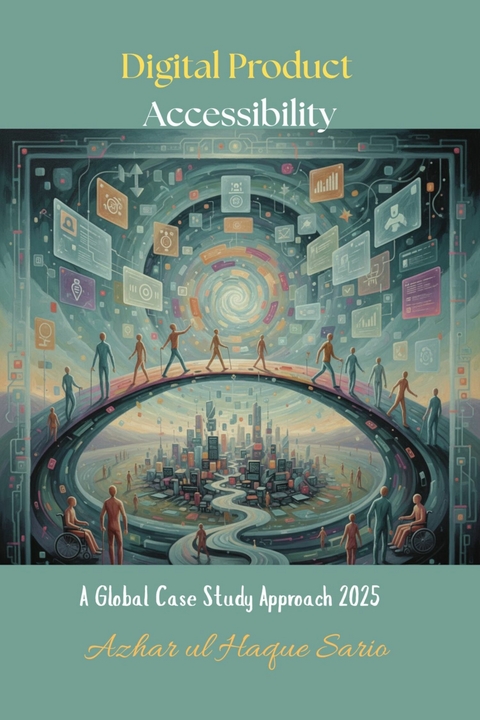
Digital Product Accessibility (eBook)
200 Seiten
Azhar Sario Hungary (Verlag)
978-3-384-72750-3 (ISBN)

Navigating the complex world of digital accessibility laws just got a whole lot easier.
This book is your guide to digital accessibility across the globe. It takes you on a tour of more than 15 countries. We explore how different nations ensure technology is usable for everyone. You will learn about the laws that shape the digital world. See how the United States relies on court cases to define accessibility. Discover Canada's mix of federal and provincial rules. Understand the European Union's powerful, market-driven approach. We also journey through the unique systems in Australia, Japan, Brazil, South Korea, and many more. Each chapter provides a clear, structured look at a country's regulatory mandate. It shows how public and private organizations implement these rules in the real world. You'll see the innovation engines driving new assistive technologies. Most importantly, you will understand the human element and the crucial role of disability advocacy.
While many books focus narrowly on technical guidelines or the laws of a single country, this book offers a unique comparative perspective that you won't find anywhere else. Our four-part analytical framework-examining the laws, practical implementation, innovation, and the human element-is applied consistently to every nation. This allows you to draw meaningful comparisons and understand why some approaches succeed while others fail. This book moves beyond theory and technical jargon. It connects the legal frameworks to the real-world experiences of businesses, innovators, and people with disabilities. It provides a holistic, practical, and global understanding that a standard compliance manual simply cannot offer, giving you the insights needed to create truly inclusive digital products.
This author has no affiliation with the board and it is independently produced under nominative fair use.
Part I: North America
The United States: A Litigious Landscape and Corporate Innovation
The Regulatory Mandate: The ADA, Section 508, and the Rule of the Courts
The story of digital accessibility in the United States is a fascinating case of old laws learning new tricks. It’s a landscape shaped not by new, internet-specific legislation, but by foundational civil rights laws being stretched and molded to fit a digital world their authors could have never imagined. This evolution has happened primarily in the courtroom, where judges have had to decide how principles of equality and access apply to websites, apps, and software. The entire framework rests on a few key pillars, each with its own story and sphere of influence.
The absolute cornerstone is the Americans with Disabilities Act (ADA), a powerful civil rights law signed in 1990. At its heart, the ADA is about prohibiting discrimination against people with disabilities in all areas of public life. Think of it as a guarantee of equal opportunity. The law is broken down into different sections, or "Titles." Title II is directed at state and local governments—everything from your local department of motor vehicles to massive public university systems. Title III, on the other hand, covers what the law calls "public accommodations." This is a broad category that includes most private businesses you interact with daily: restaurants, hotels, doctor's offices, retail stores, and movie theaters.
For many years, a critical question lingered: Do these rules, written for a world of physical ramps and accessible restrooms, apply to the internet? The U.S. Department of Justice (DOJ), the federal agency responsible for enforcing the ADA, and the federal courts have answered with a resounding and consistent "yes." Their interpretation has been that a company's website or a university's online portal is the modern equivalent of a physical storefront or a campus library. If a person with a disability cannot access these digital spaces, they are being denied the same services and opportunities as everyone else, which is a form of discrimination.
This long-standing interpretation took a monumental leap forward in April 2024. After years of offering guidance and weighing in on court cases, the DOJ issued a final rule under Title II of the ADA. This was a game-changer. For the very first time, there was a specific, legally enforceable technical standard for the websites and mobile apps of state and local governments. The rule didn't invent a new standard from scratch; instead, it pointed to an existing, globally recognized set of guidelines: the Web Content Accessibility Guidelines (WCAG) 2.1, Level AA. This set a clear, unambiguous target for public entities to aim for. The rule also came with firm deadlines. Larger entities, those serving a population of 50,000 or more, were given until April 2026 to get their digital house in order. Smaller ones received an extra year, with a deadline of April 2027. This landmark decision moved the public sector from a world of ambiguity into one of clear regulatory obligation.
While the ADA governs public and private entities, the federal government has its own set of rules, laid out in Section 508 of the Rehabilitation Act of 1973. This law is older than the ADA and is specifically focused on the federal government's own activities. It mandates that all federal agencies make their information and communication technology (ICT) accessible. This is a wide net that catches everything from internal software used by federal employees to public-facing websites like the National Park Service or the IRS. The goal of Section 508 is twofold: to ensure that federal employees with disabilities have the tools they need to do their jobs and that members of the public with disabilities can access government information and services without barriers.
Much like the new DOJ rule for the ADA, Section 508 also relies on an established technical standard. Its requirements incorporate by reference the Web Content Accessibility Guidelines (WCAG), specifically Version 2.0 at the Level AA conformance level. By doing this, the federal government aligned its own standards with the international consensus on what makes a digital product accessible. This creates a consistent baseline of accessibility across the entire federal digital landscape. So, whether you are a veteran trying to access VA benefits online, a researcher downloading data from NASA, or an employee at the Department of Agriculture using an internal timesheet system, Section 508 is the law that ensures you can do so effectively, regardless of disability.
This brings us to the most complex and contentious part of the accessibility landscape: the private sector. While the new DOJ rule brought incredible clarity for state and local governments under Title II, businesses operating under Title III of the ADA remain in a different position. There is still no specific, congressionally mandated technical standard for their websites and apps. This legislative vacuum has created a unique and challenging environment often described as "regulation through litigation."
Because Congress has not passed a law that says, "All business websites must meet WCAG 2.2 AA," the primary way the rules are being written is through lawsuits. Every year, thousands of ADA-related lawsuits are filed against businesses of all sizes, from small online boutiques to Fortune 500 companies, alleging that their websites are inaccessible. In this environment, the federal courts have become the de facto rule-makers. Case after case, judges have had to determine what a "reasonable" level of accessibility is. And time and time again, in court orders and, more frequently, in settlement agreements, one standard is consistently named as the benchmark for fixing the problem: WCAG.
This reactive process has effectively established WCAG as the unofficial, yet universally recognized, standard for the private sector. Businesses aren't complying because of a clear regulation they can follow; they are complying as a risk-mitigation strategy to avoid the significant financial and reputational costs of a lawsuit. This creates an atmosphere of legal uncertainty. Recognizing this problem, there have been bipartisan efforts to create a clear federal standard. A notable example is the proposed Websites and Software Applications Accessibility Act of 2025. Such legislation aims to provide businesses with the same kind of clarity that the public sector now has, establishing uniform guidelines that would hopefully reduce litigation and encourage proactive, rather than reactive, compliance. Until such a law is passed, however, the behavior of the private sector will continue to be shaped not by clear directives from lawmakers, but by the persistent and powerful threat of legal action.
1.2 Implementation in Practice: Corporate Responses to Legal Risk and Social Responsibility
The Shifting Landscape: From Legal Fear to a Business Imperative
In today's corporate world, the conversation around digital accessibility has fundamentally changed. It has moved from the quiet corners of IT departments into the bright lights of the boardroom. The initial push, for many U.S. corporations, was born out of a palpable fear. The legal environment had become a minefield, with a dramatic surge in lawsuits and demand letters citing violations of the Americans with Disabilities Act (ADA). This wasn't just about a few high-profile cases; it was a steady drumbeat of legal action that made executives realize that an inaccessible website could be as significant a liability as a physical storefront with no wheelchair ramp.
This high-risk environment served as a powerful, if sometimes reluctant, motivator. Companies began to see digital compliance not as an optional extra, but as a critical piece of risk management, just like cybersecurity or financial auditing. However, what started as a defensive maneuver—a way to avoid getting sued—has beautifully evolved into something much more profound. Visionary organizations began to connect the dots between legal obligations and their core values. They saw that accessibility wasn't just a legal checkbox; it was a cornerstone of what it means to be a responsible and inclusive company in the 21st century.
This is where the narrative intertwines with the broader movements of Corporate Social Responsibility (CSR) and Diversity, Equity, Inclusion, and Accessibility (DEIA). These are no longer just buzzwords for an annual report. They represent a genuine shift in how companies see their role in society. A business simply cannot claim to be committed to diversity and inclusion if its digital front door is closed to millions of people with disabilities. Integrating digital accessibility became a tangible, measurable way for a company to prove it was living its values.
The business case quickly became a compelling fusion of different motivations. First, there's the undeniable legal risk mitigation. But then, the picture gets much bigger and brighter. Leaders started to see the immense opportunity they were missing. Consider the staggering economic reality: the global population of people with disabilities, along with their friends and families, holds an estimated annual disposable income of a jaw-dropping $13 trillion. This is not a niche group; it's a global economic powerhouse. Leaving this market on the table is a colossal business oversight. By building accessible products and platforms, companies aren't just doing the right thing; they are unlocking a vast, loyal, and chronically...
| Erscheint lt. Verlag | 10.10.2025 |
|---|---|
| Sprache | englisch |
| Themenwelt | Informatik ► Web / Internet ► Web Design / Usability |
| Schlagworte | Assistive Technology • Digital accessibility • disability law • Global Compliance • inclusive design • Universal Design • Web Content Accessibility Guidelines WCAG |
| ISBN-10 | 3-384-72750-9 / 3384727509 |
| ISBN-13 | 978-3-384-72750-3 / 9783384727503 |
| Informationen gemäß Produktsicherheitsverordnung (GPSR) | |
| Haben Sie eine Frage zum Produkt? |
 EPUB (Ohne DRM)
Digital Rights Management: ohne DRM
Dieses eBook enthält kein DRM oder Kopierschutz. Eine Weitergabe an Dritte ist jedoch rechtlich nicht zulässig, weil Sie beim Kauf nur die Rechte an der persönlichen Nutzung erwerben.
Dateiformat: EPUB (Electronic Publication)
EPUB ist ein offener Standard für eBooks und eignet sich besonders zur Darstellung von Belletristik und Sachbüchern. Der Fließtext wird dynamisch an die Display- und Schriftgröße angepasst. Auch für mobile Lesegeräte ist EPUB daher gut geeignet.
Systemvoraussetzungen:
PC/Mac: Mit einem PC oder Mac können Sie dieses eBook lesen. Sie benötigen dafür die kostenlose Software Adobe Digital Editions.
eReader: Dieses eBook kann mit (fast) allen eBook-Readern gelesen werden. Mit dem amazon-Kindle ist es aber nicht kompatibel.
Smartphone/Tablet: Egal ob Apple oder Android, dieses eBook können Sie lesen. Sie benötigen dafür eine kostenlose App.
Geräteliste und zusätzliche Hinweise
Buying eBooks from abroad
For tax law reasons we can sell eBooks just within Germany and Switzerland. Regrettably we cannot fulfill eBook-orders from other countries.
aus dem Bereich