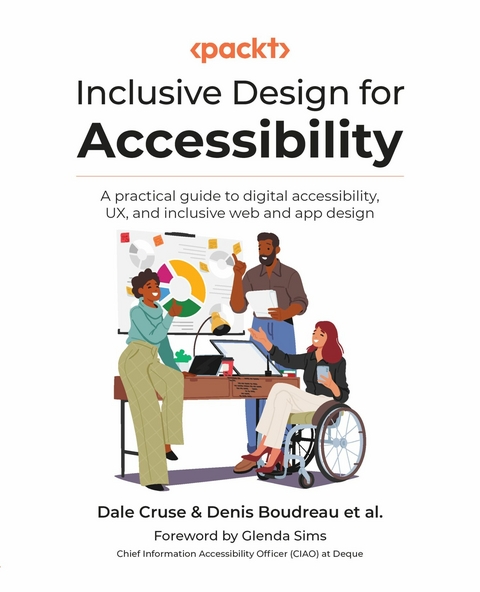
Inclusive Design for Accessibility (eBook)
322 Seiten
Packt Publishing (Verlag)
978-1-83588-823-0 (ISBN)
In today's digital world, creating inclusive experiences is both a moral and business necessity. To expand your thinking, Inclusive Design for Accessibility provides an overview of the tools and knowledge to transform your approach to digital design and development.
With contributions from twelve accessibility leaders - Dale Cruse, Denis Boudreau, Dr. Angela Young, Maya Sellon, Julianna Rowsell, Nandita Gupta, Jennifer Chadwick, Crystal Scott, Chris McMeeking, Dr. Keith Newton, Charlie Triplett, and Kai Wong - this book will lay out the fundamentals of inclusive design, as well as its application in advanced and emerging technologies, helping you build digital products that go beyond compliance and truly empower all users, regardless of abilities.
Here, you'll discover practical strategies and real-world examples that will allow you to embed accessibility into projects, from user research and testing to creating accessible websites and mobile apps. You'll also explore how AI can enhance accessibility and how to tackle challenges posed by VR and AR technologies.
For designers, developers, product managers, and business leaders, this book will reshape how you approach inclusive design, helping you move beyond ticking boxes and toward building digital solutions that serve all users effectively.
Through insights from twelve industry voices, learn how to create truly accessible and inclusive digital experiences that work for everyone, regardless of ability and backgroundKey FeaturesUnderstand inclusive design principles that will help you achieve universal usabilityGain insights into AI and emerging technologies shaping the future of accessibilityDrive organizational change with practical strategies to build an inclusive design culturePurchase of the print or Kindle book includes a free PDF eBookBook DescriptionDespite our growing reliance on digital technology, millions of users are still excluded from fully engaging with websites, apps, and digital services because nobody thought to design for them. Inclusive Design for Accessibility challenges you to rethink how you build digital experiences, offering the tools and guidance needed to move beyond compliance and create experiences that work for everyone. With contributions from twelve accessibility leaders Dale Cruse, Denis Boudreau, Dr. Angela Young, Maya Sellon, Julianna Rowsell, Nandita Gupta, Jennifer Chadwick, Crystal Scott, Chris McMeeking, Dr. Keith Newton, Charlie Triplett, and Kai Wong this book lays out the fundamentals of inclusive design and its application in advanced and emerging technologies. You'll discover practical strategies and real-world examples that show you how to embed accessibility into projects, from user research and testing to creating accessible websites and mobile apps. You ll also focus on how AI can enhance accessibility and learn to tackle the challenges posed by VR and AR. For designers, developers, product managers, and business leaders, this book will reshape how you approach inclusive design, helping you move beyond ticking boxes toward building digital products that don't leave anyone behind.What you will learnMaster the core principles of inclusive design to create products that serve allConduct diverse user research to gain insights into accessible experiencesImplement accessibility best practices in your web and mobile deploymentsCreate fully accessible content in text, audio, and video formatsExplore the accessibility challenges and opportunities with AI, VR, and ARNavigate the legal and ethical implications of accessibility to protect users and your brandEstablish accessibility-focused workflows and practices in your teamsWho this book is forThis book is for digital designers, developers, UX professionals, product managers, and business leaders committed to inclusive design. It offers practical skills for creating accessible digital products, while covering legal and ethical considerations, user research, and strategies for building an accessibility-focused culture within teams. You don t need to be an expert in UX design, web development, or accessibility to get value from this book. Each chapter delivers actionable insights that stand on their own, be it UX design, product management, development, or accessibility leadership.]]>
Preface
In an increasingly digital world, the ability to access information, services, and opportunities online is not a luxury – it’s a human right. Yet, for millions of people with disabilities, everyday digital experiences still present barriers that prevent full participation. Whether it’s a mobile app that can’t be navigated with a screen reader, a website that hides key content behind inaccessible modals, or an AI tool that misinterprets a user’s voice or intent, digital exclusion remains a persistent and solvable problem. Inclusive Design for Accessibility is a practical guide for anyone who wants to close that gap – designers, developers, content creators, QA testers, and organizational leaders alike.
This book brings together voices from across the accessibility community to provide you with a comprehensive roadmap for building inclusive digital experiences. It begins by grounding you in the principles of inclusive design and the diverse needs of real users. From there, it explores the nuts and bolts of implementation: how to design accessible user interfaces, write inclusive content, build accessible websites and mobile apps, and test with both automated tools and human insight. As technology evolves, so must our approach. That’s why we also examine accessibility in emerging spaces such as VR, AR, and AI – and look at the organizational strategies needed to scale these efforts sustainably.
Throughout the book, you will encounter real-world tools and technologies – from screen readers such as VoiceOver and NVDA to development frameworks such as SwiftUI, Compose, and React Native. But more importantly, you’ll gain a human-centered lens on accessibility: one that views inclusion not as a checklist, but as a creative, ethical, and business-critical practice. Whether you’re just starting out or looking to level up your organization’s accessibility maturity, this book will help you design with empathy, build with intention, and create digital products that work for everyone.
Who this book is for
This book is perfect for digital designers, developers, UX professionals, product managers, and business leaders committed to inclusive design. It offers practical skills to create accessible digital products, as well as covering legal and ethical aspects, user research, and building an accessibility culture within teams.
You don’t need to be an expert to get value from this book. Each chapter offers actionable insights that stand on their own – be it UX design, product management, development, or accessibility leadership.
What this book covers
In Chapter 1, Defining Inclusive Design in the Digital Age, Dale Cruse charts the evolution of accessibility from a reactive add-on to a proactive, user-centered design mindset. The chapter introduces foundational concepts such as universal design principles, the social model of disability, and inclusive research methods, equipping you to design digital experiences that work for everyone.
In Chapter 2, Understanding Diverse User Needs: Types of Disabilities and Assistive Technologies, Dr. Angela Young, CPACC, examines how people with a wide range of permanent, temporary, and situational disabilities interact with digital technology. The chapter provides an in-depth look at assistive technologies, categorizes different disability types, and maps user needs to inclusive design strategies, offering you practical guidance for creating digital products that are truly accessible and empowering for all.
In Chapter 3, Legal and Ethical Considerations in Accessible Design, Maya Sellon explains how digital accessibility is both a legal requirement and an ethical imperative. The chapter outlines global laws such as the ADA and CRPD, explores the limitations of compliance-only approaches, and emphasizes the importance of designing inclusively from the start to foster meaningful and equitable user experiences.
In Chapter 4, User Research and Testing for Inclusive Products, Julianna Rowsell guides you through building inclusive research practices that center on disabled, neurodivergent, and marginalized participants from the outset. The chapter offers strategies for equitable recruitment, accessible methodologies, and meaningful analysis, emphasizing that inclusive research is a relational, ongoing practice – not a checklist – and must translate into design decisions that reflect the lived realities of diverse users.
In Chapter 5, Designing Accessible User Interfaces: Visual and Interaction Design, Nandita Gupta explores how to build interfaces that are inclusive across visual, cognitive, and input-related dimensions. The chapter provides actionable guidance on using color responsibly, supporting cognitive accessibility, enabling multiple input methods, and scaling accessible design systems, empowering you to create digital experiences that are not only usable but equitable for all.
In Chapter 6, Creating Accessible Content: Writing, Images, and Multimedia, Jennifer Chadwick empowers content creators to communicate inclusively by using plain language, accessible formatting, and alternative content formats. The chapter offers practical guidance for writing clear text, labeling interactive elements, describing images and multimedia, and concludes with a hands-on walk-through exercise to help creators evaluate and improve accessibility across content types.
In Chapter 7, Developing Accessible Websites: HTML, CSS, and ARIA Best Practices, Crystal Scott equips developers with foundational skills to build inclusive, accessible websites. The chapter covers semantic HTML, accessible CSS styling, proper use of ARIA attributes, and testing strategies – encouraging an accessibility-first mindset that integrates inclusion into every coding decision.
In Chapter 8, Mobile Accessibility: Designing for Touch and Voice Interfaces, Chris McMeeking explores the unique challenges and opportunities of building accessible mobile applications. The chapter offers practical guidance for optimizing touch targets, supporting diverse input methods, designing for voice interaction, and ensuring responsive layouts – empowering teams to deliver inclusive mobile experiences across platforms and devices.
In Chapter 9, Accessibility in Emerging Technologies: VR, AR, and AI, Dr. Keith Newton explores how to design inclusive experiences in immersive and intelligent systems. The chapter offers practical strategies for adapting virtual and augmented reality for users with diverse needs and highlights how AI can both enhance and complicate accessibility, depending on how it’s implemented.
In Chapter 10, Foundations of Accessible Design System Patterns, Charlie Triplett lays out a comprehensive framework for building accessibility into design systems from the ground up. The chapter emphasizes starting with common user needs – such as low vision, color perception, and cognitive accessibility – before layering in more complex assistive technology support, guiding teams to create inclusive, scalable systems that reduce barriers by default.
In Chapter 11, Tools and Techniques for Accessible Evaluation and Prioritization, Kai Wong, CPACC, CHES®, guides you through the practical steps of accessibility testing for websites and mobile apps. The chapter covers how to combine automated tools with manual audits, prioritize and remediate issues, and embed accessibility into development workflows – helping teams build more inclusive digital products from the ground up.
In Chapter 12, Building an Inclusive Design Culture: Strategies for Organization, Denis Boudreau, CPWA, shows how to embed accessibility into an organization’s daily operations, culture, and mindset. The chapter outlines strategies for cultivating empathy, integrating accessibility into workflows, measuring progress, and sustaining continuous learning – empowering teams to move from compliance to a meaningful, people-centered practice of inclusive design.
To get the most out of this book
This book is for people who’ve worked on digital products – designers, developers, content strategists, researchers, and beyond. We assume you understand the basics of building websites or apps, but not necessarily accessibility or inclusive design.
You don’t need to be an expert. What matters is that you’re ready to shift your perspective – to see inclusion not as a checklist, but as a core design value that benefits everyone.
If you bring curiosity, openness, and a willingness to question default practices, you’ll find this book both practical and transformative.
Download the color images
We also provide a PDF file that has color images of the screenshots/diagrams used in this book. You can download it here: https://packt.link/gbp/9781835888223.
Conventions used
There are a number of text conventions used throughout this book.
CodeInText: Indicates code words in text, database table names, folder names, filenames, file extensions, pathnames, dummy URLs, user input, and X/Twitter handles. For example: “Tags such as <header>, <article>, and <section> provide clear definitions of their role, allowing both browsers and assistive technologies to interpret and...
| Erscheint lt. Verlag | 7.8.2025 |
|---|---|
| Vorwort | Glenda Sims |
| Sprache | englisch |
| Themenwelt | Informatik ► Web / Internet ► Web Design / Usability |
| ISBN-10 | 1-83588-823-2 / 1835888232 |
| ISBN-13 | 978-1-83588-823-0 / 9781835888230 |
| Informationen gemäß Produktsicherheitsverordnung (GPSR) | |
| Haben Sie eine Frage zum Produkt? |
 EPUB (Ohne DRM)
Digital Rights Management: ohne DRM
Dieses eBook enthält kein DRM oder Kopierschutz. Eine Weitergabe an Dritte ist jedoch rechtlich nicht zulässig, weil Sie beim Kauf nur die Rechte an der persönlichen Nutzung erwerben.
Dateiformat: EPUB (Electronic Publication)
EPUB ist ein offener Standard für eBooks und eignet sich besonders zur Darstellung von Belletristik und Sachbüchern. Der Fließtext wird dynamisch an die Display- und Schriftgröße angepasst. Auch für mobile Lesegeräte ist EPUB daher gut geeignet.
Systemvoraussetzungen:
PC/Mac: Mit einem PC oder Mac können Sie dieses eBook lesen. Sie benötigen dafür die kostenlose Software Adobe Digital Editions.
eReader: Dieses eBook kann mit (fast) allen eBook-Readern gelesen werden. Mit dem amazon-Kindle ist es aber nicht kompatibel.
Smartphone/Tablet: Egal ob Apple oder Android, dieses eBook können Sie lesen. Sie benötigen dafür eine kostenlose App.
Geräteliste und zusätzliche Hinweise
Buying eBooks from abroad
For tax law reasons we can sell eBooks just within Germany and Switzerland. Regrettably we cannot fulfill eBook-orders from other countries.
aus dem Bereich