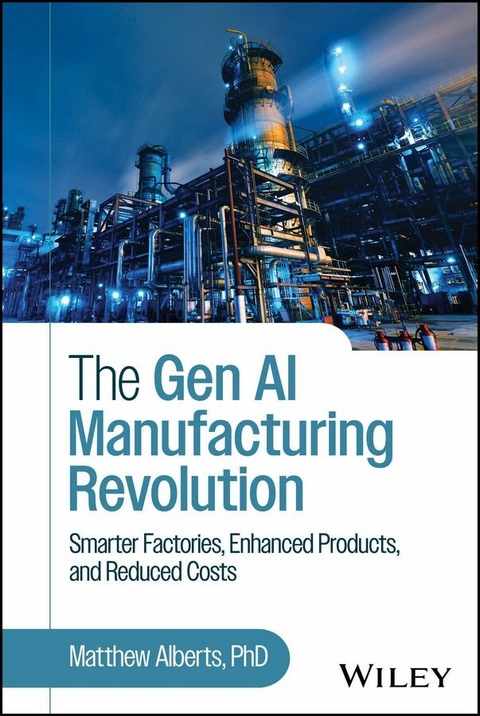
The Gen AI Manufacturing Revolution (eBook)
387 Seiten
Wiley (Verlag)
978-1-394-35721-5 (ISBN)
Transformative insights and advice to reduce downtime, navigate disruptions, and improve efficiency
The Gen AI Manufacturing Revolution highlights how generative and agentic artificial intelligence are transforming manufacturing processes, driving innovation, and reshaping the way we work. Implementing AI in manufacturing comes with unique challenges, such as integrating AI with physical machinery, managing intricate supply chains, and ensuring regulatory compliance. This book addresses these challenges, helping you harness AI's potential while navigating its complexities.
With tailored strategies and use cases, the book demonstrates how to unlock the power of Gen AI, from automating routine tasks to enabling better decision-making. You'll learn to build an AI-ready workforce, overcome common challenges in adoption, drive value across the organization, and maintain accountability.
- Leverage generative AI to streamline product design, boost creativity, and accelerate innovation
- Deploy agentic AI systems to autonomously manage workflows, monitor performance, and support complex decision-making
- Build an AI-ready workforce capable of collaborating with intelligent systems
- Address ethical, operational, and cultural challenges in AI adoption
- Drive enterprise-wide value while maintaining transparency and accountability
Whether you're looking to reduce downtime, enhance efficiency, or stay ahead of disruptive change, this book is your essential guide to leading the next wave of industrial transformation through AI.
MATTHEW ALBERTS, PhD, is a technology strategist, engineer, and thought leader. With over 15 years of experience driving digital transformation across the manufacturing, energy, and industrial sectors, he has led the adoption of cutting-edge solutions such as AI, robotics, IoT, and predictive analytics for Fortune 500 companies and high-growth startups alike.
CHAPTER 2
AI's Impact on Society and the 1-Degree World
The world is shrinking—not in physical space but in the degrees of separation between individuals, organizations, and systems. In this hyper-connected environment, where AI facilitates nearly direct relationships, organizations that fail to embrace this shift risk being left behind. Generative and Agentic AI (Gen AI) is not just another wave of technology; it's the foundation of a 1-degree world, where barriers are replaced by seamless translation, decision-making, and causality.
At the core of this transformation lies speed: the ability to act on insights immediately and accurately. In a world of growing complexity, humans cannot be in the middle of the decision-making process. Instead, they must remain in the loop, providing oversight and ethical judgment while AI systems handle complexity and deliver actionable recommendations in real time.
This chapter examines how the 1-degree world reshapes work and society, why causal relationships and speed are indispensable for Gen AI, and the ethical imperatives leaders must uphold as they navigate this profound shift.
The 1-Degree World: A Paradigm Shift in Connectivity
We are entering a new era of connectivity—the 1-degree world—where distance disappears, barriers dissolve, and decisions happen in real time. Enabled by advanced AI, this world allows individuals, systems, and organizations to connect directly, eliminating layers of inefficiency and unlocking unprecedented speed.
In the 1-degree world, we shift from gatekeeping to direct access. Traditional intermediaries—like retailers, brokers, or media outlets—lose their centrality as AI empowers businesses and individuals to interact with information, resources, and each other without friction.
Imagine a global manufacturer that once needed weeks to source raw materials through third-party brokers. Now, an AI-driven supply chain system connects it directly with suppliers, optimizing cost, availability, and delivery schedules in seconds—no emails, phone calls, or delays.
The key to thriving in this world is speed. Human-led processes, no matter how efficient, cannot compete with AI's ability to detect shifts, evaluate options, and initiate responses in milliseconds. The businesses that embrace AI-driven, direct connections will outpace competitors, adapt to disruptions effortlessly, and deliver the personalized, real-time experiences customers expect.
In the 1-degree world, success belongs to those who move faster than change itself.
How the 1-Degree World Redefines Decision-Making
The 1-degree world isn't just about connectivity—it's about faster, smarter, and more precise decision-making on the factory floor and across the entire supply chain. AI systems now allow manufacturers to anticipate issues, simulate solutions, and implement interventions almost instantaneously.
Here's how AI is transforming manufacturing decision-making in real time:
- Production optimization: Predictive AI models analyze machine performance data to detect potential breakdowns weeks before failure occurs. By automatically scheduling predictive maintenance, manufacturers reduce unplanned downtime and maintain peak production efficiency.
- Supply chain resilience: Gen AI connects manufacturers directly with raw material suppliers, continuously monitoring global logistics data to anticipate disruptions—like port delays or material shortages—and autonomously reroute shipments. The result? On-time deliveries, lower costs, and fewer production bottlenecks.
- Inventory precision: AI-driven systems dynamically adjust inventory levels based on real-time demand forecasts, machine utilization rates, and supplier reliability. This allows manufacturers to minimize excess stock while ensuring just-in-time production.
- Quality control at scale: Computer vision models inspect every product on the assembly line with micron-level accuracy, identifying defects or process deviations immediately. This proactive approach ensures consistent product quality while reducing rework and scrap.
In manufacturing, time is measured in margins. The companies that harness AI-driven, real-time insights to make decisions faster than competitors will achieve higher yields, lower costs, and stronger customer relationships.
In the 1-degree world, manual intervention becomes the bottleneck. AI eliminates the layers of human-mediated processes, allowing operations to run at the speed of data—with human expertise guiding the strategic decisions that matter most.
The Role of Humans
As AI systems handle increasingly complex decisions, the role of humans must evolve. Humans should not be in the middle of decision-making, where they can create bottlenecks. Rather, they should be in the loop, ensuring that decisions align with ethical principles and strategic goals.
There are reasons why humans can't be in the middle. These include complexity overload and error reduction.
In regard to complexity overload, modern data systems generate insights far faster than humans can process them. A human-mediated approach delays decision-making, leading to missed opportunities or operational inefficiencies. For example, a financial institution relying on humans to approve every trade misses critical windows of opportunity, whereas AI-driven trading platforms execute decisions in milliseconds.
With error reduction, humans are prone to cognitive biases and fatigue, which can impair decision-making. AI, when properly designed, eliminates these inconsistencies, delivering objective and reliable outcomes.
Although there are reasons humans can't be in the loop, it is also true that humans must be in the loop. These include having ethical oversight and accountability. AI systems may lack the nuanced judgment needed for ethical dilemmas. Humans provide critical oversight, ensuring that decisions align with organizational values and societal expectations. For example, in healthcare, AI may recommend aggressive treatments based on data, but a doctor must weigh the patient's preferences and overall well-being before acting.
AI systems execute decisions, but humans remain accountable for the outcomes. Ensuring a feedback loop between humans and AI allows organizations to maintain control and trust.
Causal Methodology
Causality matters: it is the key to accuracy and speed. The true power of Gen AI lies in its ability to move beyond correlation and uncover causal relationships—the “why” behind events. Causal methodologies enable AI systems to simulate interventions, predict outcomes, and validate decisions with unprecedented precision, allowing organizations to act faster and with greater confidence.
It is important to understand the differences between correlation and causation. Correlation identifies patterns, and causation explains them. For example:
- Correlation: “Customers who buy product X are likely to buy product Y.”
- Causation: “Customers buy product Y because it complements product X in their workflows.”
Additionally, understanding correlation and causation can improve decision accuracy. AI systems designed with causal methodologies consistently achieve decision accuracy rates above 95%, significantly reducing errors and enhancing trust in AI-driven insights.
This evolution in decision-making ability is an evolution not of man but rather of AI, as depicted in Figure 2-1. This evolution is made possible not just by the technology but also by the effective application of AI in business: specifically, for this book, for manufacturing operations. As we move toward a 1-degree world and the rise of Agentic AI, the ability to move faster than a competitor will be very apparent.
Figure 2-1: Evolution of AI in the workplace
Causal Agents in Decision-Making
To thrive in the 1-degree world, organizations must adopt causal agents. A causal agent is an AI system capable of doing the following:
- Identifying causal factors within complex datasets
- Testing hypothetical interventions to predict likely outcomes
- Providing actionable, evidence-based recommendations in seconds
As an example, a logistics company uses a causal agent to optimize delivery routes. By understanding the causal factors behind delays—such as traffic patterns, weather conditions, and order volumes—the AI adjusts routes in real time, reducing delivery times by 20% without human intervention.
Ethical Considerations in the 1-Degree World
A number of considerations are needed when working within a 1-degree world. These include the following:
- Transparency and explainability: AI systems must provide clear reasoning for their decisions to build trust and accountability.
Actionable strategy: Use explainable AI (XAI) models that allow employees and customers to understand how decisions are made. For instance, in hiring, an AI system should explain why one candidate was selected over another.
- Equitable access: The 1-degree world should democratize opportunities, not deepen inequalities. Organizations must ensure that AI benefits reach all stakeholders, not just the privileged few.
Actionable strategy: Partner with public...
| Erscheint lt. Verlag | 19.8.2025 |
|---|---|
| Sprache | englisch |
| Themenwelt | Mathematik / Informatik ► Informatik |
| Schlagworte | Agentic AI • AI machinery • AI manufacturing system • factory AI • factory technology • generative AI • manufacturing AI • manufacturing AI book • Manufacturing leader • Manufacturing technology • product design AI • supply chain AI |
| ISBN-10 | 1-394-35721-4 / 1394357214 |
| ISBN-13 | 978-1-394-35721-5 / 9781394357215 |
| Informationen gemäß Produktsicherheitsverordnung (GPSR) | |
| Haben Sie eine Frage zum Produkt? |
 EPUB (Adobe DRM)
Kopierschutz: Adobe-DRM
Adobe-DRM ist ein Kopierschutz, der das eBook vor Mißbrauch schützen soll. Dabei wird das eBook bereits beim Download auf Ihre persönliche Adobe-ID autorisiert. Lesen können Sie das eBook dann nur auf den Geräten, welche ebenfalls auf Ihre Adobe-ID registriert sind.
Details zum Adobe-DRM
Dateiformat: EPUB (Electronic Publication)
EPUB ist ein offener Standard für eBooks und eignet sich besonders zur Darstellung von Belletristik und Sachbüchern. Der Fließtext wird dynamisch an die Display- und Schriftgröße angepasst. Auch für mobile Lesegeräte ist EPUB daher gut geeignet.
Systemvoraussetzungen:
PC/Mac: Mit einem PC oder Mac können Sie dieses eBook lesen. Sie benötigen eine
eReader: Dieses eBook kann mit (fast) allen eBook-Readern gelesen werden. Mit dem amazon-Kindle ist es aber nicht kompatibel.
Smartphone/Tablet: Egal ob Apple oder Android, dieses eBook können Sie lesen. Sie benötigen eine
Geräteliste und zusätzliche Hinweise
Buying eBooks from abroad
For tax law reasons we can sell eBooks just within Germany and Switzerland. Regrettably we cannot fulfill eBook-orders from other countries.
aus dem Bereich