


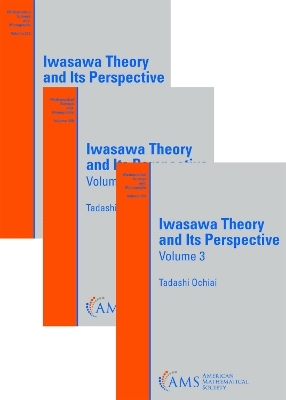
Iwasawa Theory and Its Perspective (Volumes 1-3)
Seiten
2025
American Mathematical Society (Verlag)
978-1-4704-8177-3 (ISBN)
American Mathematical Society (Verlag)
978-1-4704-8177-3 (ISBN)
Tracing Iwasawa theory’s journey from the study of ideal class groups to its expansion into elliptic curves and modular forms, these volumes examine algebraic and analytic methods. They cover p-adic L-functions, cyclotomic p-adic Galois representations, and deformations, reshaping traditional views.
Iwasawa theory began in the late 1950s with a series of papers by Kenkichi Iwasawa on ideal class groups in the cyclotomic tower of number fields and their relation to $p$-adic $ L$-functions. The theory was later generalized by putting it in the context of elliptic curves and modular forms. The main motivation for writing this book, comprised of three volumes, was the need for a total perspective that includes the new trends of generalized Iwasawa theory. Another motivation is an update of the classical theory for class groups taking into account the changed point of view on Iwasawa theory. Volume 1: explains the theory of ideal class groups, including its algebraic aspect (the Iwasawa class number formula), its analytic aspect (Leopoldt-Kubota $L$-functions), and the Iwasawa main conjecture, which is a bridge between the algebraic and the analytic aspects. Volume 2: explains various aspects of the cyclotomic Iwasawa theory of $p$-adic Galois representations. Volume 3: presents additional aspects of the Iwasawa theory of $p$-adic Galois deformations.
Iwasawa theory began in the late 1950s with a series of papers by Kenkichi Iwasawa on ideal class groups in the cyclotomic tower of number fields and their relation to $p$-adic $ L$-functions. The theory was later generalized by putting it in the context of elliptic curves and modular forms. The main motivation for writing this book, comprised of three volumes, was the need for a total perspective that includes the new trends of generalized Iwasawa theory. Another motivation is an update of the classical theory for class groups taking into account the changed point of view on Iwasawa theory. Volume 1: explains the theory of ideal class groups, including its algebraic aspect (the Iwasawa class number formula), its analytic aspect (Leopoldt-Kubota $L$-functions), and the Iwasawa main conjecture, which is a bridge between the algebraic and the analytic aspects. Volume 2: explains various aspects of the cyclotomic Iwasawa theory of $p$-adic Galois representations. Volume 3: presents additional aspects of the Iwasawa theory of $p$-adic Galois deformations.
Tadashi Ochai, Tokyo Institute of Technology, Japan
Foundations; Variation formulas. Stability. Index and nullity; Complete minimal submanifolds of non-negatively curved Riemannian manifolds; Index of minimal submanifolds of Euclidean spaces; Index of minimal submanifolds of spheres, real projective spaces, product of spheres and elliptic Berger spheres; Index of minimal submaniolds of Kahler manifolds; Glossary; Bibliography; Index; Index of authors
| Erscheinungsdatum | 02.08.2025 |
|---|---|
| Verlagsort | Providence |
| Sprache | englisch |
| Themenwelt | Mathematik / Informatik ► Mathematik ► Algebra |
| Mathematik / Informatik ► Mathematik ► Arithmetik / Zahlentheorie | |
| Mathematik / Informatik ► Mathematik ► Geometrie / Topologie | |
| ISBN-10 | 1-4704-8177-4 / 1470481774 |
| ISBN-13 | 978-1-4704-8177-3 / 9781470481773 |
| Zustand | Neuware |
| Informationen gemäß Produktsicherheitsverordnung (GPSR) | |
| Haben Sie eine Frage zum Produkt? |
Mehr entdecken
aus dem Bereich



aus dem Bereich
Eine Einführung für Studienanfänger
Buch | Softcover (2025)
Springer Spektrum (Verlag)
CHF 41,95
Sieben ausgewählte Themenstellungen
Buch | Softcover (2024)
De Gruyter Oldenbourg (Verlag)
CHF 89,95


