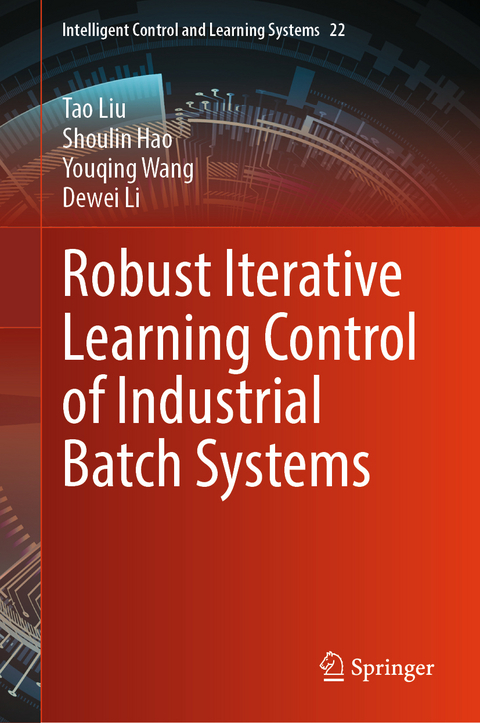
Robust Iterative Learning Control of Industrial Batch Systems
Springer Nature Switzerland AG (Verlag)
978-981-96-9777-9 (ISBN)
Tao Liu received the Ph.D. degree in Control Science and Engineering from Shanghai Jiao Tong University, Shanghai, China, in 2006. He is a Professor at the Institute of Advanced Control Technology, Dalian University of Technology, Dalian, China. His research interests include industrial process measurement by infrared spectroscopy & imaging, system identification & modeling, control system design, process control, batch process optimization, and data-driven control. He published more than 200 research papers and two monographs. He serves as an associate editor of IEEE Transactions on Industrial Informatics, editorial board member of International Journal of Control, member of the Technical Committee on Chemical Process Control of IFAC, Technical Committee on System Identification and Adaptive Control of the IEEE Control System Society, Technical Committees of Control Theory and Process Control of Chinese Association of Automation. He won the Best Paper Prize of the Journal of Process Control (2020-2022) awarded by International Federation of Automatic Control (IFAC). Shoulin Hao received his Ph.D degree in Control Theory and Control Engineering from Dalian University of Technology, Dalian, China, in 2018. He is an associate professor with the Institute of Advanced Measurement & Control Technology, Dalian University of Technology, Dalian, China. His research interests include industrial process control, iterative learning control and data-driven control. He published more than 40 research papers and coauthored one monograph. Youqing Wang received the B.S. degree in Mathematics from Shandong University in 2003, and the Ph.D. degree in Control Science and Engineering from Tsinghua University in 2008. He worked chronologically at Hong Kong University of Science and Technology, China; University of California, Santa Barbara, USA; University of Alberta, Canada; Shandong University of Science and Technology; City University of Hong Kong, China. He is currently a Professor at the Beijing University of Chemical Technology. His research interests include the control performance evaluation theory, the state and fault estimation theory, and the intelligent state monitoring theory. He served as the editor or guest editor of nine international SCI journals and worked part-time in many important international academic organizations, including membership in three technical committees of International Federation of Automatic Control (IFAC) and four professional committees of the Chinese Association of Automation (CAA). He is a recipient of several honors and awards, including IET Fellow, NSFC Distinguished Young Scientists Fund, Journal of Process Control Survey Paper Prize, and ADCHEM2015 Young Author Prize. He is also the first Chinese scholar to win the "Journal of Process Control Best Paper Prize" awarded by IFAC. Dewei Li received the B.S. degree and the Ph.D. degree in Automation from Shanghai Jiao Tong University, Shanghai, China, in 1993 and 2009, respectively. He worked as a Postdoctor Researcher with Shanghai Jiaotong University from 2009 to 2010. Now he is a Professor at the Department of Automation at Shanghai Jiao Tong University. He is also an Associate Editor of the IFAC journal, Control Engineering Practice. His research interests focus on complex system optimization control, industrial intelligent systems, and intelligent robots. He has published over 300 academic papers in international journals, such as Automatica, IEEE Transactions on Automatic Control, IEEE Transactions on Industrial Electronics, etc. He won the First Prize of Natural Science of the Chinese Association of Automation in 2016, the Second Prize of Chinese Natural Science Award in 2017, and the First Prize of Shanghai Science and Technology Progress in 2023.
Preface.- Abbreviations and Symbols.- Chapter 1:Introduction.- Chapter 2:Proportional-Integral (PI) based Iterative Learning Control.- Chapter 3:Proportional-Integral-Derivative (PID) based Iterative Learning Control.- Chapter 4:Closed-Loop ILC Scheme with State Feedback.- Chapter 5:Closed-Loop ILC Scheme with Output Feedback.- Chapter 6:Extended State Observer (ESO) based ILC Design under Process Uncertainties and Disturbance.- Chapter 7:Robust ILC Design under Process Input Constraints.- Chapter 8:2D State Predictor based ILC Design under Input Delay.- Chapter 9:Predictive State Observer (PSO) based ILC Design under Output Delay.- Chapter 10:Robust ILC Design under Process State Delay.- Chapter 11:Robust Data-Driven ILC Design for Unknown System Dynamics.
| Erscheinungsdatum | 21.10.2025 |
|---|---|
| Reihe/Serie | Intelligent Control and Learning Systems |
| Zusatzinfo | 74 Illustrations, color; 12 Illustrations, black and white |
| Verlagsort | Cham |
| Sprache | englisch |
| Maße | 155 x 235 mm |
| Themenwelt | Mathematik / Informatik ► Informatik ► Theorie / Studium |
| Technik ► Elektrotechnik / Energietechnik | |
| Technik ► Maschinenbau | |
| ISBN-10 | 981-96-9777-8 / 9819697778 |
| ISBN-13 | 978-981-96-9777-9 / 9789819697779 |
| Zustand | Neuware |
| Informationen gemäß Produktsicherheitsverordnung (GPSR) | |
| Haben Sie eine Frage zum Produkt? |
aus dem Bereich