


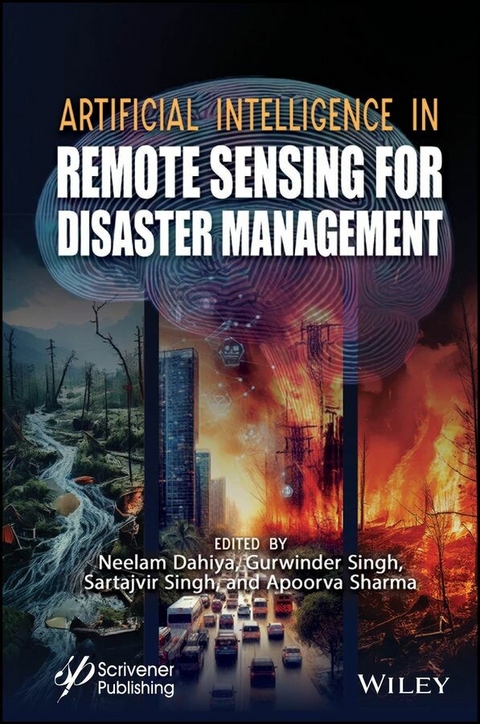
Artificial Intelligence in Remote Sensing for Disaster Management (eBook)
510 Seiten
Wiley-Scrivener (Verlag)
978-1-394-28720-8 (ISBN)
Invest in Artificial Intelligence in Remote Sensing for Disaster Management to gain invaluable insights into cutting-edge AI technologies and their transformative role in effectively monitoring and managing natural disasters.
Artificial Intelligence in Remote Sensing for Disaster Management examines the involvement of advanced tools and technologies such as Artificial Intelligence in disaster management with remote sensing. Remote sensing offers cost-effective, quick assessments and responses to natural disasters. In the past few years, many advances have been made in the monitoring and mapping of natural disasters with the integration of AI in remote sensing. This volume focuses on AI-driven observations of various natural disasters including landslides, snow avalanches, flash floods, glacial lake outburst floods, and earthquakes. There is currently a need for sustainable development, near real-time monitoring, forecasting, prediction, and management of natural resources, flash floods, sea-ice melt, cyclones, forestry, and climate changes. This book will provide essential guidance regarding AI-driven algorithms specifically developed for disaster management to meet the requirements of emerging applications.
Neelam Dahiya, PhD is an assistant professor in the Department of Computer Applications at Chitkara University, Punjab, India. She has authored over ten articles in international journals and filed more than ten patents with the Indian Patent Office, five of which were granted. She has also reviewed various articles for renowned journals and conferences. Her research interests include remote sensing, digital image processing, deep learning, and hyperspectral imaging.
Gurwinder Singh, PhD is an associate professor at the Institute of Computing at Chandigarh University, India. He has internationally published over 35 articles, conference papers, and book chapters, as well as one patent. He also serves as a member of the International Society for Photogrammetry and Remote Sensing and the Indian Society of Remote Sensing. His research interests include remote sensing, digital image processing, agricultural land use classification, machine learning, and deep learning.
Sartajvir Singh, PhD is a professor and the Associate Director for the University Institute of Engineering at Chandigarh University, Punjab, India. He has filed over 50 patents with the Indian Patent Office, with over half granted. He has authored over 50 articles in international journals and edited various proceedings for conferences and symposia in addition to serving as an editor for several international journals. His research interests include electronics, remote sensing, and digital image processing.
Apoorva Sharma is a digital analyst and assistant professor in the Department of Computer Science and Engineering, Chandigarh University, Punjab, India. She has published three articles in internationally reputed journals and conferences and contributed to innovative wearable and geospatial technologies. Her research interests include remote sensing, digital image processing, agriculture and cryosphere studies, machine learning, and deep learning.
Invest in Artificial Intelligence in Remote Sensing for Disaster Management to gain invaluable insights into cutting-edge AI technologies and their transformative role in effectively monitoring and managing natural disasters. Artificial Intelligence in Remote Sensing for Disaster Management examines the involvement of advanced tools and technologies such as Artificial Intelligence in disaster management with remote sensing. Remote sensing offers cost-effective, quick assessments and responses to natural disasters. In the past few years, many advances have been made in the monitoring and mapping of natural disasters with the integration of AI in remote sensing. This volume focuses on AI-driven observations of various natural disasters including landslides, snow avalanches, flash floods, glacial lake outburst floods, and earthquakes. There is currently a need for sustainable development, near real-time monitoring, forecasting, prediction, and management of natural resources, flash floods, sea-ice melt, cyclones, forestry, and climate changes. This book will provide essential guidance regarding AI-driven algorithms specifically developed for disaster management to meet the requirements of emerging applications.
1
Introduction to Natural Hazards, Challenges, and Managing Strategies
Puninder Kaur*, Taruna Sharma, Jaswinder Singh and Neelam Dahiya
Chitkara University Institute of Engineering and Technology, Chitkara University, Punjab, India
Abstract
Natural disasters are unforeseen events that spread danger to human existence and have major effects on our ecosystem. It includes volcanic eruptions, floods, earthquakes, wildfires, tsunamis, droughts, and extreme climate changes. To prevent and manage natural disaster has become a critical issue; if not resolved on time, it can lead to severe injuries and even death. On the basis of origin, these are categorized into various forms such as biological, geological, and hydrological. These hazards are life threatening; thus, early detection and management is necessary to resolve the issue. Remote sensing plays an important role in managing natural disaster. In the current work, a detailed review of natural disaster, challenges, and its possible managing strategies has been discussed. This research work will help the beginners, researchers, and human beings for early detection of natural hazards and also to implement effective solutions to resolve the issue.
Keywords: Disaster, flood, hazards, remote sensing
1.1 Introduction
Natural hazards are defined as the phenomena that can become disastrous when they cause significant casualties and property damage, impeding social and economic growth. If occurring on a worldwide scale and with great frequency, these endanger human society, environmental systems, and critical infrastructures [1]. Earthquakes, floods, cyclones, volcanic eruptions, and landslides are natural events that have shaped the Earth’s terrain over millennia. These natural processes can result in natural catastrophes when they interact with man-made elements such as towns, agriculture, and infrastructure [2].
India’s unique geoclimatic circumstances have made it prone to catastrophic calamities. Floods, droughts, cyclones, earthquakes, and landslides have been common occurrences. Approximately 60% of the landmass is prone to earthquakes of varying intensities, over 40 million hectares is prone to flooding, approximately 8% of the total area is prone to cyclones, and 68% of the territory is vulnerable to drought [3]. The loss of individual, municipal, and governmental assets has been massive. India has been struck by numerous disasters in recent years, including, among the major ones, the Bangalore circus tragedy (1981), Bhopal gas tragedy (1984), Gujarat cyclone (1998), Orissa super cyclone (1999), Gujarat earthquake (2001), annual flooding in large parts of the country during the monsoon, and tsunami.
In 2016, natural disasters caused up to 520 billion USD in worldwide losses, which was 60% more than previously estimated losses. China is one of the countries that have suffered significant losses due to natural calamities. The significant loss can be due to its broad region, complex and diversified ecological environment, and high frequency [4].
To successfully mitigate natural catastrophes, it is crucial to understand the predicted frequency, type, and severity of hazardous events in a certain location. Natural disaster management relies heavily on geographical information. Spatial data includes maps, aerial photography, satellite images, GPS, rainfall data, borehole data, and other geographic information. To superimpose data from disparate projections and coordinate systems, they must be converted to a common map basis. Remote sensing and geographic information systems (GIS) are effective tools for disaster management. Satellite remote sensing data can quickly map disaster-related data distributions [5]. Satellite systems vary in terms of geographic, temporal, and spectral resolution.
To analyze catastrophes, remote sensing data should be combined with other data sources such as mapping, measuring networks, or sample locations to determine valuable parameters. There are two methods for image linkage: visual interpretation and categorization.
The main focus of this chapter is to provide an overview of the numerous natural processes that have the potential to trigger natural catastrophes [6]. It comprises of an introduction section which describes about the natural hazards, which is further followed by a section on the terminologies used, classification, challenges of natural hazards, and possible solution via remote sensing. The chapter finishes with a discussion of obstacles in coping with catastrophes caused by natural hazards and suggests new directions in improving the ability to mitigate the harmful impact of natural disasters on vulnerable sections.
1.2 Terminology Used
Natural disaster have been continuously changing during the last decades. There are some important key terminologies used for natural disaster prediction which are mentioned below.
1.2.1 Hazard
Hazard has the capability to occur, change the lives of people, and has greater impact on people or places. The main reason for their occurrence is due to the interaction of social, technological, and natural systems. This idea of hazard implies that the interaction of natural and social systems is the crucial aspect in changing a natural activity into a threat. It is also vital to recognize that a “hazard” is not always dangerous; rather, it is a “threat” with the potential to do harm. The Federal Emergency Management Agency (FEMA) defines hazards as “events or physical conditions capable of causing fatalities, injuries, property damage, and infrastructure” [7].
1.2.2 Mitigation
The mitigation sector “mitigates or prevents the adverse effects of natural hazards with measures, activities, and actions taken by humans and communities”. It employs an integrated strategy that includes land use planning, infrastructure development, ecosystem restoration, and public awareness, all of which are critical for risk reduction and resiliency [8]. Mitigation is primarily beneficial for reducing the likelihood and severity of such accidents. It is unavoidable because it develops various techniques to limit human life losses, lessen the destruction of personal property, and lessen the intervention from communities.
1.2.3 Vulnerability
Vulnerability in hazardous areas refers to the link between people, infrastructure, assets, and ecosystems that are considered targets for these hazards. It may have adverse impacts on the planet due to ecological conditions, socioeconomic and structural factors, and lack of access to the necessary infrastructures and resources [8]. There is a need for holistic approaches to protect, especially for developing economies, from natural risks such as incorporating socio-economic improvement, infrastructure development, risk-lowering measures, and community empowerment. The vulnerability of poor people to the aftermath of disasters can be minimized by diagnosing the reasons for their vulnerability and by improving their resilience to prevent it.
1.2.4 Disaster
Disaster refers to any activity that foreshadows negative consequences and is a one-of-a-kind event that affects the natural environment. Disasters have a wide-ranging impact on people, property, and the environment, causing both short- and long-term harm. Natural occurrences can be complicated or benign, and they can be caused completely by people or by a combination of the two [9]. Disasters vary in severity, ranging from a few individuals or houses to the entire country, and can occur simultaneously. While individuals cannot predict catastrophes, anticipatory efforts can assist to mitigate the impacts by making the impact less severe and decreasing the danger to vulnerable populations.
1.2.5 Risk
Risk is the possibility of an unintentional action occurring, and there may be a variety of harmful behaviors that result in individuals losing their lives, damaging the beauty of the environment, and incurring economic losses. It considers the probability of the event’s occurrence as well as the extent of its impact when determining the hazard’s risk level. After all assessments from 2013 to 2020, the natural risk is continuously increasing [9]. The formula is provided in Equation 1.1 [10].
R stands for risk, and it may be calculated using the multiplication factor of H and V. H stands for hazards (disaster), and V is for vulnerability. If the value of dangers and vulnerabilities raises, so is the likelihood of risk.
1.3 Classification of Natural Hazards
Natural disasters encompass a wide range of occurrences that pose dangers to human life, transportation, and ecosystems. Some typical forms of natural hazards are shown in Figure 1.1.
1.3.1 Biological Natural Hazards
Biological risks are those that result from numerous biological processes. It includes some variants of disease which can spread from person to person and also has the capability to infect human beings at a large scale [11]. Biological natural hazards are events or phenomena that come from the stable probiotic that exists in animals, plants, and other organisms—for instance, viruses, bacteria, parasites, insects, and pathogens—which present health and wellness challenges, decline in agriculture, damage to ecosystems, and undermining of economies. Apart from human health systems,...
| Erscheint lt. Verlag | 28.5.2025 |
|---|---|
| Sprache | englisch |
| Themenwelt | Mathematik / Informatik ► Informatik ► Theorie / Studium |
| Schlagworte | Artificial Intelligence • damage assessment • Deep learning • Disaster Rehabilitation • disaster risk reduction • earthquakes • emergency response • floods • Glacial Lake Outburst Floods (GLOF) • Landslides • Landslide Susceptibility • machine learning • Natural Hazards • Remote Sensing • Snow avalanches |
| ISBN-10 | 1-394-28720-8 / 1394287208 |
| ISBN-13 | 978-1-394-28720-8 / 9781394287208 |
| Informationen gemäß Produktsicherheitsverordnung (GPSR) | |
| Haben Sie eine Frage zum Produkt? |
 EPUB (Adobe DRM)
Kopierschutz: Adobe-DRM
Adobe-DRM ist ein Kopierschutz, der das eBook vor Mißbrauch schützen soll. Dabei wird das eBook bereits beim Download auf Ihre persönliche Adobe-ID autorisiert. Lesen können Sie das eBook dann nur auf den Geräten, welche ebenfalls auf Ihre Adobe-ID registriert sind.
Details zum Adobe-DRM
Dateiformat: EPUB (Electronic Publication)
EPUB ist ein offener Standard für eBooks und eignet sich besonders zur Darstellung von Belletristik und Sachbüchern. Der Fließtext wird dynamisch an die Display- und Schriftgröße angepasst. Auch für mobile Lesegeräte ist EPUB daher gut geeignet.
Systemvoraussetzungen:
PC/Mac: Mit einem PC oder Mac können Sie dieses eBook lesen. Sie benötigen eine
eReader: Dieses eBook kann mit (fast) allen eBook-Readern gelesen werden. Mit dem amazon-Kindle ist es aber nicht kompatibel.
Smartphone/Tablet: Egal ob Apple oder Android, dieses eBook können Sie lesen. Sie benötigen eine
Geräteliste und zusätzliche Hinweise
Buying eBooks from abroad
For tax law reasons we can sell eBooks just within Germany and Switzerland. Regrettably we cannot fulfill eBook-orders from other countries.
aus dem Bereich


