


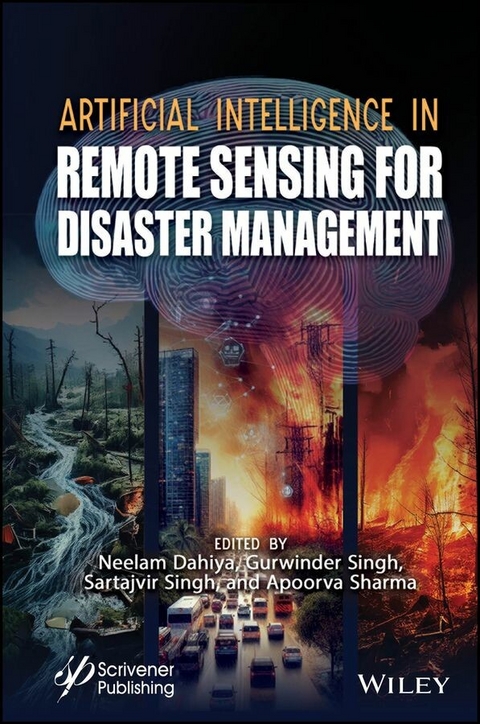
Artificial Intelligence in Remote Sensing for Disaster Management (eBook)
372 Seiten
Wiley-Scrivener (Verlag)
978-1-394-28721-5 (ISBN)
Invest in Artificial Intelligence in Remote Sensing for Disaster Management to gain invaluable insights into cutting-edge AI technologies and their transformative role in effectively monitoring and managing natural disasters.
Artificial Intelligence in Remote Sensing for Disaster Management examines the involvement of advanced tools and technologies such as Artificial Intelligence in disaster management with remote sensing. Remote sensing offers cost-effective, quick assessments and responses to natural disasters. In the past few years, many advances have been made in the monitoring and mapping of natural disasters with the integration of AI in remote sensing. This volume focuses on AI-driven observations of various natural disasters including landslides, snow avalanches, flash floods, glacial lake outburst floods, and earthquakes. There is currently a need for sustainable development, near real-time monitoring, forecasting, prediction, and management of natural resources, flash floods, sea-ice melt, cyclones, forestry, and climate changes. This book will provide essential guidance regarding AI-driven algorithms specifically developed for disaster management to meet the requirements of emerging applications.
Neelam Dahiya, PhD is an assistant professor in the Department of Computer Applications at Chitkara University, Punjab, India. She has authored over ten articles in international journals and filed more than ten patents with the Indian Patent Office, five of which were granted. She has also reviewed various articles for renowned journals and conferences. Her research interests include remote sensing, digital image processing, deep learning, and hyperspectral imaging.
Gurwinder Singh, PhD is an associate professor at the Institute of Computing at Chandigarh University, India. He has internationally published over 35 articles, conference papers, and book chapters, as well as one patent. He also serves as a member of the International Society for Photogrammetry and Remote Sensing and the Indian Society of Remote Sensing. His research interests include remote sensing, digital image processing, agricultural land use classification, machine learning, and deep learning.
Sartajvir Singh, PhD is a professor and the Associate Director for the University Institute of Engineering at Chandigarh University, Punjab, India. He has filed over 50 patents with the Indian Patent Office, with over half granted. He has authored over 50 articles in international journals and edited various proceedings for conferences and symposia in addition to serving as an editor for several international journals. His research interests include electronics, remote sensing, and digital image processing.
Apoorva Sharma is a digital analyst and assistant professor in the Department of Computer Science and Engineering, Chandigarh University, Punjab, India. She has published three articles in internationally reputed journals and conferences and contributed to innovative wearable and geospatial technologies. Her research interests include remote sensing, digital image processing, agriculture and cryosphere studies, machine learning, and deep learning.
Invest in Artificial Intelligence in Remote Sensing for Disaster Management to gain invaluable insights into cutting-edge AI technologies and their transformative role in effectively monitoring and managing natural disasters. Artificial Intelligence in Remote Sensing for Disaster Management examines the involvement of advanced tools and technologies such as Artificial Intelligence in disaster management with remote sensing. Remote sensing offers cost-effective, quick assessments and responses to natural disasters. In the past few years, many advances have been made in the monitoring and mapping of natural disasters with the integration of AI in remote sensing. This volume focuses on AI-driven observations of various natural disasters including landslides, snow avalanches, flash floods, glacial lake outburst floods, and earthquakes. There is currently a need for sustainable development, near real-time monitoring, forecasting, prediction, and management of natural resources, flash floods, sea-ice melt, cyclones, forestry, and climate changes. This book will provide essential guidance regarding AI-driven algorithms specifically developed for disaster management to meet the requirements of emerging applications.
| Erscheint lt. Verlag | 19.5.2025 |
|---|---|
| Sprache | englisch |
| Themenwelt | Mathematik / Informatik ► Informatik ► Theorie / Studium |
| Schlagworte | Artificial Intelligence • damage assessment • Deep learning • Disaster Rehabilitation • disaster risk reduction • earthquakes • emergency response • floods • Glacial Lake Outburst Floods (GLOF) • Landslides • Landslide Susceptibility • machine learning • Natural Hazards • Remote Sensing • Snow avalanches |
| ISBN-10 | 1-394-28721-6 / 1394287216 |
| ISBN-13 | 978-1-394-28721-5 / 9781394287215 |
| Informationen gemäß Produktsicherheitsverordnung (GPSR) | |
| Haben Sie eine Frage zum Produkt? |
 PDF (Adobe DRM)
Kopierschutz: Adobe-DRM
Adobe-DRM ist ein Kopierschutz, der das eBook vor Mißbrauch schützen soll. Dabei wird das eBook bereits beim Download auf Ihre persönliche Adobe-ID autorisiert. Lesen können Sie das eBook dann nur auf den Geräten, welche ebenfalls auf Ihre Adobe-ID registriert sind.
Details zum Adobe-DRM
Dateiformat: PDF (Portable Document Format)
Mit einem festen Seitenlayout eignet sich die PDF besonders für Fachbücher mit Spalten, Tabellen und Abbildungen. Eine PDF kann auf fast allen Geräten angezeigt werden, ist aber für kleine Displays (Smartphone, eReader) nur eingeschränkt geeignet.
Systemvoraussetzungen:
PC/Mac: Mit einem PC oder Mac können Sie dieses eBook lesen. Sie benötigen eine
eReader: Dieses eBook kann mit (fast) allen eBook-Readern gelesen werden. Mit dem amazon-Kindle ist es aber nicht kompatibel.
Smartphone/Tablet: Egal ob Apple oder Android, dieses eBook können Sie lesen. Sie benötigen eine
Geräteliste und zusätzliche Hinweise
Buying eBooks from abroad
For tax law reasons we can sell eBooks just within Germany and Switzerland. Regrettably we cannot fulfill eBook-orders from other countries.
aus dem Bereich


