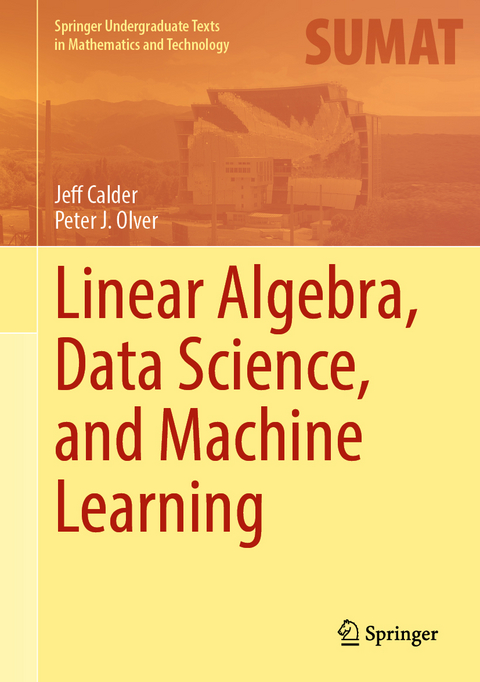
Linear Algebra, Data Science, and Machine Learning
Springer International Publishing (Verlag)
978-3-031-93763-7 (ISBN)
This text provides a mathematically rigorous introduction to modern methods of machine learning and data analysis at the advanced undergraduate/beginning graduate level. The book is self-contained and requires minimal mathematical prerequisites. There is a strong focus on learning how and why algorithms work, as well as developing facility with their practical applications. Apart from basic calculus, the underlying mathematics linear algebra, optimization, elementary probability, graph theory, and statistics is developed from scratch in a form best suited to the overall goals. In particular, the wide-ranging linear algebra components are unique in their ordering and choice of topics, emphasizing those parts of the theory and techniques that are used in contemporary machine learning and data analysis. The book will provide a firm foundation to the reader whose goal is to work on applications of machine learning and/or research into the further development of this highly active field of contemporary applied mathematics.
To introduce the reader to a broad range of machine learning algorithms and how they are used in real world applications, the programming language Python is employed and offers a platform for many of the computational exercises. Python notebooks complementing various topics in the book are available on a companion GitHub site specified in the Preface, and can be easily accessed by scanning the QR codes or clicking on the links provided within the text. Exercises appear at the end of each section, including basic ones designed to test comprehension and computational skills, while others range over proofs not supplied in the text, practical computations, additional theoretical results, and further developments in the subject. The Students Solutions Manual may be accessed from GitHub. Instructors may apply for access to the Instructors Solutions Manual from the link supplied on the text s Springer website.
The book can be used in a junior or senior level course for students majoring in mathematics with a focus on applications as well as students from other disciplines who desire to learn the tools of modern applied linear algebra and optimization. It may also be used as an introduction to fundamental techniques in data science and machine learning for advanced undergraduate and graduate students or researchers from other areas, including statistics, computer science, engineering, biology, economics and finance, and so on.
Peter J. Olver received his Ph.D. from Harvard University in 1976 under the guidance of Prof. Garrett Birkhoff. After being a Dickson Instructor at the University of Chicago and a postdoc at the University of Oxford, he has been on the faculty of the School of Mathematics at the University of Minnesota since 1980, and a full professor since 1985. He served as the Head of the Department from 2008 to 2020. He has supervised 23 Ph.D. students to date, as well as mentoring 30 postdocs and visiting students and scholars from around the world. He has also supervised over 25 undergraduate research projects, many of which have led to publications. He is a Fellow of the American Mathematical Society, the Society for Industrial and Applied Mathematics (SIAM), and the Institute of Physics, UK His research interests revolve around the applications of symmetry and Lie groups to differential equations. Over the years, he has contributed to a wide range of fields, including partial differential equations, the calculus of variations, mathematical physics, fluid mechanics, elasticity, quantum mechanics, Hamiltonian mechanics, geometric numerical methods, differential geometry, classical invariant theory, algebra, computer vision and image processing, anthropology, and beyond. Since 1976, he has given more than 500 invited lectures on his research at conferences, universities, colleges, and institutes throughout the world. He is the author of over 160 papers in refereed journals, and over 50 in conference proceedings. He was named a "Highly Cited Researcher'' by Thomson-ISI in 2003. He has written 5 books, including the definitive text on Applications of Lie Groups to Differential Equations, which was published in 1986, translated into Russian, and also republished in China. His most recent books are two undergraduate texts: Partial Differential Equations and the second edition of Applied Linear Algebra,the latter coauthored with his wife, Chehrzad Shakiban.
Jeff Calder is an associate professor of mathematics at the University of Minnesota. His research involves interactions between partial differential equations (PDE), numerical analysis, applied probability, and computer science. He is interested in both the rigorous analysis of PDE and the development and implementation of algorithms. Fall 2023/Spring 2024 he is teaching a new sequence of course Mathematics of Machine Learning and Data Analysis.
Preface.- 1 Vectors.- 2 Inner Product, Orthogonality, Norm.- 3 Matrices.- 4. How Matrices Interact with Inner Products and Norms.- 5 Eigenvalues and Singular Values.- 6 Basics of Optimization.- 7 Introduction to Machine Learning and Data.- 8 Principal Component Analysis.- 9 Graph Theory and Graph-based Learning.- 10 Neural Networks and Deep Learning.- 11 Advanced Optimization.- Bibliography.- Index.
| Erscheinungsdatum | 20.07.2025 |
|---|---|
| Reihe/Serie | Springer Undergraduate Texts in Mathematics and Technology |
| Zusatzinfo | XXIII, 629 p. 639 illus. in color. |
| Verlagsort | Cham |
| Sprache | englisch |
| Maße | 178 x 254 mm |
| Themenwelt | Mathematik / Informatik ► Mathematik ► Algebra |
| Schlagworte | affine iterative systems • Cauchy-Schwarz inequality • classification • Clustering • Data Science • Deep learning • dimension reduction • Gradient descent • Gram matrices • graph-based learning • graph theory • heavy ball method • K-means clustering • linear algebra • Lipschitz continuity • machine learning • neural network • Optimization • Principal Component Analysis • QR factorization • Regression • Semi-Supervised Learning • Spectral Graph theory • Support Vector Machines • textbook data science • textbook linear algebra • textbook machine learning • Triangle Inequality • two layer neural network • two layer ReLU network |
| ISBN-10 | 3-031-93763-5 / 3031937635 |
| ISBN-13 | 978-3-031-93763-7 / 9783031937637 |
| Zustand | Neuware |
| Informationen gemäß Produktsicherheitsverordnung (GPSR) | |
| Haben Sie eine Frage zum Produkt? |
aus dem Bereich