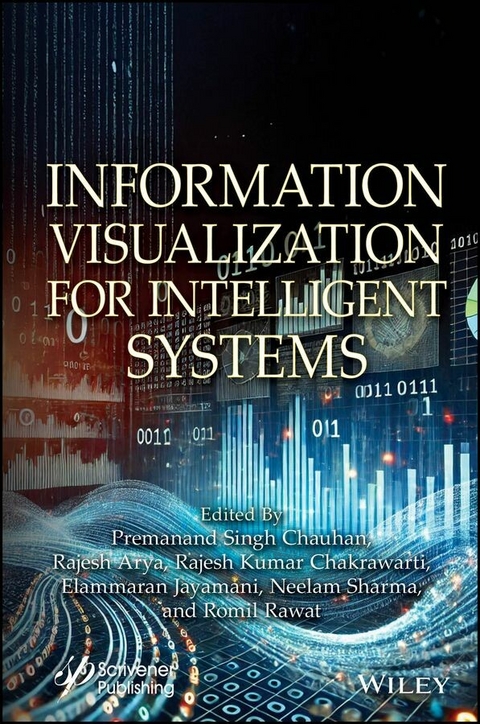
Information Visualization for Intelligent Systems (eBook)
805 Seiten
Wiley-Scrivener (Verlag)
978-1-394-30579-7 (ISBN)
Information Visualization for Intelligent Systems provides readers with essential insights into cutting-edge advancements in machine intelligence and explores how these transformative technologies are revolutionizing data analysis and decision-making in an increasingly complex world.
The book explores advanced computing, or machine intelligence, which enables technology-machines, devices, or algorithms-to interact intelligently with their surroundings, make decisions, and take actions to achieve objectives. Unlike natural human intelligence, artificial intelligence (AI) is demonstrated by machines.
Modern advancements in high-speed computing drive paradigm shifts, enabling complex machine intelligence systems and novel cyber systems that utilize data to perform specific tasks. While standalone cyber systems are common, integrating multiple systems into cohesive, intelligent structures interacting deeply with physical systems remains underexplored and primarily philosophical in existing literature.
These technological breakthroughs have revolutionized data generation, cloud storage, global information exchange, and rapid computing. For example, machine intelligence models analyze video surveillance to identify threats, support early infection detection in healthcare, and enhance chemical industry processes. While promising, these advancements remain in their infancy, offering significant potential for further development.
Premanand Singh Chauhan, PhD, is a director at the Sushila Devi Bansal College of Technology, Indore, India with seven years of industry experience and 20 years of teaching experience. He has edited one book, authored two books and 55 research articles, and has published three patents, one of which was granted. He is the editor of the proceedings of many reputed international conferences, technical adviser for many industries working in the field of manufacturing, and also a member of many professional bodies.
Rajesh Arya, PhD, is a principal at the Sushila Devi Bansal College of Engineering, Indore, India. He has more than 15 years of experience teaching courses related to electrical and computer engineering. He has published more than 45 research papers in the journals and conferences of repute publishers and is an Associate Member of the Institution of Engineers.
Rajesh Kumar Chakrawarti, PhD, is a professor and dean at the Department of Computer Science and Engineering/Information Technology, Sushila Devi Bansal College, Indore, India with over 21 years of experience in academia and industry. He is actively involved in teaching courses at both the undergraduate and postgraduate levels and is eagerly involved in teaching, training, research and development, and department, institution, and university development activities. He has organized and attended over 100 seminars, workshops, conferences, and certifications and has presented and published over 100 research papers, chapters in books, and abstracts in national and international conferences and journals.
Elammaran Jayamani, PhD, is an associate professor in the Mechanical Engineering program in the Faculty of Engineering, Computing, and Science at the Swinburne University of Technology, Sarawak Campus. Dr. Elammaran has been a creative educator for over 23 years, promoting sustainable materials research and development and is well-versed in training and mentoring students, research scholars, and educators. He is a member of the Institution of Mechanical Engineers as a Chartered Engineer.
Neelam Sharma, PhD, is an associate professor and the head of Electronics and Communication Engineering at Sushila Devi Bansal College of Technology, Indore, India with over 18 years of teaching experience. She has been published in various SCI and Scopus journals and IEEE conferences and is a life member of the International Society for Technology in Education.
Romil Rawat has attended several research programs and received research grants from the United States, Germany, Italy, and the United Kingdom. He has chaired international conferences and hosted several research events, in addition to publishing several research patents. His research interests include cyber security, Internet of Things, dark web crime analysis and investigation techniques, and working towards tracing illicit anonymous contents of cyber terrorism and criminal activities.
Information Visualization for Intelligent Systems provides readers with essential insights into cutting-edge advancements in machine intelligence and explores how these transformative technologies are revolutionizing data analysis and decision-making in an increasingly complex world. The book explores advanced computing, or machine intelligence, which enables technology machines, devices, or algorithms to interact intelligently with their surroundings, make decisions, and take actions to achieve objectives. Unlike natural human intelligence, artificial intelligence (AI) is demonstrated by machines. Modern advancements in high-speed computing drive paradigm shifts, enabling complex machine intelligence systems and novel cyber systems that utilize data to perform specific tasks. While standalone cyber systems are common, integrating multiple systems into cohesive, intelligent structures interacting deeply with physical systems remains underexplored and primarily philosophical in existing literature. These technological breakthroughs have revolutionized data generation, cloud storage, global information exchange, and rapid computing. For example, machine intelligence models analyze video surveillance to identify threats, support early infection detection in healthcare, and enhance chemical industry processes. While promising, these advancements remain in their infancy, offering significant potential for further development.
1
Analysis of Restaurant Reviews Using Novel Hybrid Approach Algorithm Over Convolutional Neural Network Algorithm with Improved Accuracy
K. Abhilash Reddy and Uma Priyadarsini P.S.*
Department of Computer Science and Engineering, Saveetha School of Engineering, Saveetha Institute of Medical and Technical Sciences, Saveetha University, Chennai, Tamil Nadu, India
Abstract
The goal of this endeavor is to assess restaurant evaluations using a novel hybrid approach method in conjunction with the algorithm known as convolutional neural network (CNN). The study presents a novel hybrid approach that uses deep learning to classify restaurant evaluations as either good or negative. A collection of reviews was compiled in order to assess the efficacy of the proposed method. The hybrid approach algorithm (accuracy = 96.1%) analyzes the reviews and increases the measured accuracy over CNN (accuracy = 92.30%) with a statistically significant value of 0.004. The findings from the assessment conducted on the test dataset indicate that, in comparison to alternative methodologies currently in use, the novel hybrid approach technique yields the most precise reviews.
Keywords: Sentiment analysis, novel hybrid approach, convolutional neural network, deep learning, restaurant reviews, polarity, food
Introduction
In recent years, the growth of restaurants through online platforms has been significant, with websites becoming the primary way for customers to provide their opinions and assess the quality of restaurants and food services. The sentiment of customers can be inferred from these online reviews, which play a crucial role in shaping the reputation of an eatery. The potential to evaluate customers’ opinions and make adjustments is provided by the contact between customers and owners via Internet platforms. Training machines with labeled data provides the benefit of more accurate future analysis of customer sentiment (Young et al., 2018). The significance of this study extracted features from reviews and predicted their sentiment using a mixed deep learning technique. The findings of this study will help business owners by offering insightful information for making decisions. The procedure entails removing text from the web, classifying it, and figuring out how it feels. This contribution comprises a dataset comprising one thousand reviews sourced from Bangladesh. Chinsha T.C. proposed a feature based on an analysis of restaurant reviews (Chinsha and Joseph, 2015). The applications of the analysis of restaurant reviews using the novel hybrid approach algorithm include (Sharif, Hoque, and Hossain, 2019) the following: Improving Restaurant Operations: The analysis of customer feedback can be used by restaurants to identify areas for improvement and make informed decisions about menu offerings, food services, and other aspects of their operations. Customer Segmentation: Customers can be divided into groups according to their opinions and preferences using the hybrid approach, allowing restaurants to tailor their customers (Mohammad, Kiritchenko, and Zhu, 2013).
The examination of restaurant review systems has generated a significant amount of scholarly interest in recent years. On Google Scholar, over 191 papers were published, whereas on IEEE, over 97 papers were published. This research aims to analyze individuals’ perspectives about restaurants using an innovative method. By utilizing deep learning architectures, this study seeks to achieve higher accuracy in sentiment analysis of restaurant reviews. The innovative combination of a convolutional neural network (CNN) and a novel hybrid strategy is suggested to address the diversity of recent datasets. A sample of 1000 reviews was collected and preprocessed to structure the unstructured and unlabeled data, with labels assigned as positive or negative. The CNN model learns the representation of words, while the novel hybrid approach learns more nuanced representations specific to the classification task. Hyperparameters were optimized before training the model to improve accuracy. Sentiment analysis is a common approach to predict customer reviews, as shown in previous studies by authors like Gan, who assessed restaurants based on factors like the quality of the food, cost, service, or atmosphere, and its context, and Jia, who created a model for categorizing restaurant reviews (Jia, 2020). Using a set of data of 1060 reviews, author Niphat Claypo developed a sentiment analysis framework using a combination of K-means clustering and the MRF feature selection (Claypo and Jaiyen, 2015). The optimal average K-means accuracy was 71.73%. An opinion mining model with 70% accuracy was proposed by author Sun using a dependency parser and Sentiwordnet (Sun, Luo, and Chen, 2017). Author Soujanya Poria developed the CNN methodology for identifying sentiment meaning using aspect uprooting. A multilayer CNN was used for word tagging according to Young et al. (2018).
The research gap is to overcome these limitations, a hybrid approach combining deep learning and sentiment analysis is proposed to classify sentiment polarity as either positive or negative. However, it is important to note that the accuracy of the machine learning models is contingent upon the quality of the training data, and any biases or inaccuracies could result in incorrect predictions. Additionally, the interpretability of some machine learning models, such as deep learning networks, can be limited, making it challenging to comprehend their reasoning. This study evaluates the effectiveness of a new hybrid approach method in comparison to a CNN algorithm for improving the accuracy of emotion polarity categorization in restaurant reviews.
Related Work
In the past five years, between 2017 and 2021, there has been an analysis of restaurant review systems that have been the subject of a sizable number of research articles. There are over 191 papers published on Google Scholar and over 97 papers published in IEEE. Hossain, Sharif, and Hoque (2020) conducted an analysis utilizing 4000 Bengali movie reviews, suggested a sentiment analysis model, and achieved a precision of 88.90% for long short-term memory (LSTM) and 82.42% for SVM. Utilizing the multinomial naive Bayes system that has an accuracy rating of 84%, 2000 Bengali critiques of books were utilized to categorize sentiment opposites into positive and negative categories (Hossein, Hoque, and Sarker, 2021). Sarker (2019) offered an LSTM-based sentiment analysis with an accuracy of 55.23% to categorize 1500 tweets into positive, negative, and neutral groups. The study of Wahid, Hasan, and Alom (2019) introduces a method for sentiment analysis utilizing LSTM (long short-term memory) on a dataset of 10,000 comments on Facebook to divide Bengali content into either positive or negative groups with 95% accuracy.
An LSTM-based algorithm was used to classify attitudes from Facebook tweets, achieving an 85% accuracy on a set of 10,000 Bengali messages. Previous studies on sentiment analysis in Bengali focused on datasets such as Twitter posts, book reviews, and movie ratings, but these datasets were generally small. There is a dearth of research on sentiment analysis of restaurant reviews in the Bengali language other than this study. A total of 6625 restaurant reviews were gathered for the current study from a variety of online sources, including restaurant pages (1763), groups (1940), and Facebook comments (2922). Furthermore, 2000 restaurant reviews were acquired using the Yelp dataset. Data obtained from February 2020 to June 2020 contained inconsistent reviews. To address this, a filter was designed to exclude duplicates, comments with a minimum of three terms, mixed language evaluations, neutral sentiment evaluations, and reviews containing punctuation, numerals, and emojis. The filter produced a refined dataset of 6435 evaluations, which had been manually annotated by three annotators with 12 to 18 months of expertise in natural language processing (NLP). The annotation process entailed preserving the labels of 2000 evaluations from the Yelp dataset. Mohammad, Kiritchenko, and Zhu (2013) employed Cohen’s Kappa to assess the inter-rater agreement among annotators for evaluating the annotation quality. The data exhibit good quality, as indicated by the average Kappa value of 0.81 (Kwok & Yu, 2013).
Existing Methodology
Convolutional Neural Network Algorithm
CNNs are a deep learning technique known for their effectiveness in image identification and may also be applied to text classification tasks like sentiment evaluation of restaurant reviews. In the case of restaurant reviews, the text data are transformed into numerical data using techniques such as tokenization, padding, and one-hot encoding. The CNN model is then trained using the numerical data. During training, the model learns the patterns and relationships between the words and phrases in the reviews and the corresponding sentiment (positive, neutral, or negative). After the model has undergone training, it can be utilized to categorize fresh reviews and forecast the sentiment expressed in the review. Evaluating the model’s accuracy can be done by utilizing metrics such as precision, recall, and F1-score.
Overall, using a CNN algorithm for sentiment analysis of restaurant reviews can lead to effective and efficient classification results.
Algorithm Steps
# Data preprocessing
- Load the restaurant review dataset
- Clean and preprocess the text data
- Tokenize the text data into sequences...
| Erscheint lt. Verlag | 5.3.2025 |
|---|---|
| Sprache | englisch |
| Themenwelt | Informatik ► Office Programme ► Outlook |
| ISBN-10 | 1-394-30579-6 / 1394305796 |
| ISBN-13 | 978-1-394-30579-7 / 9781394305797 |
| Informationen gemäß Produktsicherheitsverordnung (GPSR) | |
| Haben Sie eine Frage zum Produkt? |
 EPUB (Adobe DRM)
Kopierschutz: Adobe-DRM
Adobe-DRM ist ein Kopierschutz, der das eBook vor Mißbrauch schützen soll. Dabei wird das eBook bereits beim Download auf Ihre persönliche Adobe-ID autorisiert. Lesen können Sie das eBook dann nur auf den Geräten, welche ebenfalls auf Ihre Adobe-ID registriert sind.
Details zum Adobe-DRM
Dateiformat: EPUB (Electronic Publication)
EPUB ist ein offener Standard für eBooks und eignet sich besonders zur Darstellung von Belletristik und Sachbüchern. Der Fließtext wird dynamisch an die Display- und Schriftgröße angepasst. Auch für mobile Lesegeräte ist EPUB daher gut geeignet.
Systemvoraussetzungen:
PC/Mac: Mit einem PC oder Mac können Sie dieses eBook lesen. Sie benötigen eine
eReader: Dieses eBook kann mit (fast) allen eBook-Readern gelesen werden. Mit dem amazon-Kindle ist es aber nicht kompatibel.
Smartphone/Tablet: Egal ob Apple oder Android, dieses eBook können Sie lesen. Sie benötigen eine
Geräteliste und zusätzliche Hinweise
Buying eBooks from abroad
For tax law reasons we can sell eBooks just within Germany and Switzerland. Regrettably we cannot fulfill eBook-orders from other countries.
aus dem Bereich