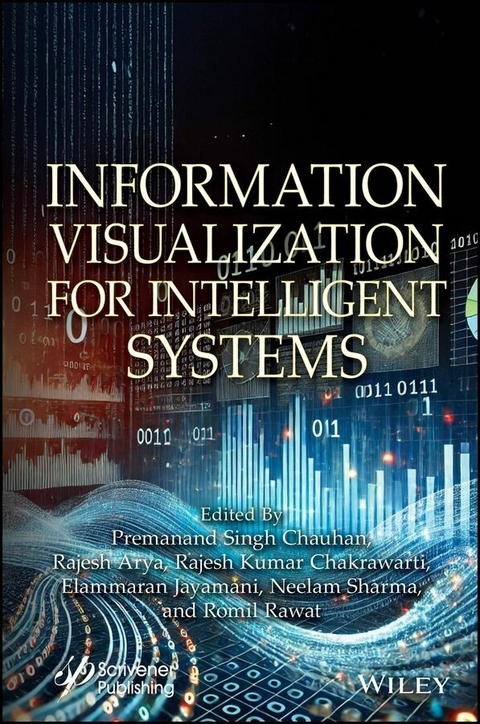
Information Visualization for Intelligent Systems (eBook)
567 Seiten
Wiley-Scrivener (Verlag)
978-1-394-30580-3 (ISBN)
Information Visualization for Intelligent Systems provides readers with essential insights into cutting-edge advancements in machine intelligence and explores how these transformative technologies are revolutionizing data analysis and decision-making in an increasingly complex world.
The book explores advanced computing, or machine intelligence, which enables technology-machines, devices, or algorithms-to interact intelligently with their surroundings, make decisions, and take actions to achieve objectives. Unlike natural human intelligence, artificial intelligence (AI) is demonstrated by machines.
Modern advancements in high-speed computing drive paradigm shifts, enabling complex machine intelligence systems and novel cyber systems that utilize data to perform specific tasks. While standalone cyber systems are common, integrating multiple systems into cohesive, intelligent structures interacting deeply with physical systems remains underexplored and primarily philosophical in existing literature.
These technological breakthroughs have revolutionized data generation, cloud storage, global information exchange, and rapid computing. For example, machine intelligence models analyze video surveillance to identify threats, support early infection detection in healthcare, and enhance chemical industry processes. While promising, these advancements remain in their infancy, offering significant potential for further development.
Premanand Singh Chauhan, PhD, is a director at the Sushila Devi Bansal College of Technology, Indore, India with seven years of industry experience and 20 years of teaching experience. He has edited one book, authored two books and 55 research articles, and has published three patents, one of which was granted. He is the editor of the proceedings of many reputed international conferences, technical adviser for many industries working in the field of manufacturing, and also a member of many professional bodies.
Rajesh Arya, PhD, is a principal at the Sushila Devi Bansal College of Engineering, Indore, India. He has more than 15 years of experience teaching courses related to electrical and computer engineering. He has published more than 45 research papers in the journals and conferences of repute publishers and is an Associate Member of the Institution of Engineers.
Rajesh Kumar Chakrawarti, PhD, is a professor and dean at the Department of Computer Science and Engineering/Information Technology, Sushila Devi Bansal College, Indore, India with over 21 years of experience in academia and industry. He is actively involved in teaching courses at both the undergraduate and postgraduate levels and is eagerly involved in teaching, training, research and development, and department, institution, and university development activities. He has organized and attended over 100 seminars, workshops, conferences, and certifications and has presented and published over 100 research papers, chapters in books, and abstracts in national and international conferences and journals.
Elammaran Jayamani, PhD, is an associate professor in the Mechanical Engineering program in the Faculty of Engineering, Computing, and Science at the Swinburne University of Technology, Sarawak Campus. Dr. Elammaran has been a creative educator for over 23 years, promoting sustainable materials research and development and is well-versed in training and mentoring students, research scholars, and educators. He is a member of the Institution of Mechanical Engineers as a Chartered Engineer.
Neelam Sharma, PhD, is an associate professor and the head of Electronics and Communication Engineering at Sushila Devi Bansal College of Technology, Indore, India with over 18 years of teaching experience. She has been published in various SCI and Scopus journals and IEEE conferences and is a life member of the International Society for Technology in Education.
Romil Rawat has attended several research programs and received research grants from the United States, Germany, Italy, and the United Kingdom. He has chaired international conferences and hosted several research events, in addition to publishing several research patents. His research interests include cyber security, Internet of Things, dark web crime analysis and investigation techniques, and working towards tracing illicit anonymous contents of cyber terrorism and criminal activities.
Information Visualization for Intelligent Systems provides readers with essential insights into cutting-edge advancements in machine intelligence and explores how these transformative technologies are revolutionizing data analysis and decision-making in an increasingly complex world. The book explores advanced computing, or machine intelligence, which enables technology machines, devices, or algorithms to interact intelligently with their surroundings, make decisions, and take actions to achieve objectives. Unlike natural human intelligence, artificial intelligence (AI) is demonstrated by machines. Modern advancements in high-speed computing drive paradigm shifts, enabling complex machine intelligence systems and novel cyber systems that utilize data to perform specific tasks. While standalone cyber systems are common, integrating multiple systems into cohesive, intelligent structures interacting deeply with physical systems remains underexplored and primarily philosophical in existing literature. These technological breakthroughs have revolutionized data generation, cloud storage, global information exchange, and rapid computing. For example, machine intelligence models analyze video surveillance to identify threats, support early infection detection in healthcare, and enhance chemical industry processes. While promising, these advancements remain in their infancy, offering significant potential for further development.
| Erscheint lt. Verlag | 5.3.2025 |
|---|---|
| Sprache | englisch |
| Themenwelt | Informatik ► Office Programme ► Outlook |
| ISBN-10 | 1-394-30580-X / 139430580X |
| ISBN-13 | 978-1-394-30580-3 / 9781394305803 |
| Informationen gemäß Produktsicherheitsverordnung (GPSR) | |
| Haben Sie eine Frage zum Produkt? |
 PDF (Adobe DRM)
Kopierschutz: Adobe-DRM
Adobe-DRM ist ein Kopierschutz, der das eBook vor Mißbrauch schützen soll. Dabei wird das eBook bereits beim Download auf Ihre persönliche Adobe-ID autorisiert. Lesen können Sie das eBook dann nur auf den Geräten, welche ebenfalls auf Ihre Adobe-ID registriert sind.
Details zum Adobe-DRM
Dateiformat: PDF (Portable Document Format)
Mit einem festen Seitenlayout eignet sich die PDF besonders für Fachbücher mit Spalten, Tabellen und Abbildungen. Eine PDF kann auf fast allen Geräten angezeigt werden, ist aber für kleine Displays (Smartphone, eReader) nur eingeschränkt geeignet.
Systemvoraussetzungen:
PC/Mac: Mit einem PC oder Mac können Sie dieses eBook lesen. Sie benötigen eine
eReader: Dieses eBook kann mit (fast) allen eBook-Readern gelesen werden. Mit dem amazon-Kindle ist es aber nicht kompatibel.
Smartphone/Tablet: Egal ob Apple oder Android, dieses eBook können Sie lesen. Sie benötigen eine
Geräteliste und zusätzliche Hinweise
Buying eBooks from abroad
For tax law reasons we can sell eBooks just within Germany and Switzerland. Regrettably we cannot fulfill eBook-orders from other countries.
aus dem Bereich