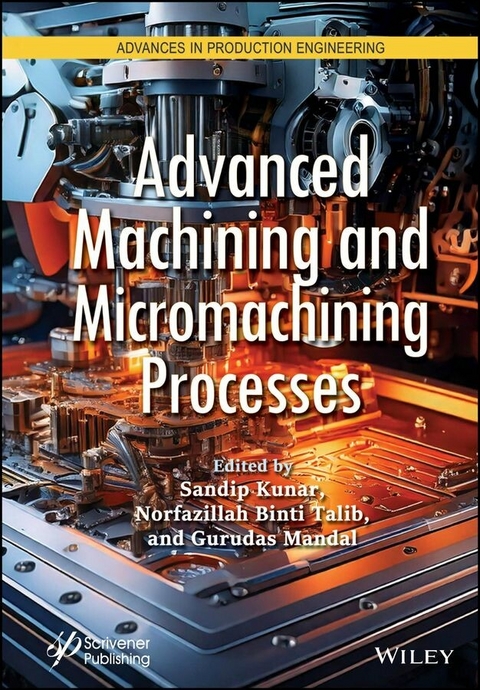
Advanced Machining and Micromachining Processes (eBook)
1041 Seiten
Wiley-Scrivener (Verlag)
978-1-394-30170-6 (ISBN)
This book offers a comprehensive overview of the fundamentals, principles, and latest innovations in advanced machine and micromachining processes.
Businesses are continually seeking innovative advanced machining and micromachining techniques that optimize efficiency while reducing environmental harm. This growing competitive pressure has spurred the development of sophisticated design and production concepts. Modern machining and micromachining methods have evolved to accommodate the use of newer materials across diverse applications, while ensuring precise machining accuracy.
The primary aim of this book is to explore and analyze various approaches in modern machining and micromachining processes, with a focus on their effectiveness and application in successful product development. Consequently, the book emphasizes an industrial engineering perspective.
This book covers a range of advanced machining and micromachining processes that can be utilized by the manufacturing industry to enhance productivity and contribute to socioeconomic development. Additionally, it highlights ongoing research projects in the field and provides insights into the latest advancements in advanced machining and micromachining techniques.
The 31 chapters in the book cover the following subjects: abrasive jet machining; water jet machining; principles of electro discharge machining; wire-electro discharge machining; laser beam machining; plasma arc machining; ion beam machining; electrochemical machining; ultrasonic machining; electron beam machining; electrochemical grinding; photochemical machining process; abrasive-assisted micromachining; abrasive water jet micromachining; electro discharge machining; electrochemical micromachining; ultrasonic micromachining; laser surface modification techniques; ion beam processes; glass workpiece micromachining using electrochemical discharge machining; abrasive water jet machining; ultrasonic vibration-assisted micromachining; laser micromachining's role in improving tool wear resistance; stress; and surface roughness in high-strength alloys; abrasive flow finishing process; elastic emission machining; magnetic abrasive finishing process; genetic algorithm for multi-objective optimization in machining; machining of Titanium Grade-2 and P-20 tool steel; and wet bulk micromachining in MEMS fabrication.
Audience
The book is intended for a wide audience including mechanical, manufacturing, biomedical, and industrial engineers and R&D researchers involved in advanced machining and micromachining technology.
Sandip Kunar, PhD, is an assistant professor in the Department of Mechanical Engineering, Aditya Engineering College, A.P., India. He has published more than 50 research papers in various reputed international journals, national and international conference proceedings, 16 book chapters, and 10 books as well as two patents. His research interests include non-conventional machining processes, micromachining processes, advanced manufacturing technology, and industrial engineering.
Norfazillah Binti Talib, PhD, is a senior lecturer in the Department of Manufacturing Engineering, Faculty of Mechanical and Manufacturing Engineering, University Tun Hussien Onn Malaysia, Parit Raja, Johar, Malaysia. She has also been appointed the Head of the Precision Machining Research Center. She has published numerous papers in reputable journals, book chapters, and proceedings from conferences and has filed one patent. Her research interests include sustainable manufacturing processes, bio-based lubricants, and tribology.
Gurudas Mandal, PhD, is an assistant professor in the Department of Metallurgical Engineering, Kazi Nazrul University, West Bengal, India. He has about 25 technical research publications in international journals, eight conference proceedings and 10 book chapters, as well as one patent.
This book offers a comprehensive overview of the fundamentals, principles, and latest innovations in advanced machine and micromachining processes. Businesses are continually seeking innovative advanced machining and micromachining techniques that optimize efficiency while reducing environmental harm. This growing competitive pressure has spurred the development of sophisticated design and production concepts. Modern machining and micromachining methods have evolved to accommodate the use of newer materials across diverse applications, while ensuring precise machining accuracy. The primary aim of this book is to explore and analyze various approaches in modern machining and micromachining processes, with a focus on their effectiveness and application in successful product development. Consequently, the book emphasizes an industrial engineering perspective. This book covers a range of advanced machining and micromachining processes that can be utilized by the manufacturing industry to enhance productivity and contribute to socioeconomic development. Additionally, it highlights ongoing research projects in the field and provides insights into the latest advancements in advanced machining and micromachining techniques. The 31 chapters in the book cover the following subjects: abrasive jet machining; water jet machining; principles of electro discharge machining; wire-electro discharge machining; laser beam machining; plasma arc machining; ion beam machining; electrochemical machining; ultrasonic machining; electron beam machining; electrochemical grinding; photochemical machining process; abrasive-assisted micromachining; abrasive water jet micromachining; electro discharge machining; electrochemical micromachining; ultrasonic micromachining; laser surface modification techniques; ion beam processes; glass workpiece micromachining using electrochemical discharge machining; abrasive water jet machining; ultrasonic vibration-assisted micromachining; laser micromachining s role in improving tool wear resistance; stress; and surface roughness in high-strength alloys; abrasive flow finishing process; elastic emission machining; magnetic abrasive finishing process; genetic algorithm for multi-objective optimization in machining; machining of Titanium Grade-2 and P-20 tool steel; and wet bulk micromachining in MEMS fabrication. Audience The book is intended for a wide audience including mechanical, manufacturing, biomedical, and industrial engineers and R&D researchers involved in advanced machining and micromachining technology.
1
Overview of Advanced Machining and Micromachining Processes
M. Abdur Rahman1*, Serajul Haque1 and N. Sri Rangarajalu2
1Department of Mechanical Engineering, B. S. Abdur Rahman Crescent Institute of Science & Technology, Chennai, India
2Department of Production Technology, MIT Campus, Anna University, Chennai, India
Abstract
Motivated by an insatiable pursuit of precision and efficiency, the manufacturing landscape has undergone a transformative evolution driven by advanced and micromachining processes. This paradigm shift is rooted in the imperative to fabricate intricate components for diverse industries, necessitating unprecedented accuracy and intricacy. Micromachining, operating on a scale often measured in micrometers, thrives on specialized tools like laser ablation, micro-electro-discharge machining (micro-EDM), and photochemical machining, surpassing the constraints of conventional methodologies when dealing with minute features. The symbiosis between micromachining and advanced manufacturing processes catalyzes the development of micro-electromechanical systems, sensors, and biomedical devices, pushing technological boundaries. The synergy between micromachining and advanced manufacturing processes is a powerful force, paving the way for micro-electromechanical systems, sensors, and biomedical devices, pushing the frontiers of technology. This collaboration between industries striving for smaller, lighter, and more efficient products will undoubtedly shape the future of precision manufacturing. Beyond technical prowess, advanced and micromachining processes signify a philosophical shift in manufacturing, moving from mass production to tailored components that cater to specific and unique requirements. This comprehensive exploration delves into the heart of this transformative journey, analyzing the various processes that define precision and innovation. Each chapter dissects a distinct technique, revealing the underlying mechanisms propelling its capabilities and shedding light on recent research endeavors, providing a glimpse into the future of micromachining and its potential to redefine the manufacturing landscape. More than a technical treatise, this work invites readers to explore the frontiers of precision manufacturing, where human ingenuity and technological prowess converge to create possibilities once confined to the realm of imagination.
Keywords: Micromachining, advanced manufacturing, precision, efficiency
1.1 Introduction
The manufacturing sector has evolved significantly, propelled by a continuous quest for precision, efficiency, and innovation. This evolution is deeply rooted in the need to meet the ever-increasing demands of diverse industries, from aerospace to medical devices, where intricate components play a pivotal role in overall system performance. At the heart of this transformation lies the unyielding pursuit of precision and efficiency. As industries demand components with tighter tolerances and enhanced performance, traditional machining methods have given way to advanced machining and micromachining processes, heralding a new era in manufacturing. The emergence of advanced machining and micromachining processes stands as a testament to human ingenuity and technological progress. These cutting-edge technologies have not only redefined the possibilities within the manufacturing realm but have also opened doors to novel applications, pushing the boundaries of what was once deemed achievable [1].
The impact of these technologies on the manufacturing industry is revolutionary. The ability to produce components with unprecedented accuracy and intricacy has far-reaching implications, from improving the efficiency of existing systems to unlocking the potential for entirely new designs and functionalities. Micromachining and advanced manufacturing processes represent cutting-edge technologies that have revolutionized precision manufacturing on a miniature scale. In the realm of micromachining, precision is paramount as it involves the fabrication of extremely small components with dimensions typically ranging from a few micrometers to a few millimeters. This field has gained prominence due to the increasing demand for miniaturized devices in various industries such as electronics, medical, aerospace, and telecommunications [2].
At the heart of micromachining lies the ability to fabricate intricate structures with high accuracy. Traditional machining techniques often face limitations when dealing with features on a microscale. In contrast, micromachining employs specialized tools, techniques, and technologies tailored to handle the challenges posed by miniaturization. These processes include precision machining, laser ablation, micro-electro-discharge machining (micro-EDM), and photochemical machining, among others. The integration of micromachining and advanced manufacturing processes has far-reaching implications. It facilitates the development of micro-electromechanical systems (MEMS), sensors, biomedical devices, and other intricate components critical to modern technology. As industries continue to demand smaller, lighter, and more efficient products, the synergy between micromachining and advanced manufacturing will undoubtedly play a pivotal role in shaping the future of precision manufacturing. This introduction merely scratches the surface of the vast landscape of possibilities that emerge at the intersection of micromachining and advanced manufacturing processes [3, 4].
One of the hallmark features of advanced machining and micromachining processes is their ability to achieve levels of accuracy that were once considered unattainable. This newfound precision is a game-changer for industries where even the slightest deviation can have significant consequences. Intricacy in component design has reached unprecedented levels, thanks to the capabilities of these processes. Microscale features, intricate geometries, and complex structures are now achievable with a level of detail that was once inconceivable, opening avenues for innovation in product design and functionality. The advent of advanced machining and micromachining processes represents more than just a technological shift. It signifies a paradigm shift in the philosophy of manufacturing itself. The focus is no longer solely on mass production but on the ability to tailor components with precision, catering to specific and often unique requirements.
In recent years, advancements in advanced machining and micromachining processes have been instrumental in pushing the boundaries of precision manufacturing. These breakthroughs have not only enhanced the capabilities of existing technologies but have also given rise to novel methodologies, shaping the future of the manufacturing industry. For example, laser machining can achieve ultimate precision and is a promising approach for advanced materials and structures, with applications from nanometers to atomic scales [5].
Recent breakthroughs in micro-milling focus on the development of ultra-small cutting tools with enhanced durability and wear resistance. Furthermore, advancements in precision control systems enable real-time adjustments, ensuring consistent and accurate micromachining even in dynamic conditions. In laser micromachining, advancements include the integration of ultrafast laser systems, allowing for precise ablation with minimal thermal effects. The use of novel beam shaping techniques and adaptive optics enhances the versatility of laser micromachining for a wider range of materials. Micro-EDM is a useful process for manufacturing micro components and parts in difficult-to-machine materials, but improvements in material removal rate, surface finish, tool wear, and dimensional accuracy are needed. Micro-EDM has seen improvements in electrode materials and tool design, enabling higher machining accuracy and reduced tool wear. Additionally, advancements in real-time monitoring systems provide enhanced control over the micromachining process, ensuring optimal results [6, 7].
Embarking on the exploration of advanced and micromachining processes, each subsequent chapter is dedicated to unraveling the intricacies, applications, and advancements that characterize these cutting-edge technologies. The journey through these chapters spans from foundational principles to the cutting edge of research and development, presenting a comprehensive panorama that delineates the future trajectory of manufacturing.
This book navigates diverse technological realms, systematically analyzing processes emblematic of precision and innovation. Each chapter addresses a distinct advanced or micromachining process, methodically uncovering layers to reveal the underlying mechanisms propelling these techniques. Furthermore, the book illuminates recent research endeavors within the micromachining domain, providing insights into contemporary developments in the field.
1.1.1 Classification of Advanced Machining and Micromachining Processes
Advanced machining and micromachining processes encompass a diverse array of techniques, each tailored to specific applications and materials. Classifying these processes helps provide a systematic understanding of their underlying principles and applications. The classification can be broadly categorized into two main groups: traditional advanced machining and emerging micromachining processes.
1.1.1.1 Mechanical Machining
Mechanical machining refers to the process of using mechanical tools and machines to shape, cut, or form materials into a desired shape or size. This process is commonly used in...
| Erscheint lt. Verlag | 5.3.2025 |
|---|---|
| Reihe/Serie | Advances in Production Engineering |
| Sprache | englisch |
| Themenwelt | Informatik ► Theorie / Studium ► Künstliche Intelligenz / Robotik |
| Technik ► Maschinenbau | |
| Schlagworte | Abrasive Assisted Machining • Abrasive jet machining • Abrasive Water Jet Micromachining • Electrical Discharge Machining • Electrical Discharge Micromachining • Electrochemical grinding • electrochemical machining • electrochemical micromachining • Focused ion beam machining • Laser Beam Machining • Photochemical machining • Plasma Arch Machining • Water Jet Machining • Wire-Electrical Discharge Machining |
| ISBN-10 | 1-394-30170-7 / 1394301707 |
| ISBN-13 | 978-1-394-30170-6 / 9781394301706 |
| Informationen gemäß Produktsicherheitsverordnung (GPSR) | |
| Haben Sie eine Frage zum Produkt? |
 EPUB (Adobe DRM)
Kopierschutz: Adobe-DRM
Adobe-DRM ist ein Kopierschutz, der das eBook vor Mißbrauch schützen soll. Dabei wird das eBook bereits beim Download auf Ihre persönliche Adobe-ID autorisiert. Lesen können Sie das eBook dann nur auf den Geräten, welche ebenfalls auf Ihre Adobe-ID registriert sind.
Details zum Adobe-DRM
Dateiformat: EPUB (Electronic Publication)
EPUB ist ein offener Standard für eBooks und eignet sich besonders zur Darstellung von Belletristik und Sachbüchern. Der Fließtext wird dynamisch an die Display- und Schriftgröße angepasst. Auch für mobile Lesegeräte ist EPUB daher gut geeignet.
Systemvoraussetzungen:
PC/Mac: Mit einem PC oder Mac können Sie dieses eBook lesen. Sie benötigen eine
eReader: Dieses eBook kann mit (fast) allen eBook-Readern gelesen werden. Mit dem amazon-Kindle ist es aber nicht kompatibel.
Smartphone/Tablet: Egal ob Apple oder Android, dieses eBook können Sie lesen. Sie benötigen eine
Geräteliste und zusätzliche Hinweise
Buying eBooks from abroad
For tax law reasons we can sell eBooks just within Germany and Switzerland. Regrettably we cannot fulfill eBook-orders from other countries.
aus dem Bereich