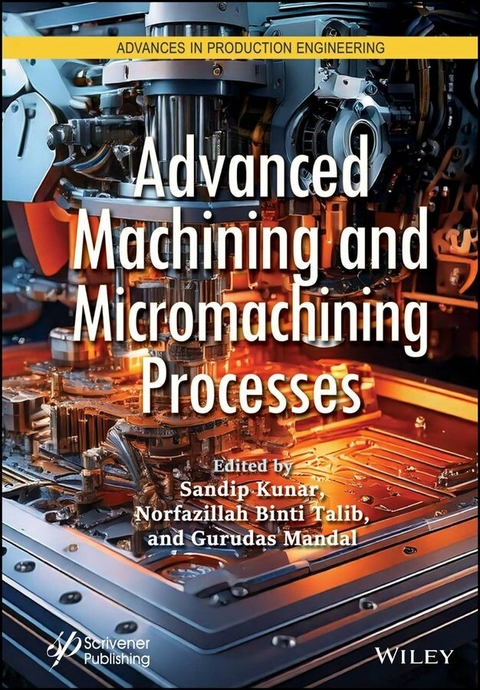
Advanced Machining and Micromachining Processes (eBook)
589 Seiten
Wiley-Scrivener (Verlag)
978-1-394-30172-0 (ISBN)
This book offers a comprehensive overview of the fundamentals, principles, and latest innovations in advanced machine and micromachining processes.
Businesses are continually seeking innovative advanced machining and micromachining techniques that optimize efficiency while reducing environmental harm. This growing competitive pressure has spurred the development of sophisticated design and production concepts. Modern machining and micromachining methods have evolved to accommodate the use of newer materials across diverse applications, while ensuring precise machining accuracy.
The primary aim of this book is to explore and analyze various approaches in modern machining and micromachining processes, with a focus on their effectiveness and application in successful product development. Consequently, the book emphasizes an industrial engineering perspective.
This book covers a range of advanced machining and micromachining processes that can be utilized by the manufacturing industry to enhance productivity and contribute to socioeconomic development. Additionally, it highlights ongoing research projects in the field and provides insights into the latest advancements in advanced machining and micromachining techniques.
The 31 chapters in the book cover the following subjects: abrasive jet machining; water jet machining; principles of electro discharge machining; wire-electro discharge machining; laser beam machining; plasma arc machining; ion beam machining; electrochemical machining; ultrasonic machining; electron beam machining; electrochemical grinding; photochemical machining process; abrasive-assisted micromachining; abrasive water jet micromachining; electro discharge machining; electrochemical micromachining; ultrasonic micromachining; laser surface modification techniques; ion beam processes; glass workpiece micromachining using electrochemical discharge machining; abrasive water jet machining; ultrasonic vibration-assisted micromachining; laser micromachining's role in improving tool wear resistance; stress; and surface roughness in high-strength alloys; abrasive flow finishing process; elastic emission machining; magnetic abrasive finishing process; genetic algorithm for multi-objective optimization in machining; machining of Titanium Grade-2 and P-20 tool steel; and wet bulk micromachining in MEMS fabrication.
Audience
The book is intended for a wide audience including mechanical, manufacturing, biomedical, and industrial engineers and R&D researchers involved in advanced machining and micromachining technology.
Sandip Kunar, PhD, is an assistant professor in the Department of Mechanical Engineering, Aditya Engineering College, A.P., India. He has published more than 50 research papers in various reputed international journals, national and international conference proceedings, 16 book chapters, and 10 books as well as two patents. His research interests include non-conventional machining processes, micromachining processes, advanced manufacturing technology, and industrial engineering.
Norfazillah Binti Talib, PhD, is a senior lecturer in the Department of Manufacturing Engineering, Faculty of Mechanical and Manufacturing Engineering, University Tun Hussien Onn Malaysia, Parit Raja, Johar, Malaysia. She has also been appointed the Head of the Precision Machining Research Center. She has published numerous papers in reputable journals, book chapters, and proceedings from conferences and has filed one patent. Her research interests include sustainable manufacturing processes, bio-based lubricants, and tribology.
Gurudas Mandal, PhD, is an assistant professor in the Department of Metallurgical Engineering, Kazi Nazrul University, West Bengal, India. He has about 25 technical research publications in international journals, eight conference proceedings and 10 book chapters, as well as one patent.
This book offers a comprehensive overview of the fundamentals, principles, and latest innovations in advanced machine and micromachining processes. Businesses are continually seeking innovative advanced machining and micromachining techniques that optimize efficiency while reducing environmental harm. This growing competitive pressure has spurred the development of sophisticated design and production concepts. Modern machining and micromachining methods have evolved to accommodate the use of newer materials across diverse applications, while ensuring precise machining accuracy. The primary aim of this book is to explore and analyze various approaches in modern machining and micromachining processes, with a focus on their effectiveness and application in successful product development. Consequently, the book emphasizes an industrial engineering perspective. This book covers a range of advanced machining and micromachining processes that can be utilized by the manufacturing industry to enhance productivity and contribute to socioeconomic development. Additionally, it highlights ongoing research projects in the field and provides insights into the latest advancements in advanced machining and micromachining techniques. The 31 chapters in the book cover the following subjects: abrasive jet machining; water jet machining; principles of electro discharge machining; wire-electro discharge machining; laser beam machining; plasma arc machining; ion beam machining; electrochemical machining; ultrasonic machining; electron beam machining; electrochemical grinding; photochemical machining process; abrasive-assisted micromachining; abrasive water jet micromachining; electro discharge machining; electrochemical micromachining; ultrasonic micromachining; laser surface modification techniques; ion beam processes; glass workpiece micromachining using electrochemical discharge machining; abrasive water jet machining; ultrasonic vibration-assisted micromachining; laser micromachining s role in improving tool wear resistance; stress; and surface roughness in high-strength alloys; abrasive flow finishing process; elastic emission machining; magnetic abrasive finishing process; genetic algorithm for multi-objective optimization in machining; machining of Titanium Grade-2 and P-20 tool steel; and wet bulk micromachining in MEMS fabrication. Audience The book is intended for a wide audience including mechanical, manufacturing, biomedical, and industrial engineers and R&D researchers involved in advanced machining and micromachining technology.
| Erscheint lt. Verlag | 21.2.2025 |
|---|---|
| Reihe/Serie | Advances in Production Engineering |
| Sprache | englisch |
| Themenwelt | Informatik ► Theorie / Studium ► Künstliche Intelligenz / Robotik |
| Technik ► Maschinenbau | |
| Schlagworte | Abrasive Assisted Machining • Abrasive jet machining • Abrasive Water Jet Micromachining • Electrical Discharge Machining • Electrical Discharge Micromachining • Electrochemical grinding • electrochemical machining • electrochemical micromachining • Focused ion beam machining • Laser Beam Machining • Photochemical machining • Plasma Arch Machining • Water Jet Machining • Wire-Electrical Discharge Machining |
| ISBN-10 | 1-394-30172-3 / 1394301723 |
| ISBN-13 | 978-1-394-30172-0 / 9781394301720 |
| Informationen gemäß Produktsicherheitsverordnung (GPSR) | |
| Haben Sie eine Frage zum Produkt? |
 PDF (Adobe DRM)
Kopierschutz: Adobe-DRM
Adobe-DRM ist ein Kopierschutz, der das eBook vor Mißbrauch schützen soll. Dabei wird das eBook bereits beim Download auf Ihre persönliche Adobe-ID autorisiert. Lesen können Sie das eBook dann nur auf den Geräten, welche ebenfalls auf Ihre Adobe-ID registriert sind.
Details zum Adobe-DRM
Dateiformat: PDF (Portable Document Format)
Mit einem festen Seitenlayout eignet sich die PDF besonders für Fachbücher mit Spalten, Tabellen und Abbildungen. Eine PDF kann auf fast allen Geräten angezeigt werden, ist aber für kleine Displays (Smartphone, eReader) nur eingeschränkt geeignet.
Systemvoraussetzungen:
PC/Mac: Mit einem PC oder Mac können Sie dieses eBook lesen. Sie benötigen eine
eReader: Dieses eBook kann mit (fast) allen eBook-Readern gelesen werden. Mit dem amazon-Kindle ist es aber nicht kompatibel.
Smartphone/Tablet: Egal ob Apple oder Android, dieses eBook können Sie lesen. Sie benötigen eine
Geräteliste und zusätzliche Hinweise
Buying eBooks from abroad
For tax law reasons we can sell eBooks just within Germany and Switzerland. Regrettably we cannot fulfill eBook-orders from other countries.
aus dem Bereich