Design and Forecasting Models for Disease Management (eBook)
325 Seiten
Wiley-Scrivener (Verlag)
978-1-394-23406-6 (ISBN)

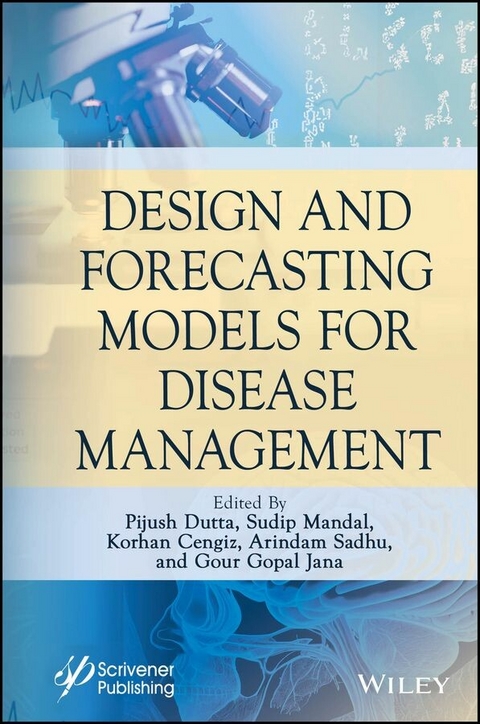
The book provides an essential overview of AI techniques in disease management and how these computational methods can lead to further innovations in healthcare.
Design and Forecasting Models for Disease Management is a resourceful volume of 13 chapters that elaborates on computational methods and how AI techniques can aid in smart disease management. It contains several statistical and AI techniques that can be used to acquire data on many different diseases. The main objective of this book is to demonstrate how AI techniques work for early disease detection and forecasting useful information for medical experts. As such, this volume intends to serve as a resource to elicit and elaborate on possible intelligent mechanisms for helping detect early signs of diseases. Additionally, the book examines numerous machine learning and data analysis techniques in the biomedical field that are used for detecting and forecasting disease management at the cellular level. It discusses various applications of image segmentation, data analysis techniques, and hybrid machine learning techniques for illnesses, and encompasses modeling, prediction, and diagnosis of disease data.
Audience
Researchers, engineers and graduate students in the fields of computational biology, information technology, bioinformatics, and epidemiology.
Pijush Dutta, PhD, is an assistant professor and head of the Department of Electronics and Communication Engineering at Greater Kolkata College of Engineering and Management, West Bengal, India, with over 11 years of teaching and over seven years of research experience. He has published eight books, as well as 14 patents and over 100 research articles in national and international journals and conferences. His research interests include sensors and transducers, nonlinear process control systems, the Internet of Things (IoT), and machine and deep learning.
Sudip Mandal, PhD, is an assistant professor in the Electronics and Communication Engineering Department at Jalpaiguri Government Engineering College, India. He has over 50 publications in national and international peer-reviewed journals and conferences, as well as two Indian patents and two books. He is a member of the Institute of Electrical and Electronics Engineers' Computational Intelligence Society.
Korhan Cengiz, PhD, is an associate professor in the Department of Computer Engineering at Istinye University, Istanbul, Turkey. He has published over 40 articles in international peer-reviewed journals, five international patents, and edited over ten books. His research interests include wireless sensor networks, wireless communications, and statistical signal processing.
Arindam Sadhu, PhD, is an assistant professor in the Electronics and Communication Engineering Department at Swami Vivekananda University, West Bengal, India, with over five years of teaching and over three years of research experience. He has published two international patents and over ten articles in national and international journals and conferences. His research interests include post-complementary metal-oxide-semiconductor transistors, quantum computing, and quantum dot cellular automata.
Gour Gopal Jana is an assistant professor in the Electronics and Communication Engineering Department at Greater Kolkata College of Engineering and Management, West Bengal, India, with over 13 years of teaching and over three years of research experience. He has published two international patents and over ten research articles in national and international journals and conference proceedings. His research interests include metal thin film sensors, biosensors, nanobiosensors, and nanocomposites.
The book provides an essential overview of AI techniques in disease management and how these computational methods can lead to further innovations in healthcare. Design and Forecasting Models for Disease Management is a resourceful volume of 13 chapters that elaborates on computational methods and how AI techniques can aid in smart disease management. It contains several statistical and AI techniques that can be used to acquire data on many different diseases. The main objective of this book is to demonstrate how AI techniques work for early disease detection and forecasting useful information for medical experts. As such, this volume intends to serve as a resource to elicit and elaborate on possible intelligent mechanisms for helping detect early signs of diseases. Additionally, the book examines numerous machine learning and data analysis techniques in the biomedical field that are used for detecting and forecasting disease management at the cellular level. It discusses various applications of image segmentation, data analysis techniques, and hybrid machine learning techniques for illnesses, and encompasses modeling, prediction, and diagnosis of disease data. Audience Researchers, engineers and graduate students in the fields of computational biology, information technology, bioinformatics, and epidemiology.
| Erscheint lt. Verlag | 24.2.2025 |
|---|---|
| Sprache | englisch |
| Themenwelt | Mathematik / Informatik ► Informatik ► Theorie / Studium |
| ISBN-10 | 1-394-23406-6 / 1394234066 |
| ISBN-13 | 978-1-394-23406-6 / 9781394234066 |
| Informationen gemäß Produktsicherheitsverordnung (GPSR) | |
| Haben Sie eine Frage zum Produkt? |
 PDF (Adobe DRM)
Kopierschutz: Adobe-DRM
Adobe-DRM ist ein Kopierschutz, der das eBook vor Mißbrauch schützen soll. Dabei wird das eBook bereits beim Download auf Ihre persönliche Adobe-ID autorisiert. Lesen können Sie das eBook dann nur auf den Geräten, welche ebenfalls auf Ihre Adobe-ID registriert sind.
Details zum Adobe-DRM
Dateiformat: PDF (Portable Document Format)
Mit einem festen Seitenlayout eignet sich die PDF besonders für Fachbücher mit Spalten, Tabellen und Abbildungen. Eine PDF kann auf fast allen Geräten angezeigt werden, ist aber für kleine Displays (Smartphone, eReader) nur eingeschränkt geeignet.
Systemvoraussetzungen:
PC/Mac: Mit einem PC oder Mac können Sie dieses eBook lesen. Sie benötigen eine
eReader: Dieses eBook kann mit (fast) allen eBook-Readern gelesen werden. Mit dem amazon-Kindle ist es aber nicht kompatibel.
Smartphone/Tablet: Egal ob Apple oder Android, dieses eBook können Sie lesen. Sie benötigen eine
Geräteliste und zusätzliche Hinweise
Buying eBooks from abroad
For tax law reasons we can sell eBooks just within Germany and Switzerland. Regrettably we cannot fulfill eBook-orders from other countries.
aus dem Bereich