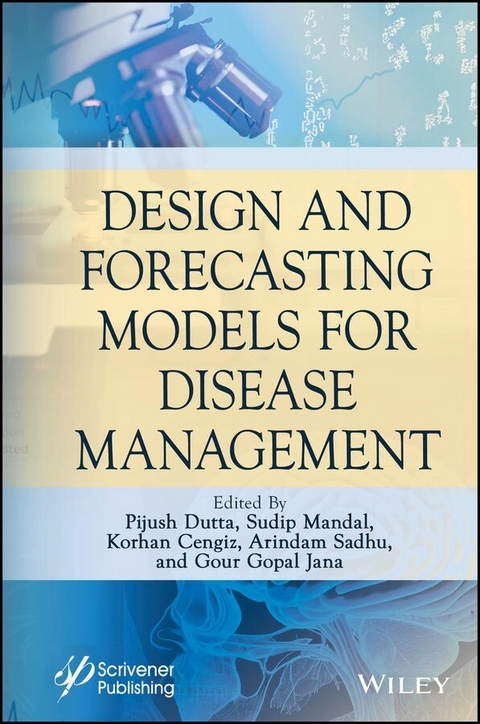
Design and Forecasting Models for Disease Management (eBook)
488 Seiten
Wiley-Scrivener (Verlag)
978-1-394-23405-9 (ISBN)
The book provides an essential overview of AI techniques in disease management and how these computational methods can lead to further innovations in healthcare.
Design and Forecasting Models for Disease Management is a resourceful volume of 13 chapters that elaborates on computational methods and how AI techniques can aid in smart disease management. It contains several statistical and AI techniques that can be used to acquire data on many different diseases. The main objective of this book is to demonstrate how AI techniques work for early disease detection and forecasting useful information for medical experts. As such, this volume intends to serve as a resource to elicit and elaborate on possible intelligent mechanisms for helping detect early signs of diseases. Additionally, the book examines numerous machine learning and data analysis techniques in the biomedical field that are used for detecting and forecasting disease management at the cellular level. It discusses various applications of image segmentation, data analysis techniques, and hybrid machine learning techniques for illnesses, and encompasses modeling, prediction, and diagnosis of disease data.
Audience
Researchers, engineers and graduate students in the fields of computational biology, information technology, bioinformatics, and epidemiology.
Pijush Dutta, PhD, is an assistant professor and head of the Department of Electronics and Communication Engineering at Greater Kolkata College of Engineering and Management, West Bengal, India, with over 11 years of teaching and over seven years of research experience. He has published eight books, as well as 14 patents and over 100 research articles in national and international journals and conferences. His research interests include sensors and transducers, nonlinear process control systems, the Internet of Things (IoT), and machine and deep learning.
Sudip Mandal, PhD, is an assistant professor in the Electronics and Communication Engineering Department at Jalpaiguri Government Engineering College, India. He has over 50 publications in national and international peer-reviewed journals and conferences, as well as two Indian patents and two books. He is a member of the Institute of Electrical and Electronics Engineers' Computational Intelligence Society.
Korhan Cengiz, PhD, is an associate professor in the Department of Computer Engineering at Istinye University, Istanbul, Turkey. He has published over 40 articles in international peer-reviewed journals, five international patents, and edited over ten books. His research interests include wireless sensor networks, wireless communications, and statistical signal processing.
Arindam Sadhu, PhD, is an assistant professor in the Electronics and Communication Engineering Department at Swami Vivekananda University, West Bengal, India, with over five years of teaching and over three years of research experience. He has published two international patents and over ten articles in national and international journals and conferences. His research interests include post-complementary metal-oxide-semiconductor transistors, quantum computing, and quantum dot cellular automata.
Gour Gopal Jana is an assistant professor in the Electronics and Communication Engineering Department at Greater Kolkata College of Engineering and Management, West Bengal, India, with over 13 years of teaching and over three years of research experience. He has published two international patents and over ten research articles in national and international journals and conference proceedings. His research interests include metal thin film sensors, biosensors, nanobiosensors, and nanocomposites.
The book provides an essential overview of AI techniques in disease management and how these computational methods can lead to further innovations in healthcare. Design and Forecasting Models for Disease Management is a resourceful volume of 13 chapters that elaborates on computational methods and how AI techniques can aid in smart disease management. It contains several statistical and AI techniques that can be used to acquire data on many different diseases. The main objective of this book is to demonstrate how AI techniques work for early disease detection and forecasting useful information for medical experts. As such, this volume intends to serve as a resource to elicit and elaborate on possible intelligent mechanisms for helping detect early signs of diseases. Additionally, the book examines numerous machine learning and data analysis techniques in the biomedical field that are used for detecting and forecasting disease management at the cellular level. It discusses various applications of image segmentation, data analysis techniques, and hybrid machine learning techniques for illnesses, and encompasses modeling, prediction, and diagnosis of disease data. Audience Researchers, engineers and graduate students in the fields of computational biology, information technology, bioinformatics, and epidemiology.
Preface
Overview
The novel application of artificial intelligence (AI) techniques, including machine learning, and deep learning analytics for design and forecasting models for disease management, is an emerging area in computer science, computation biology, information technology, bioinformatics, bioinformatics, and epidemiology. During the last 20 years, various AI approaches have been successfully applied in diverse fields. Medicine is one of the most active domains for AI techniques, since they facilitate model diagnostics information based on statistical data and reveal hidden dependencies between symptoms of major diseases.
The present capacity to develop, evaluate, manufacture, distribute, and administer effective medical countermeasures is inadequate to meet the burden of both recurrent and emerging outbreaks of infectious diseases. When such interventions are unavailable, public health measures and supportive clinical care remain the only feasible tools to slow an emerging outbreak. Decision-making under such circumstances can be greatly improved by the use of appropriate data and advanced analytics, such as infectious disease modeling. Furthermore, these analyses can guide decision-making when medical countermeasures become available, allowing them to be used more effectively.
Forecasting is an emerging analytical capability that has demonstrated value in recent outbreaks by informing policy and enabling real-time epidemic management decisions. Since healthcare is one of the key parameters in assessing the gross domestic product (GDP) of any country, it has become crucial to transition from traditional healthcare practices to a smart healthcare system. New healthcare technologies provide numerous opportunities to maximize disease recognition, analysis, and other natural variables that may affect it. Therefore, it is necessary to understand how computer-assisted technologies can best be utilized and adopted in the conversion to smart healthcare.
This book is an essential publication that widens the spectrum of computational methods that can aid in smart disease management. It contains several statistical and AI techniques that can be used to acquire data of many different diseases.
Objective
AI techniques for early disease detection and forecasting can reveal useful information to medical experts. As such, this volume intends to serve as a resource to elicit and elaborate on possible intelligent mechanisms for helping in the modeling, prediction, and diagnosis of the infected individuals, as well as providing means for detecting early signs of the disease. As such, this book examines numerous ML and DL techniques in the biomedical field that are used for detecting and forecasting disease management at the cellular level. It discusses applications for image segmentation, classification, neural networks, and a variety of computational intelligence approaches. It also discusses DL techniques for noise elimination and filtering of brain disease and hybrid ML techniques for diabetes prediction, mental illness, and stress level monitoring approaches.
We hope this book encourages an even wider adoption of these concepts and methods to assist physicians in problem solving and stimulates research that will lead to additional innovations in this area.
Organization
The volume comprises thirteen comprehensive chapters that encompass the modelling, prediction, and diagnosis of disease data. The arrangement of the chapters guides the reader from effective modelling of different disease data to detection and diagnosis. Chapter 1 presents an overview of how AI is transforming healthcare, as well as examples of consumer resistance to it, the economic implications of AI aversion, and ethical consideration and governance. Hand in hand with the emerging technology, healthcare systems are becoming progressively complex while constantly adapting to socioeconomic, epidemiological, and demographic changes, contributing to intricate global healthcare objectives.
Chapter 2 explores the use of integrated, and systematic moral cognitive therapy as a means of administering AI in the healthcare sector. The integration of AI in healthcare has the potential to improve prognosis with the help of an enormous database, but concerns have arisen regarding the vulnerability of a large section of end-users and the ethical implications of its use.
Social inequities, poverty lack of education, and risk of lifestyle diseases are mutually complementary to each other. An unhealthy lifestyle claims maximum responsibility among the factors of becoming a victim of lifestyle diseases. Zero preventive options other than lifestyle modification have enhanced the complication of management of such mass health issues.
Chapter 3 investigates a conceptual model that can bridge the gaps between healthcare, policy, and disease prevention. Such a model can assist with the recording and reporting of data to analyze the victim’s pattern of lifestyle adoption in place of the current healthcare alternative. Color Filter Array (CFA) data can be efficiently compressed using existing image compression algorithms such as JPEG. In addition, it tested the overall performance of CFA compression methods and demosaicing algorithm selection. These CFA compression methods exploit how CFA images do not contain repetitive data introduced by demosaicing.
Chapter 4 establishes a relationship between the discovery of different CFA compression techniques and describes how the choice of demosaicing algorithm affects visual quality. Using a simple bilinear demosaicing method, CFA image compression produces better images compared to the traditional compression scheme.
Through image processing techniques, digital images can be compressed, monitored, and transmitted effectively in remote settings. Digital images have a significant effect on modern society, science, technology, and art. Some techniques utilized in image enhancement include filtering, segmentation, object recognition, and image fusion. Image processing techniques have played a crucial role in advancing healthcare, particularly in the field of smart healthcare. Chapter 5 reviews image processing for medical applications using secure smart healthcare techniques. Furthermore, the various challenges that scientists must resolve because of disease are also discussed. Image enhancement techniques engage an essential and fundamental task and interpretability of biomedical images, enabling accurate diagnosis and analysis. This chapter provides a comprehensive overview of image enhancement techniques that are specifically tailored for biomedical images. Chapter 6 presents various image enhancement methods designed specifically for biomedical imaging. The chapter evaluates and contrasts the usefulness of various approaches and the extent to which they are beneficial to the biomedical field.
Disease progression prediction is essential for patient care and therapeutic development. Clinical, genetic, and molecular data related to Parkinson’s disease (PD) are collectively gathered by the Accelerating Medicines Partnership (AMP). Chapter 7 presents parameters linked to Parkinson’s disease progression and evaluates the appropriateness of the AMP PD dataset for predictive modeling through an Exploratory Data Analysis (EDA). The onset of the Covid-19 pandemic and the practice of social isolation have led to a rise in instances of mental health issues. Advances in machine learning in the present decade have created additional opportunities for detection and the identification of mental health issues. Chapter 8 investigates the automatic prediction and diagnosis of mental illness using machine learning algorithms.
One of the most common neurodegenerative illnesses that affect older adults and mostly impair memory in the brain is Alzheimer’s disease. Chapter 9 presents three models, efficient net B2, efficient net B3, and efficient net B4 architecture-based deep learning solutions for detecting and categorizing Alzheimer’s disease.
One of the biggest issues in today’s world is mental stress. Now that age is not taken into account when calculating stress levels, it makes no difference. Depression, heart attacks, and even suicide can result from extreme stress. Stress may have an impact on many facets of our existence, such as our behavior, emotions, and capacity for thought. Chapter 10 presents a machine-learning approach for measuring a person’s stress level using three crucial parameters: body temperature, step count, and humidity.
Diabetes Mellitus is commonly known as a metabolic issue in which the body cannot utilize insulin, store glucose for energy, or produce insulin. Diabetes patients can suffer various sicknesses that incorporate kidney disappointment, stroke, visual impairment, cardiovascular failures, and lower appendage removal. Chapter 11 presents a hybrid-based machine learning approach for identifying the potential chances of contracting diabetes diseases.
The increasing adoption of smart healthcare care and Internet of Things (IoT) devices has revolutionized the healthcare industries, offering enhanced patient monitoring, diagnosis, and treatment. However, the integration of these devices into the healthcare ecosystem raises serious concerns regarding the security and privacy of sensitive medical records. Chapter 12 contributes to strengthening the overall cyber security framework within the healthcare industry, ensuring patients’ trust in smart healthcare IoT devices and fostering the continued growth of remote patient monitoring.
The proliferation...
| Erscheint lt. Verlag | 7.3.2025 |
|---|---|
| Sprache | englisch |
| Themenwelt | Mathematik / Informatik ► Informatik ► Theorie / Studium |
| ISBN-10 | 1-394-23405-8 / 1394234058 |
| ISBN-13 | 978-1-394-23405-9 / 9781394234059 |
| Informationen gemäß Produktsicherheitsverordnung (GPSR) | |
| Haben Sie eine Frage zum Produkt? |
 EPUB (Adobe DRM)
Kopierschutz: Adobe-DRM
Adobe-DRM ist ein Kopierschutz, der das eBook vor Mißbrauch schützen soll. Dabei wird das eBook bereits beim Download auf Ihre persönliche Adobe-ID autorisiert. Lesen können Sie das eBook dann nur auf den Geräten, welche ebenfalls auf Ihre Adobe-ID registriert sind.
Details zum Adobe-DRM
Dateiformat: EPUB (Electronic Publication)
EPUB ist ein offener Standard für eBooks und eignet sich besonders zur Darstellung von Belletristik und Sachbüchern. Der Fließtext wird dynamisch an die Display- und Schriftgröße angepasst. Auch für mobile Lesegeräte ist EPUB daher gut geeignet.
Systemvoraussetzungen:
PC/Mac: Mit einem PC oder Mac können Sie dieses eBook lesen. Sie benötigen eine
eReader: Dieses eBook kann mit (fast) allen eBook-Readern gelesen werden. Mit dem amazon-Kindle ist es aber nicht kompatibel.
Smartphone/Tablet: Egal ob Apple oder Android, dieses eBook können Sie lesen. Sie benötigen eine
Geräteliste und zusätzliche Hinweise
Buying eBooks from abroad
For tax law reasons we can sell eBooks just within Germany and Switzerland. Regrettably we cannot fulfill eBook-orders from other countries.
aus dem Bereich