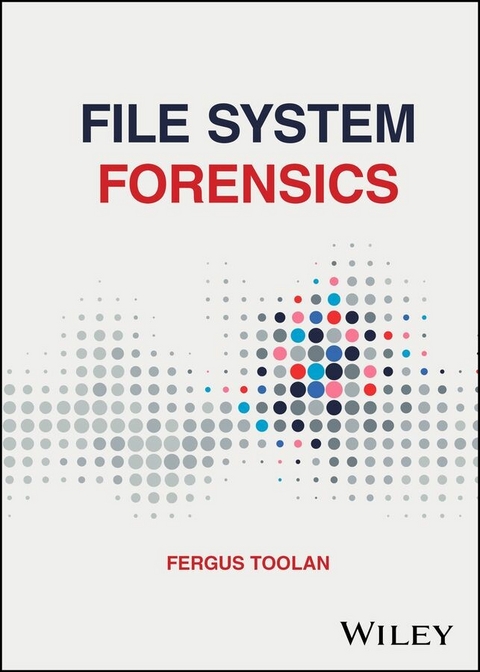
File System Forensics (eBook)
873 Seiten
Wiley (Verlag)
978-1-394-28980-6 (ISBN)
Comprehensive forensic reference explaining how file systems function and how forensic tools might work on particular file systems
File System Forensics delivers comprehensive knowledge of how file systems function and, more importantly, how digital forensic tools might function in relation to specific file systems. It provides a step-by-step approach for file content and metadata recovery to allow the reader to manually recreate and validate results from file system forensic tools.
The book includes a supporting website that shares all of the data (i.e. sample file systems) used for demonstration in the text and provides teaching resources such as instructor guides, extra material, and more.
Written by a highly qualified associate professor and consultant in the field, File System Forensics includes information on:
- The necessary concepts required to understand file system forensics for anyone with basic computing experience
- File systems specific to Windows, Linux, and macOS, with coverage of FAT, ExFAT, and NTFS
- Advanced topics such as deleted file recovery, fragmented file recovery, searching for particular files, links, checkpoints, snapshots, and RAID
- Issues facing file system forensics today and various issues that might evolve in the field in the coming years
File System Forensics is an essential, up-to-date reference on the subject for graduate and senior undergraduate students in digital forensics, as well as digital forensic analysts and other law enforcement professionals.
Fergus Toolan, PhD, is an Associate Professor in the Norwegian Police University College. He has published over 30 peer-reviewed papers and supervised a number of master's and PhD students throughout his career. Additionally, Dr. Toolan has provided consultancy services to a number of police services and other governmental organizations. He has taught a range of courses from introductory programming to advanced databases, and from computer hardware to discrete mathematics.
Comprehensive forensic reference explaining how file systems function and how forensic tools might work on particular file systems File System Forensics delivers comprehensive knowledge of how file systems function and, more importantly, how digital forensic tools might function in relation to specific file systems. It provides a step-by-step approach for file content and metadata recovery to allow the reader to manually recreate and validate results from file system forensic tools. The book includes a supporting website that shares all of the data (i.e. sample file systems) used for demonstration in the text and provides teaching resources such as instructor guides, extra material, and more. Written by a highly qualified associate professor and consultant in the field, File System Forensics includes information on: The necessary concepts required to understand file system forensics for anyone with basic computing experienceFile systems specific to Windows, Linux, and macOS, with coverage of FAT, ExFAT, and NTFSAdvanced topics such as deleted file recovery, fragmented file recovery, searching for particular files, links, checkpoints, snapshots, and RAIDIssues facing file system forensics today and various issues that might evolve in the field in the coming years File System Forensics is an essential, up-to-date reference on the subject for graduate and senior undergraduate students in digital forensics, as well as digital forensic analysts and other law enforcement professionals.
1
Introduction
In recent years the volume of digital evidence in criminal investigations has increased dramatically. Consider the situation at the turn of the century when the standard computer was the desktop computer a device that resided on, as the name suggests, the desk. The majority of crime scenes did not involve a computer. When computers were involved they were generally relevant only in specific case types such as hacking/cybercrime; child abuse material; and fraud. Returning to the present, there is digital evidence in almost every case!1 The majority of people carry smartphones on their person at all times. Cars contain navigation, entertainment and camera systems. Homes and businesses have digital CCTV systems that run continuously. People communicate through social media. The end result for investigators2 is that there has been a vast increase in the quantity of digital evidence encountered during investigation.
Almost all data in electronic storage media is held in files. A file is an object on a computing device that stores data, information, settings or applications. Every document, picture, spreadsheet, database, etc. on a computer system is composed of one or more files. Every computer system therefore needs a method of managing files. This is generally achieved through the use of a file system. File systems exist on every electronic storage device and provide a method of locating the actual file's content and also provide information about the file itself. An ability to access these files is of vital importance during investigation.
Investigators have many tools at their disposal which allow them to access this information. However, these tools suffer certain limitations including:
- Unsupported File Systems: There are many different file systems in existence. File system forensic tools generally support only the most common file systems, those that are found on the most common operating systems. However, there are many more that are sometimes encountered during an investigation. These might be impossible to process without knowledge of how file systems function.
- Undisclosed Methods: Most file system forensic tools are closed source3 meaning users are unable to see exactly what actions are being performed. A knowledge of file system structures will allow the investigator to show how data is stored in a file system and therefore show possible means of recovering said data. It also supports verification of the results of closed‐source tools.
- Cost: The majority of these tools are commercial tools with associated cost implications for users. Knowledge of how file systems function could ultimately allow an investigator to create their own tools.
Hence it is necessary that investigators understand the structures that are utilised by file systems. This not only allows the investigator to analyse file systems which are not supported by the current tool but also allows them to explain possible means by which these tools work. Digital forensic analysts are often considered ‘experts’ in their field. Knowledge of file systems and their underlying structures will allow these analysts to more validly claim this title and stand over the evidence generated by file system forensic tools.
1.1 What is Digital Forensics?
In recent years the term digital forensics has become more familiar to all, especially anyone involved in investigation. Digital evidence is seen in TV shows on a regular basis. Numerous jobs are available in many areas which require skills in digital forensics, from e‐discovery to incident response and cybersecurity. But what is digital forensics? That's a difficult question to answer!
There is no single accepted definition of digital forensics. In this section a number of definitions are presented and the common elements identified. This process will eventually culminate in the definition that is used throughout this book.
Interpol defines digital forensics as:
… a branch of forensic science that focuses on identifying, acquiring, processing, analysing, and reporting on data stored electronically.
Interpol (n.d.)
Lang et al define digital forensics as:
… the science of identifying, collecting, preserving, documenting, examining, analyzing and presenting evidence from computers, networks, and other electronic devices.
Lang et al. (2014)
Techopedia defines digital forensics as:
… the process of uncovering and interpreting electronic data. The goal of the process is to preserve any evidence in its most original form while performing a structured investigation by collecting, identifying and validating the digital information for the purpose of reconstructing past events.
Techopedia (n.d.)
These, and the many other definitions that can be found, all share some common traits. For instance all of them mention electronic devices/data. All evidence in digital forensics is generated from electronic traces. These traces may be found on storage media, in network traffic, online, etc. Hence digital forensics is forensic analysis performed on electronically stored/transmitted information. Additionally both Lang et al. (2014) and Interpol mention science. Digital forensics is a branch of forensic science and as such should be based on scientific principles.
All of the above definitions attempt to define the process that is followed. Many definitions use similar wording to describe these processes. For instance words such as identifying, collecting (or acquiring), preserving, presenting (or reporting) or analysing (or interpreting) are used in the majority of definitions.
Hence, for the purposes of this book the following definition will be adopted.
Digital forensics is the application of scientific principles to the identification, preservation, collection, analysis and presentation of evidence obtained from electronic media.
1.2 File System Forensics
File system forensics is a particular branch of digital forensics in which the electronic medium in question is the actual storage device (i.e. the disk). File systems are structures which organise information on disk. The file system is the structure that allows saved information to be retrieved at a later date. When a file is saved, not only is the content saved but information about the content (metadata) is also saved. This metadata provides much necessary information about the file content such as timestamps and file size, but also provides information on how to locate the content on disk.
Techopedia defines a file system as:
… a process that manages how and where data on a storage disk, typically a hard disk drive (HDD), is stored, accessed and managed. It is a logical disk component that manages a disk's internal operations as it relates to a computer and is abstract to a human user.
Techopedia (n.d.)
File system forensics therefore involves the application of the scientific method to identify, preserve, collect, analyse and present evidence recovered from a file system. In order to be able to perform these tasks the analyst (whether human or software) must fully understand the structures on which the file system in question is based. Different file systems result in very different structures and hence different analysis methods.
For instance compare two commonly encountered file systems in digital forensics: The File Allocation Table (FAT) and the new Apple File System (APFS). FAT is an old file system and in comparison to modern file systems such as APFS it is very simple. Generally older file systems allow for the storage/retrieval of information from them and very little else. FAT contains three structures that are of interest to forensic examiners (the volume boot record, the file allocation table and directory entries) meaning that only a small amount of knowledge is required to analyse this file system effectively. Now compare this to APFS. APFS is a modern file system. It provides much more functionality than an older system such as FAT. This includes encryption, snapshots, compression, etc. The underlying structures are inherently more complex meaning that this file system is much more difficult to examine effectively.
1.3 Digital Forensic Principles
The United Kingdom's Association of Chief Police Officers4 (ACPO) drafted the Good Practice Guide for Digital Evidence. Version 5 (released in 2012) is the latest version of this document. This document contains a set of four principles for the effective handling of digital evidence.
These ACPO principles, as they are often called, are based on the UK legal system and the rules of evidence in that system. However, the principles are almost universal and have been adopted in many countries over recent years. These principles are:
- Principle 1: No action taken by law enforcement agencies, persons employed within these agencies or their agents should change data which may subsequently be relied upon in court.
- Principle 2: In circumstances where a person finds it necessary to access original data, that person must be competent to do so and be able to give evidence explaining the relevance and the implications of their actions.
- Principle 3: An audit trail or other record of all processes applied to digital evidence should be created and preserved. An independent third party should be able to examine...
| Erscheint lt. Verlag | 17.2.2025 |
|---|---|
| Sprache | englisch |
| Themenwelt | Mathematik / Informatik ► Informatik ► Theorie / Studium |
| Schlagworte | digital forensics • ExFAT file system • Fat File System • forensic analysis • Forensic Files • forensic tools • fragmented file recovery • Linux file systems • MacOS file systems • metadata recovery • NTFS file system • windows file systems |
| ISBN-10 | 1-394-28980-4 / 1394289804 |
| ISBN-13 | 978-1-394-28980-6 / 9781394289806 |
| Informationen gemäß Produktsicherheitsverordnung (GPSR) | |
| Haben Sie eine Frage zum Produkt? |
 EPUB (Adobe DRM)
Kopierschutz: Adobe-DRM
Adobe-DRM ist ein Kopierschutz, der das eBook vor Mißbrauch schützen soll. Dabei wird das eBook bereits beim Download auf Ihre persönliche Adobe-ID autorisiert. Lesen können Sie das eBook dann nur auf den Geräten, welche ebenfalls auf Ihre Adobe-ID registriert sind.
Details zum Adobe-DRM
Dateiformat: EPUB (Electronic Publication)
EPUB ist ein offener Standard für eBooks und eignet sich besonders zur Darstellung von Belletristik und Sachbüchern. Der Fließtext wird dynamisch an die Display- und Schriftgröße angepasst. Auch für mobile Lesegeräte ist EPUB daher gut geeignet.
Systemvoraussetzungen:
PC/Mac: Mit einem PC oder Mac können Sie dieses eBook lesen. Sie benötigen eine
eReader: Dieses eBook kann mit (fast) allen eBook-Readern gelesen werden. Mit dem amazon-Kindle ist es aber nicht kompatibel.
Smartphone/Tablet: Egal ob Apple oder Android, dieses eBook können Sie lesen. Sie benötigen eine
Geräteliste und zusätzliche Hinweise
Buying eBooks from abroad
For tax law reasons we can sell eBooks just within Germany and Switzerland. Regrettably we cannot fulfill eBook-orders from other countries.
aus dem Bereich