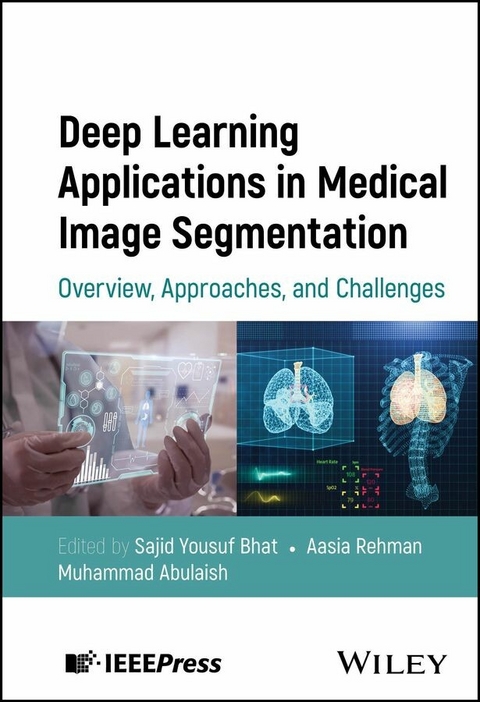
Deep Learning Applications in Medical Image Segmentation (eBook)
490 Seiten
Wiley-IEEE Press (Verlag)
978-1-394-24534-5 (ISBN)
Apply revolutionary deep learning technology to the fast-growing field of medical image segmentation
Precise medical image segmentation is rapidly becoming one of the most important tools in medical research, diagnosis, and treatment. The potential for deep learning, a technology which is already revolutionizing practice across hundreds of subfields, is immense. The prospect of using deep learning to address the traditional shortcomings of image segmentation demands close inspection and wide proliferation of relevant knowledge.
Deep Learning Applications in Medical Image Segmentation meets this demand with a comprehensive introduction and its growing applications. Covering foundational concepts and its advanced techniques, it offers a one-stop resource for researchers and other readers looking for a detailed understanding of the topic. It is deeply engaged with the main challenges and recent advances in the field of deep-learning-based medical image segmentation.
Readers will also find:
- Analysis of deep learning models, including FCN, UNet, SegNet, Dee Lab, and many more
- Detailed discussion of medical image segmentation divided by area, incorporating all major organs and organ systems
- Recent deep learning advancements in segmenting brain tumors, retinal vessels, and inner ear structures
- Analyzes the effectiveness of deep learning models in segmenting lung fields for respiratory disease diagnosis
- Explores the application and benefits of Generative Adversarial Networks (GANs) in enhancing medical image segmentation
- Identifies and discusses the key challenges faced in medical image segmentation using deep learning techniques
- Provides an overview of the latest advancements, applications, and future trends in deep learning for medical image analysis
Deep Learning Applications in Medical Image Segmentation is ideal for academics and researchers working with medical image segmentation, as well as professionals in medical imaging, data science, and biomedical engineering.
Sajid Yousuf Bhat, PhD, is an Assistant Professor in the Department of Computer Science, University of Kashmir, Srinagar, India. Dr. Bhat received his PhD in Computer Science from Jamia Millia Islamia, India, in 2014. His current areas of research include image analysis, machine learning, network analysis and business intelligence.
Aasia Rehman, PhD, is a Lecturer in the Department of Computer Science, University of Kashmir, Srinagar, India. Dr. Rehman earned her PhD in Computer Science from the University of Kashmir, India, in 2023. Her current research area includes medical image segmentation, image classification and deep learning.
Muhammad Abulaish, PhD, is a Professor in the Department of Computer Science, South Asian University, New Delhi, India. Professor Abulaish earned his PhD in Computer Science from the Indian Institute of Technology Delhi, India, in 2007. His research focuses on the development of innovative data mining, machine learning, and network analysis techniques to address real-world societal and industrial problems.
Apply revolutionary deep learning technology to the fast-growing field of medical image segmentation Precise medical image segmentation is rapidly becoming one of the most important tools in medical research, diagnosis, and treatment. The potential for deep learning, a technology which is already revolutionizing practice across hundreds of subfields, is immense. The prospect of using deep learning to address the traditional shortcomings of image segmentation demands close inspection and wide proliferation of relevant knowledge. Deep Learning Applications in Medical Image Segmentation meets this demand with a comprehensive introduction and its growing applications. Covering foundational concepts and its advanced techniques, it offers a one-stop resource for researchers and other readers looking for a detailed understanding of the topic. It is deeply engaged with the main challenges and recent advances in the field of deep-learning-based medical image segmentation. Readers will also find: Analysis of deep learning models, including FCN, UNet, SegNet, Dee Lab, and many moreDetailed discussion of medical image segmentation divided by area, incorporating all major organs and organ systemsRecent deep learning advancements in segmenting brain tumors, retinal vessels, and inner ear structuresAnalyzes the effectiveness of deep learning models in segmenting lung fields for respiratory disease diagnosisExplores the application and benefits of Generative Adversarial Networks (GANs) in enhancing medical image segmentationIdentifies and discusses the key challenges faced in medical image segmentation using deep learning techniquesProvides an overview of the latest advancements, applications, and future trends in deep learning for medical image analysis Deep Learning Applications in Medical Image Segmentation is ideal for academics and researchers working with medical image segmentation, as well as professionals in medical imaging, data science, and biomedical engineering.
1
Introduction to Medical Image Segmentation: Overview of Modalities, Benchmark Datasets, Data Augmentation Techniques, and Evaluation Metrics
Aasia Rehman1 and Suhail Qadir Mir2
1Department of Computer Science, University of Kashmir, Srinagar, Jammu and Kashmir, India
2Department of Informatics and Computer Systems, King Khalid University, Abha, Saudi Arabia
1.1 Introduction
Medical image analysis is an essential part of monitoring the clinical progression of the disease and how the patient is responding to a certain kind of treatment and thus helps in further planning of treatment for patients. Medical imaging has sped up the diagnosis and treatment of a number of illnesses. There are generally many different kinds of medical imaging modalities that make use of different techniques to produce images for various purposes. Figure 1.1 shows the examples of different medical images. In today’s clinical practice, imaging modalities such as X-ray, computed tomography (CT), magnetic resonance imaging (MRI), and US are commonly used. These medical images either examine multiple organs (e.g. MRI and CT) or are specific to particular organs (e.g. retinal images, mammograms, dermoscopy, and colonoscopy). The volume of data produced from each modality also varies (Shen et al. 2017). Each imaging modality offers distinct advantages for various applications and diagnostic objectives, as well as limits in revealing the internal structure and functions of the many organs of the body. X-ray, CT, MRI, US, dermoscopy, colonoscopy, microscopic images, and optical coherence tomography (OCT) are just a few examples of the most widely used medical imaging modalities that will be discussed in this chapter. In addition to this, we discuss their basic principle of working along with their usage.
1.1.1 X-Rays
In the medical field, X-ray imaging is employed to generate detailed images of internal anatomical structures, such as bones, aiding in the diagnostic process. X-rays, classified as electromagnetic waves, possess the capability to penetrate various solid objects, including the human body. Among the common imaging modalities, X-rays are frequently utilized to visualize internal bodily structures. The procedure involves directing a focused beam of X-rays toward the specific region of interest within the body. Upon traversing through the body, the X-rays are captured by a sensitive detector, such as film or a digital sensor. Different tissues within the body interact with X-rays differently; softer tissues, like muscles and organs, absorb fewer X-rays, resulting in darker shades on the resultant image, while denser tissues, like bones, absorb more X-rays, manifesting as white areas on the image. A proper amount of radiation must be used, and the body component must be at the ideal location relative to the X-ray beam, for a clear image to be produced. To get a more accurate depiction of the body’s three-dimensional (3D) structure, many pictures of the same location are acquired from different angles and superimposed to create a two-dimensional (2D) image. A radiologist, a specialized medical practitioner, focuses on analyzing medical images to diagnose various conditions such as fractures, cancers, and other ailments by interpreting the visual information depicted in the images. An X-ray is electromagnetic radiation that is produced in a glass tube that has been evacuated. A cathode and an anode create a voltage gap, which propels electrons across the vacuum of the tube and toward the revolving tungsten anode. When electrons impact the anode, they generate both X-rays and heat. X-rays are exclusively produced when there is a voltage differential applied across the cathode and anode, rendering the X-ray tube inert until activated by the medical radiation technologist. X-ray, CT, fluoroscopy, and angiography are all types of imaging that employ this physical on/off setup. X-rays are commonly employed to capture images of bones, primarily to assess for fractures or other abnormalities. Additionally, dentists and orthodontists utilize X-rays to obtain detailed views of teeth. Moreover, X-rays are instrumental in detecting tumors or abnormalities in bones. They are also used to guide surgeons during surgery. X-ray images of the breast are obtained during mammography to find and assess anomalies like tumors or microcalcifications. As it can spot probable cancer signals before they can be felt during a physical examination, it is a crucial tool in the early identification and prevention of breast cancer. X-rays are not only utilized for imaging the bones but also the chest and lungs to diagnose diseases, including pneumonia, lung cancer, and emphysema. In addition to detecting gallstones, kidney stones, and intestinal obstruction, X-ray imaging can be used to evaluate abdominal organs such as the liver, spleen, and kidneys. Figure 1.1l represents an example of chest X-ray. Due to its broad accessibility, speed, and affordability, X-ray imaging stands as a widely favored diagnostic method. It is a noninvasive procedure, eliminating the need for incisions or injections, thus ensuring a reasonably safe and comfortable experience for the patient. Low tissue contrast is one of the drawbacks of X-ray imaging. Distinguishing between malignancies and healthy tissue is more difficult than with other modalities. X-ray imaging also has the drawback of only providing a 2D picture of the body’s 3D structure, which might make it impossible to see certain internal structures, especially in inaccessible locations. Some aspects of interior structures can be obscured by the lack of depth in the 2D image, making it harder to make accurate diagnoses.
Figure 1.1 Different kinds of medical imaging modalities.
1.1.2 Computed Tomography (CT)
A CT scan, or computerized tomography scan, generates intricate images of the body’s internal structures by combining X-rays and computer technology. Unlike traditional X-rays, CT scans produce cross-sectional images, offering a different perspective of the body. These scans are noninvasive, ensuring a painless experience for the patient. By aiming X-rays at the body from various angles and measuring the intensity of the X-rays as they move through the body with detectors, CT scans can provide high-resolution images of internal anatomy. CT scans use a multi-slice detector, a specialized sort of X-ray detector that can gather many images simultaneously from different angles to provide detailed cross-sectional views of the body. Spatial filtering, which reduces noise and boosts contrast, and multi-energy imaging, which employs X-rays of varying energies to record distinct data and enhance contrast, are two more methods used in CT scans to improve image quality. CT scans produce images that can be viewed in a variety of formats, including cross-sectional slices, 3D images, and even virtual reality images, thanks to computer processing. Radiologic technologists do CT scans, while radiologists, medical specialists with training in image interpretation, decipher the results. When using a CT scanner, the patient will lie on a table that will be moved into the center of a machine in the shape of a doughnut. The scanner’s internal X-ray tube spins to produce a sequence of X-ray beams at varying angles as it rounds the patient. The X-ray light creates a pattern of attenuation as it goes through the body because it is absorbed at different rates by various tissues. An array of detectors positioned opposite the X-ray tube picks up the pattern of attenuated X-rays and turns them into electrical impulses. The data from these electrical signals is then transferred to a computer, where complex algorithms are used to reassemble the information as a 3D image. CT scans are employed to enhance the examination of soft tissues and intricate areas of the image that may not be clearly defined by traditional X-rays. They are commonly employed to visualize and assess blood vessels, internal organs, bones, the brain, neck, spine, and chest. CT scans aid medical professionals in various diagnostic tasks, including tumor detection, fracture evaluation, and monitoring the impact of cancer treatment on patients.
Figure 1.1a shows an example of a CT scan of the lungs. CT imaging’s high resolution is a big benefit since it allows doctors to see anatomical details such as bone structure, organ function, and blood vessel structure. This makes it beneficial for diagnosing a large variety of illnesses. In addition to its usefulness as a diagnostic tool, CT imaging technology is commonly available in settings such as hospitals, clinics, and doctors’ offices. In addition, CT imaging is quick and efficient, with data typically being made available in a short amount of time. Ionizing radiation exposure is a key concern with CT imaging since it can increase the risk of cancer and other health issues, especially with repeated scans or in pregnant women. CT scanners also represent a large financial commitment, which can be out of reach for some hospitals. Because of this, some patients may not be able to get their hands on this form of imaging. The advantages and disadvantages of CT scans must be weighed carefully, and when possible, other imaging methods should be considered.
1.1.3 Medical Resonance Imaging (MRI)
MRI, or magnetic resonance imaging, shares similarities with CT scans but offers superior quality, producing detailed cross-sectional images of body structures. Similar to CT scans, MRIs are painless and safe, as magnetic fields and...
| Erscheint lt. Verlag | 3.1.2025 |
|---|---|
| Sprache | englisch |
| Themenwelt | Mathematik / Informatik ► Informatik ► Grafik / Design |
| Medizin / Pharmazie ► Gesundheitsfachberufe | |
| Medizin / Pharmazie ► Medizinische Fachgebiete | |
| Schlagworte | Benchmark Datasets • brain anomalies • Cell Segmentation • cnns • contour-based algorithms • Data Augmentation • Deep Lab • Deep learning • Diabetic retinopathy • FCN • generative adversarial networks • graph neural networks • inner ear segmentation • Lung Segmentation • Mask R-CNN • Medical Images • Multi-scale Models • Pyramid Scene Parsing Network • recurrent neutral networks • region-based techniques • Segmentation • segnet • Thresholding • unet |
| ISBN-10 | 1-394-24534-3 / 1394245343 |
| ISBN-13 | 978-1-394-24534-5 / 9781394245345 |
| Informationen gemäß Produktsicherheitsverordnung (GPSR) | |
| Haben Sie eine Frage zum Produkt? |
 EPUB (Adobe DRM)
Kopierschutz: Adobe-DRM
Adobe-DRM ist ein Kopierschutz, der das eBook vor Mißbrauch schützen soll. Dabei wird das eBook bereits beim Download auf Ihre persönliche Adobe-ID autorisiert. Lesen können Sie das eBook dann nur auf den Geräten, welche ebenfalls auf Ihre Adobe-ID registriert sind.
Details zum Adobe-DRM
Dateiformat: EPUB (Electronic Publication)
EPUB ist ein offener Standard für eBooks und eignet sich besonders zur Darstellung von Belletristik und Sachbüchern. Der Fließtext wird dynamisch an die Display- und Schriftgröße angepasst. Auch für mobile Lesegeräte ist EPUB daher gut geeignet.
Systemvoraussetzungen:
PC/Mac: Mit einem PC oder Mac können Sie dieses eBook lesen. Sie benötigen eine
eReader: Dieses eBook kann mit (fast) allen eBook-Readern gelesen werden. Mit dem amazon-Kindle ist es aber nicht kompatibel.
Smartphone/Tablet: Egal ob Apple oder Android, dieses eBook können Sie lesen. Sie benötigen eine
Geräteliste und zusätzliche Hinweise
Buying eBooks from abroad
For tax law reasons we can sell eBooks just within Germany and Switzerland. Regrettably we cannot fulfill eBook-orders from other countries.
aus dem Bereich