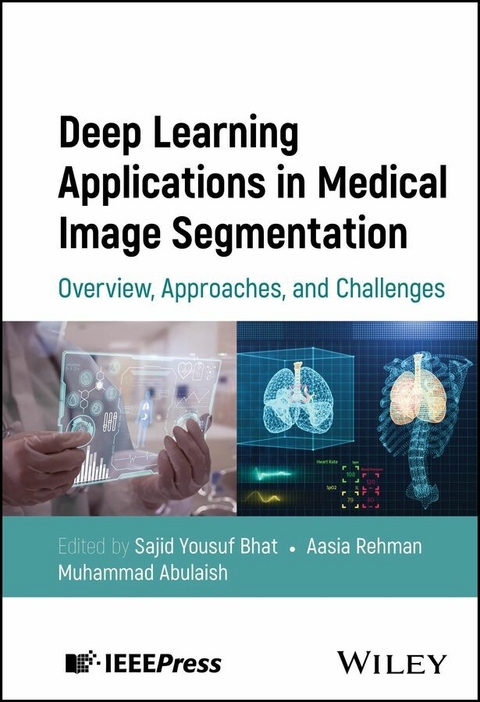
Deep Learning Applications in Medical Image Segmentation (eBook)
317 Seiten
Wiley-IEEE Press (Verlag)
978-1-394-24535-2 (ISBN)
Apply revolutionary deep learning technology to the fast-growing field of medical image segmentation
Precise medical image segmentation is rapidly becoming one of the most important tools in medical research, diagnosis, and treatment. The potential for deep learning, a technology which is already revolutionizing practice across hundreds of subfields, is immense. The prospect of using deep learning to address the traditional shortcomings of image segmentation demands close inspection and wide proliferation of relevant knowledge.
Deep Learning Applications in Medical Image Segmentation meets this demand with a comprehensive introduction and its growing applications. Covering foundational concepts and its advanced techniques, it offers a one-stop resource for researchers and other readers looking for a detailed understanding of the topic. It is deeply engaged with the main challenges and recent advances in the field of deep-learning-based medical image segmentation.
Readers will also find:
- Analysis of deep learning models, including FCN, UNet, SegNet, Dee Lab, and many more
- Detailed discussion of medical image segmentation divided by area, incorporating all major organs and organ systems
- Recent deep learning advancements in segmenting brain tumors, retinal vessels, and inner ear structures
- Analyzes the effectiveness of deep learning models in segmenting lung fields for respiratory disease diagnosis
- Explores the application and benefits of Generative Adversarial Networks (GANs) in enhancing medical image segmentation
- Identifies and discusses the key challenges faced in medical image segmentation using deep learning techniques
- Provides an overview of the latest advancements, applications, and future trends in deep learning for medical image analysis
Deep Learning Applications in Medical Image Segmentation is ideal for academics and researchers working with medical image segmentation, as well as professionals in medical imaging, data science, and biomedical engineering.
Sajid Yousuf Bhat, PhD, is an Assistant Professor in the Department of Computer Science, University of Kashmir, Srinagar, India. Dr. Bhat received his PhD in Computer Science from Jamia Millia Islamia, India, in 2014. His current areas of research include image analysis, machine learning, network analysis and business intelligence.
Aasia Rehman, PhD, is a Lecturer in the Department of Computer Science, University of Kashmir, Srinagar, India. Dr. Rehman earned her PhD in Computer Science from the University of Kashmir, India, in 2023. Her current research area includes medical image segmentation, image classification and deep learning.
Muhammad Abulaish, PhD, is a Professor in the Department of Computer Science, South Asian University, New Delhi, India. Professor Abulaish earned his PhD in Computer Science from the Indian Institute of Technology Delhi, India, in 2007. His research focuses on the development of innovative data mining, machine learning, and network analysis techniques to address real-world societal and industrial problems.
Apply revolutionary deep learning technology to the fast-growing field of medical image segmentation Precise medical image segmentation is rapidly becoming one of the most important tools in medical research, diagnosis, and treatment. The potential for deep learning, a technology which is already revolutionizing practice across hundreds of subfields, is immense. The prospect of using deep learning to address the traditional shortcomings of image segmentation demands close inspection and wide proliferation of relevant knowledge. Deep Learning Applications in Medical Image Segmentation meets this demand with a comprehensive introduction and its growing applications. Covering foundational concepts and its advanced techniques, it offers a one-stop resource for researchers and other readers looking for a detailed understanding of the topic. It is deeply engaged with the main challenges and recent advances in the field of deep-learning-based medical image segmentation. Readers will also find: Analysis of deep learning models, including FCN, UNet, SegNet, Dee Lab, and many moreDetailed discussion of medical image segmentation divided by area, incorporating all major organs and organ systemsRecent deep learning advancements in segmenting brain tumors, retinal vessels, and inner ear structuresAnalyzes the effectiveness of deep learning models in segmenting lung fields for respiratory disease diagnosisExplores the application and benefits of Generative Adversarial Networks (GANs) in enhancing medical image segmentationIdentifies and discusses the key challenges faced in medical image segmentation using deep learning techniquesProvides an overview of the latest advancements, applications, and future trends in deep learning for medical image analysis Deep Learning Applications in Medical Image Segmentation is ideal for academics and researchers working with medical image segmentation, as well as professionals in medical imaging, data science, and biomedical engineering.
| Erscheint lt. Verlag | 3.1.2025 |
|---|---|
| Sprache | englisch |
| Themenwelt | Mathematik / Informatik ► Informatik ► Grafik / Design |
| Medizin / Pharmazie ► Gesundheitsfachberufe | |
| Medizin / Pharmazie ► Medizinische Fachgebiete | |
| Schlagworte | Benchmark Datasets • brain anomalies • Cell Segmentation • cnns • contour-based algorithms • Data Augmentation • Deep Lab • Deep learning • Diabetic retinopathy • FCN • generative adversarial networks • graph neural networks • inner ear segmentation • Lung Segmentation • Mask R-CNN • Medical Images • Multi-scale Models • Pyramid Scene Parsing Network • recurrent neutral networks • region-based techniques • Segmentation • segnet • Thresholding • unet |
| ISBN-10 | 1-394-24535-1 / 1394245351 |
| ISBN-13 | 978-1-394-24535-2 / 9781394245352 |
| Informationen gemäß Produktsicherheitsverordnung (GPSR) | |
| Haben Sie eine Frage zum Produkt? |
 PDF (Adobe DRM)
Kopierschutz: Adobe-DRM
Adobe-DRM ist ein Kopierschutz, der das eBook vor Mißbrauch schützen soll. Dabei wird das eBook bereits beim Download auf Ihre persönliche Adobe-ID autorisiert. Lesen können Sie das eBook dann nur auf den Geräten, welche ebenfalls auf Ihre Adobe-ID registriert sind.
Details zum Adobe-DRM
Dateiformat: PDF (Portable Document Format)
Mit einem festen Seitenlayout eignet sich die PDF besonders für Fachbücher mit Spalten, Tabellen und Abbildungen. Eine PDF kann auf fast allen Geräten angezeigt werden, ist aber für kleine Displays (Smartphone, eReader) nur eingeschränkt geeignet.
Systemvoraussetzungen:
PC/Mac: Mit einem PC oder Mac können Sie dieses eBook lesen. Sie benötigen eine
eReader: Dieses eBook kann mit (fast) allen eBook-Readern gelesen werden. Mit dem amazon-Kindle ist es aber nicht kompatibel.
Smartphone/Tablet: Egal ob Apple oder Android, dieses eBook können Sie lesen. Sie benötigen eine
Geräteliste und zusätzliche Hinweise
Buying eBooks from abroad
For tax law reasons we can sell eBooks just within Germany and Switzerland. Regrettably we cannot fulfill eBook-orders from other countries.
aus dem Bereich