


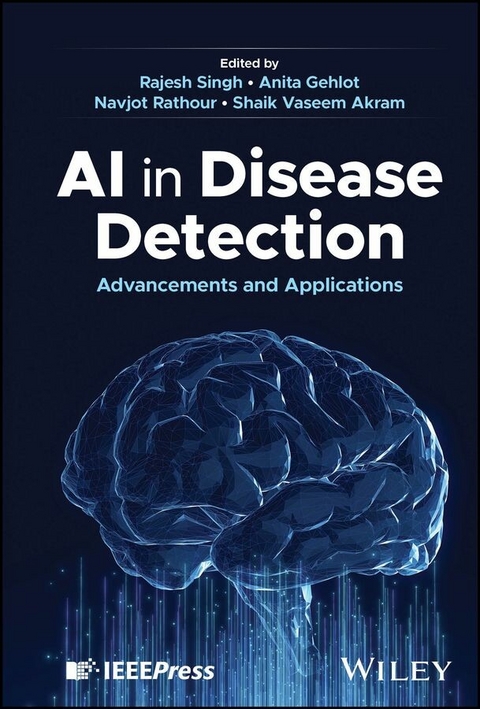
AI in Disease Detection (eBook)
403 Seiten
Wiley-IEEE Press (Verlag)
978-1-394-27868-8 (ISBN)
Comprehensive resource encompassing recent developments, current use cases, and future opportunities for AI in disease detection
AI in Disease Detection discusses the integration of artificial intelligence to revolutionize disease detection approaches, with case studies of AI in disease detection as well as insight into the opportunities and challenges of AI in healthcare as a whole. The book explores a wide range of individual AI components such as computer vision, natural language processing, and machine learning as well as the development and implementation of AI systems for efficient practices in data collection, model training, and clinical validation.
This book assists readers in assessing big data in healthcare and determining the drawbacks and possibilities associated with the implementation of AI in disease detection; categorizing major applications of AI in disease detection such as cardiovascular disease detection, cancer diagnosis, neurodegenerative disease detection, and infectious disease control, as well as implementing distinct AI methods and algorithms with medical data including patient records and medical images, and understanding the ethical and social consequences of AI in disease detection such as confidentiality, bias, and accessibility to healthcare.
Sample topics explored in AI in Disease Detection include:
- Legal implication of AI in healthcare, with approaches to ensure privacy and security of patients and their data
- Identification of new biomarkers for disease detection, prediction of disease outcomes, and customized treatment plans depending on patient characteristics
- AI's role in disease surveillance and outbreak detection, with case studies of its current usage in real-world scenarios
- Clinical validation processes for AI disease detection models and how they can be validated for accuracy and effectiveness
Delivering excellent coverage of the subject, AI in Disease Detection is an essential up-to-date reference for students, healthcare professionals, academics, and practitioners seeking to understand the possible applications of AI in disease detection and stay on the cutting edge of the most recent breakthroughs in the field.
Dr. Rajesh Singh, Professor, Electronics & Communication Engineering and Director, Research & Innovation, Uttaranchal University, India. Dr. Singh was featured among the top ten inventors in 2010 to 2020 by Clarivate Analytics in 'India's Innovation Synopsis' in March 2021.
Dr. Anita Gehlot, Professor, Electronics & Communication Engineering and Head -Research and Innovation, Uttaranchal University, India.
Dr. Navjot Rathour, Associate Professor, Electronics & Communication Engineering, Chandigarh University, Mohali, India.
Dr. Shaik Vaseem Akram, Assistant Professor, Electronics & Communication Engineering, S R University, Telangana, India.
Comprehensive resource encompassing recent developments, current use cases, and future opportunities for AI in disease detection AI in Disease Detection discusses the integration of artificial intelligence to revolutionize disease detection approaches, with case studies of AI in disease detection as well as insight into the opportunities and challenges of AI in healthcare as a whole. The book explores a wide range of individual AI components such as computer vision, natural language processing, and machine learning as well as the development and implementation of AI systems for efficient practices in data collection, model training, and clinical validation. This book assists readers in assessing big data in healthcare and determining the drawbacks and possibilities associated with the implementation of AI in disease detection; categorizing major applications of AI in disease detection such as cardiovascular disease detection, cancer diagnosis, neurodegenerative disease detection, and infectious disease control, as well as implementing distinct AI methods and algorithms with medical data including patient records and medical images, and understanding the ethical and social consequences of AI in disease detection such as confidentiality, bias, and accessibility to healthcare. Sample topics explored in AI in Disease Detection include: Legal implication of AI in healthcare, with approaches to ensure privacy and security of patients and their dataIdentification of new biomarkers for disease detection, prediction of disease outcomes, and customized treatment plans depending on patient characteristicsAI s role in disease surveillance and outbreak detection, with case studies of its current usage in real-world scenariosClinical validation processes for AI disease detection models and how they can be validated for accuracy and effectiveness Delivering excellent coverage of the subject, AI in Disease Detection is an essential up-to-date reference for students, healthcare professionals, academics, and practitioners seeking to understand the possible applications of AI in disease detection and stay on the cutting edge of the most recent breakthroughs in the field.
| Erscheint lt. Verlag | 31.12.2024 |
|---|---|
| Sprache | englisch |
| Themenwelt | Mathematik / Informatik ► Informatik ► Theorie / Studium |
| Schlagworte | ai clinical validation • ai medical data collection • ai medical data collection, ai medical model training • ai medical model training • disease detection approaches • disease detection computer vision • disease detection machine learning • disease detection natural language processing |
| ISBN-10 | 1-394-27868-3 / 1394278683 |
| ISBN-13 | 978-1-394-27868-8 / 9781394278688 |
| Informationen gemäß Produktsicherheitsverordnung (GPSR) | |
| Haben Sie eine Frage zum Produkt? |
 PDF (Adobe DRM)
Kopierschutz: Adobe-DRM
Adobe-DRM ist ein Kopierschutz, der das eBook vor Mißbrauch schützen soll. Dabei wird das eBook bereits beim Download auf Ihre persönliche Adobe-ID autorisiert. Lesen können Sie das eBook dann nur auf den Geräten, welche ebenfalls auf Ihre Adobe-ID registriert sind.
Details zum Adobe-DRM
Dateiformat: PDF (Portable Document Format)
Mit einem festen Seitenlayout eignet sich die PDF besonders für Fachbücher mit Spalten, Tabellen und Abbildungen. Eine PDF kann auf fast allen Geräten angezeigt werden, ist aber für kleine Displays (Smartphone, eReader) nur eingeschränkt geeignet.
Systemvoraussetzungen:
PC/Mac: Mit einem PC oder Mac können Sie dieses eBook lesen. Sie benötigen eine
eReader: Dieses eBook kann mit (fast) allen eBook-Readern gelesen werden. Mit dem amazon-Kindle ist es aber nicht kompatibel.
Smartphone/Tablet: Egal ob Apple oder Android, dieses eBook können Sie lesen. Sie benötigen eine
Geräteliste und zusätzliche Hinweise
Buying eBooks from abroad
For tax law reasons we can sell eBooks just within Germany and Switzerland. Regrettably we cannot fulfill eBook-orders from other countries.
aus dem Bereich


