


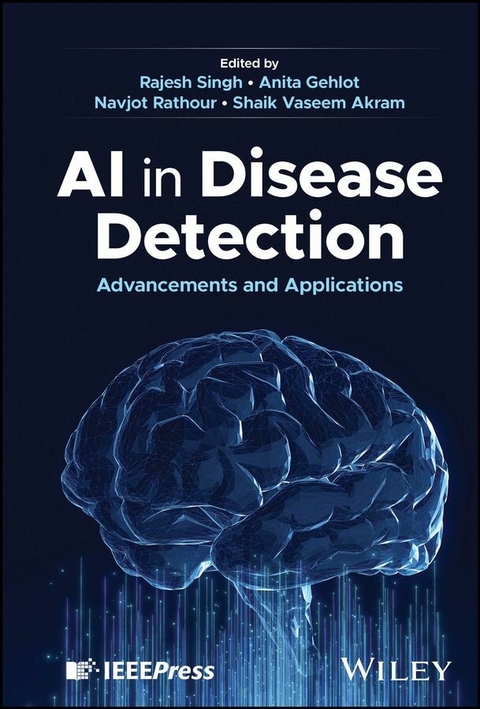
AI in Disease Detection (eBook)
635 Seiten
Wiley-IEEE Press (Verlag)
978-1-394-27867-1 (ISBN)
Comprehensive resource encompassing recent developments, current use cases, and future opportunities for AI in disease detection
AI in Disease Detection discusses the integration of artificial intelligence to revolutionize disease detection approaches, with case studies of AI in disease detection as well as insight into the opportunities and challenges of AI in healthcare as a whole. The book explores a wide range of individual AI components such as computer vision, natural language processing, and machine learning as well as the development and implementation of AI systems for efficient practices in data collection, model training, and clinical validation.
This book assists readers in assessing big data in healthcare and determining the drawbacks and possibilities associated with the implementation of AI in disease detection; categorizing major applications of AI in disease detection such as cardiovascular disease detection, cancer diagnosis, neurodegenerative disease detection, and infectious disease control, as well as implementing distinct AI methods and algorithms with medical data including patient records and medical images, and understanding the ethical and social consequences of AI in disease detection such as confidentiality, bias, and accessibility to healthcare.
Sample topics explored in AI in Disease Detection include:
- Legal implication of AI in healthcare, with approaches to ensure privacy and security of patients and their data
- Identification of new biomarkers for disease detection, prediction of disease outcomes, and customized treatment plans depending on patient characteristics
- AI's role in disease surveillance and outbreak detection, with case studies of its current usage in real-world scenarios
- Clinical validation processes for AI disease detection models and how they can be validated for accuracy and effectiveness
Delivering excellent coverage of the subject, AI in Disease Detection is an essential up-to-date reference for students, healthcare professionals, academics, and practitioners seeking to understand the possible applications of AI in disease detection and stay on the cutting edge of the most recent breakthroughs in the field.
Dr. Rajesh Singh, Professor, Electronics & Communication Engineering and Director, Research & Innovation, Uttaranchal University, India. Dr. Singh was featured among the top ten inventors in 2010 to 2020 by Clarivate Analytics in 'India's Innovation Synopsis' in March 2021.
Dr. Anita Gehlot, Professor, Electronics & Communication Engineering and Head -Research and Innovation, Uttaranchal University, India.
Dr. Navjot Rathour, Associate Professor, Electronics & Communication Engineering, Chandigarh University, Mohali, India.
Dr. Shaik Vaseem Akram, Assistant Professor, Electronics & Communication Engineering, S R University, Telangana, India.
Comprehensive resource encompassing recent developments, current use cases, and future opportunities for AI in disease detection AI in Disease Detection discusses the integration of artificial intelligence to revolutionize disease detection approaches, with case studies of AI in disease detection as well as insight into the opportunities and challenges of AI in healthcare as a whole. The book explores a wide range of individual AI components such as computer vision, natural language processing, and machine learning as well as the development and implementation of AI systems for efficient practices in data collection, model training, and clinical validation. This book assists readers in assessing big data in healthcare and determining the drawbacks and possibilities associated with the implementation of AI in disease detection; categorizing major applications of AI in disease detection such as cardiovascular disease detection, cancer diagnosis, neurodegenerative disease detection, and infectious disease control, as well as implementing distinct AI methods and algorithms with medical data including patient records and medical images, and understanding the ethical and social consequences of AI in disease detection such as confidentiality, bias, and accessibility to healthcare. Sample topics explored in AI in Disease Detection include: Legal implication of AI in healthcare, with approaches to ensure privacy and security of patients and their dataIdentification of new biomarkers for disease detection, prediction of disease outcomes, and customized treatment plans depending on patient characteristicsAI s role in disease surveillance and outbreak detection, with case studies of its current usage in real-world scenariosClinical validation processes for AI disease detection models and how they can be validated for accuracy and effectiveness Delivering excellent coverage of the subject, AI in Disease Detection is an essential up-to-date reference for students, healthcare professionals, academics, and practitioners seeking to understand the possible applications of AI in disease detection and stay on the cutting edge of the most recent breakthroughs in the field.
1
Introduction to AI in Disease Detection — An Overview of the Use of AI in Detecting Diseases, Including the Benefits and Limitations of the Technology
Arvind Singh Rawat1, Jagadheswaran Rajendran1, and Shailendra Singh Sikarwar2
1 Universiti Sains Malaysia, Minden, Penang, Malaysia
2 Department of Computer Science, PGV College, Gwalior, Madhya Pradesh, India
Introduction
The merger of disease detection and artificial intelligence (AI) predicts a paradigm shift in modern medicine that rebalances the playing field toward a new frontier in diagnostic practices and healthcare delivery [1]. Quite recently, within the last decade, there has been manifold augmentation in computational power paralleled by a corresponding growth in healthcare data, both forerunners to unprecedented developments in AI‐driven disease detection. This chapter gives an overview of the changing landscape of AI in disease detection. It reviews innovations and upcoming trends that are likely to transform clinical practice in the future. At the heart of this metamorphosis lies the power of deep learning algorithms, AI methods inspired by the arrangement and functionality of the neocortex [2].
Deep learning (DL) is very good at deciphering complex patterns from large datasets. Hence, deep learning can allow fast and accurate analysis of medical imaging, genomic sequences, electronic health records (EHRs), and other health data modalities. Drawing on this potential, AI empowers clinicians with improved accuracy in diagnosis, thus allowing for very early detection of various diseases, such as cancer and cardiovascular disorders, or even neurological conditions. However, introducing AI into disease detection does not come easy. Probably, most of the concerns are focused on the intrinsic opacity of DL models, often referred to as the “black box” problem [3].
Compared to the traditional diagnosis methods – where a clinician explains the reasoning behind the decisions – the AI algorithm is an esoteric mathematical construct, and its decision processes simply cannot be fathomed by human beings. Thus, incorporating AI‐driven diagnostics will call for a massive paradigm shift in how clinicians view algorithmic recommendations and build trust in them. Moreover, the training of AI models on such large datasets further raises ethical, privacy, and security concerns. The aggregation of such sensitive patient data is connected with enormous challenges regarding privacy and protection against bias in algorithms. Addressing these concerns will be critical in enabling the acceptance and trust of AI‐driven diagnostics among healthcare professionals and patients alike [4]. It is against this backdrop that the current research sets out to explore innovations that aspire to surmount these challenges and, in a real sense, unleash the power of AI in disease detection. By integrating multimodal fusion techniques, researchers can draw from relatively disparate data sources and, hence, compose a rather detailed profile of a patient for improved diagnostic accuracy and personalization. Transfer learning has proven to be one of the very promising approaches, which can avoid all the limitations of data scarcity by effortlessly adapting pretrained deep models of learning for specific disease detection with minimal labeled data. Furthermore, on the horizon, techniques of explainable AI (XAI) bring the promise of enhanced interpretability for AI‐driven diagnoses into reality; it would bridge the gap between algorithmic recommendations and clinical decision‐making.
XAI offers a transparent explanation of the AI‐generated predictions, empowering a clinician's understanding and trust in algorithmic outputs. This opens the possibility for collaboration between experts “acting human‐like” with AI systems. Federated learning is another upcoming paradigm that can maintain privacy but collaboratively train machine learning (ML) models across decentralized healthcare ecosystems. Federated learning decentralizes data storage and model training to address concerns about data privacy and security while enabling AI models to learn from diversified patient populations. The trajectory for the responsible integration of AI in disease detection is to be identified through an authentic synthesis between these innovations and emerging trends, contributing to advancing the paradigm of precision medicine, and boosting healthcare outcomes for patients worldwide.
Objectives
- Evaluate the Efficacy of Multimodal Fusion Techniques in Disease Detection
- Assess the effectiveness of integrating diverse data modalities, including medical imaging, genomics, proteomics, and EHRs, through multimodal fusion techniques.
- Investigate how multimodal fusion enhances diagnostic accuracy, facilitates early disease detection, and enables personalized treatment strategies.
- Explore the challenges and opportunities associated with integrating heterogeneous data sources, including data compatibility, feature extraction, and model complexity.
- Investigate the Potential of Transfer Learning for Disease Detection in Resource‐Constrained Settings
- Evaluate the feasibility and performance of transfer learning approaches in adapting pretrained deep learning models to specific disease detection tasks with limited labeled data.
- Compare the effectiveness of transfer learning across different medical imaging modalities and disease domains.
- Assess the scalability and generalizability of transfer learning techniques in resource‐constrained healthcare environments, such as low‐resource settings and rural areas.
- Enhance Interpretability of AI‐Driven Diagnoses through XAI Techniques
- Explore state‐of‐the‐art XAI methods for generating transparent and interpretable explanations for AI‐generated predictions in disease detection.
- Assess how XAI impacts clinician trust, acceptance, and decision‐making regarding the adoption of AI‐powered diagnostic tools.
- Research how a tradeoff between interpretability and performance in AI models can be made. And try to do both.
- Address Ethical and Privacy Concerns in AI‐Powered Disease Detection through Federated Learning
- Evaluate the feasibility and effectiveness of federated learning approaches to secure data while enabling training across collaborative models across multiple healthcare organizations.
- Research the impact of federated learning to minimize algorithmic bias and ensure equitable access to AI‐based diagnostic tools.
- Explores the legal and policy implications of federated learning in healthcare, including data governance, consent management, and compliance with data protection regulations.
- Assess the Clinical Utility and Adoption Barriers of AI‐Driven Disease Detection
- Conducting user research as well as clinical trials will give a realistic effectiveness and clinical utility of AI‐based diagnostic tools in disease detection.
- They present barriers to adoption, which include clinician skepticism, workflow integration challenges, and regulatory barriers; they recommend strategies to overcome them.
- Research economic issues in implementing AI‐based disease detection methods such as cost‐effectiveness, reimbursement policies, and return on investment for healthcare providers [5, 6].
- Explore Novel Approaches for Continuous Monitoring and Early Warning Systems in Disease Detection
- Investigate the potential of AI‐based continuous monitoring systems, such as wearables and remote patient monitoring platforms, to detect early signs of illness and health deterioration.
- Assess the feasibility and scalability of integrating continuous surveillance data into AI‐based disease detection algorithms.
- Explore advanced data analytics techniques, including time series analysis and anomaly detection, to identify subtle changes in patient health trajectories and inform interventions timely intervention [7].
- Foster Interdisciplinary Collaboration and Knowledge Translation in AI‐Powered Disease Detection
- Facilitate knowledge exchange and collaboration among computer scientists, clinicians, biomedical researchers, and policymakers to drive innovation in disease detection using AI.
- Develop educational initiatives and training programs to bridge the gap between AI research and clinical practice, equipping healthcare professionals with the skills and knowledge needed to effectively take advantage of AI‐based diagnostic tools.
- Promote ethical considerations and responsible practices of AI in disease detection through cross‐sector dialogue, stakeholder engagement, and public awareness efforts [8].
Literature Review
Artificial intelligence has been transforming industries – not excluding health – into how much attention is put to its application for disease detection. This literature review explores the current state of AI in disease detection, its methodologies, benefits, challenges, and prospects (see Table 1.1).
AI techniques, specifically ML and DL, are the bedrock of improvements in disease detection. ML algorithms scan Big Data for any trend that may indicate various diseases....
| Erscheint lt. Verlag | 31.12.2024 |
|---|---|
| Sprache | englisch |
| Themenwelt | Mathematik / Informatik ► Informatik ► Theorie / Studium |
| Schlagworte | ai clinical validation • ai medical data collection • ai medical data collection, ai medical model training • ai medical model training • disease detection approaches • disease detection computer vision • disease detection machine learning • disease detection natural language processing |
| ISBN-10 | 1-394-27867-5 / 1394278675 |
| ISBN-13 | 978-1-394-27867-1 / 9781394278671 |
| Informationen gemäß Produktsicherheitsverordnung (GPSR) | |
| Haben Sie eine Frage zum Produkt? |
 EPUB (Adobe DRM)
Kopierschutz: Adobe-DRM
Adobe-DRM ist ein Kopierschutz, der das eBook vor Mißbrauch schützen soll. Dabei wird das eBook bereits beim Download auf Ihre persönliche Adobe-ID autorisiert. Lesen können Sie das eBook dann nur auf den Geräten, welche ebenfalls auf Ihre Adobe-ID registriert sind.
Details zum Adobe-DRM
Dateiformat: EPUB (Electronic Publication)
EPUB ist ein offener Standard für eBooks und eignet sich besonders zur Darstellung von Belletristik und Sachbüchern. Der Fließtext wird dynamisch an die Display- und Schriftgröße angepasst. Auch für mobile Lesegeräte ist EPUB daher gut geeignet.
Systemvoraussetzungen:
PC/Mac: Mit einem PC oder Mac können Sie dieses eBook lesen. Sie benötigen eine
eReader: Dieses eBook kann mit (fast) allen eBook-Readern gelesen werden. Mit dem amazon-Kindle ist es aber nicht kompatibel.
Smartphone/Tablet: Egal ob Apple oder Android, dieses eBook können Sie lesen. Sie benötigen eine
Geräteliste und zusätzliche Hinweise
Buying eBooks from abroad
For tax law reasons we can sell eBooks just within Germany and Switzerland. Regrettably we cannot fulfill eBook-orders from other countries.
aus dem Bereich


