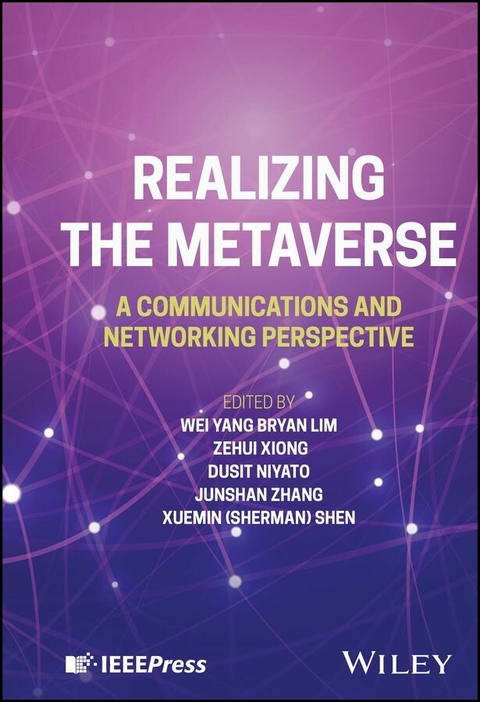
Realizing the Metaverse (eBook)
316 Seiten
Wiley-IEEE Press (Verlag)
9781394188918 (ISBN)
A guide to the challenges in making virtual reality, reality
The Metaverse, a version of the internet in which online interactions take place in real time within fully realized virtual spaces, has been promised as the next frontier in wireless communication. It has drawn huge investment from Silicon Valley and widespread media attention. However, the technologies required to make the Metaverse a reality are still in their infancy, and significant barriers must be overcome if this massive step is to be taken.
Realizing the Metaverse provides a systematic overview of these challenges and their likely solutions. Focusing on five key areas-infrastructure, access, intelligence, security, and future developments-it offers one of the first comprehensive, formalized treatments of the Metaverse as a nascent reality. It promises to be an integral contribution to the future development of Metaverse technologies.
Realizing the Metaverse readers will also find:
- An editorial team with extensive research experience in the field
- Detailed discussion of topics such as augmented reality (AR) adaptation, haptic feedback, artificial intelligence, and more
- Enlightening discussion of open questions and future prospects for research
Realizing the Metaverse is ideal for graduate and advanced undergraduate students in wireless technology, network communications, and related fields, as well as for researchers and industry professionals involved with the Metaverse or adjacent technologies.
Wei Yang Bryan Lim, PhD, is a Wallenberg-NTU Presidential Postdoctoral Fellow, Nanyang Technological University, Singapore. He has received Best Paper Awards from the IEEE Wireless Communications and Networking Conference and the IEEE SPCC Technical Committee, and regularly serves as a reviewer for leading journals.
Zehui Xiong, PhD, is an Assistant Professor at Singapore University of Technology and Design. He has published extensively, won many prestigious career/paper awards, and served as the editor for many leading journals in the areas of Internet of Things, edge computing and intelligence. He serves as the Associate Director of Future Communications R&D Programme. He was featured on the list of Forbes Asia 30 under 30 in 2023.
Dusit Niyato, PhD, is a Professor in the School of Computer and Engineering, Nanyang Technological University, Singapore. He is an IEEE Fellow and serves as editor of numerous prestigious journals, including as editor-in-chief of IEEE Communications Surveys and Tutorials.
Junshan Zhang, PhD, is a Professor in the Electrical and Computer Engineering Department at the University of California, Davis, USA. He has researched and published extensively on information networks, data science, 5g, wireless communications, and related subjects, and currently serves as editor-in-chief for IEEE Transactions on Wireless Communication.
Xuemin (Sherman) Shen, PhD, is a University Professor in the Department of Electrical and Computer Engineering, University of Waterloo, Canada. He has published extensively on network resource management, wireless network security, Internet of Things, 5G, and more. He is a Fellow of the Engineering Institute of Canada, the Canadian Academy of Engineering, and the Royal Society of Canada, among others.
A guide to the challenges in making virtual reality, reality The Metaverse, a version of the internet in which online interactions take place in real time within fully realized virtual spaces, has been promised as the next frontier in wireless communication. It has drawn huge investment from Silicon Valley and widespread media attention. However, the technologies required to make the Metaverse a reality are still in their infancy, and significant barriers must be overcome if this massive step is to be taken. Realizing the Metaverse provides a systematic overview of these challenges and their likely solutions. Focusing on five key areas infrastructure, access, intelligence, security, and future developments it offers one of the first comprehensive, formalized treatments of the Metaverse as a nascent reality. It promises to be an integral contribution to the future development of Metaverse technologies. Realizing the Metaverse readers will also find: An editorial team with extensive research experience in the field Detailed discussion of topics such as augmented reality (AR) adaptation, haptic feedback, artificial intelligence, and more Enlightening discussion of open questions and future prospects for research Realizing the Metaverse is ideal for graduate and advanced undergraduate students in wireless technology, network communications, and related fields, as well as for researchers and industry professionals involved with the Metaverse or adjacent technologies.
2
Communication and Computing in Edge-enabled Metaverse
Minrui Xu1, Wei Chong Ng2, Wei Yang Bryan Lim2, and Dusit Niyato1
1School of Computer Science and Engineering, Nanyang Technological University, Singapore, Singapore
2Alibaba Group and Alibaba-NTU Joint Research Institute, Nanyang Technological University, Singapore, Singapore
2.1 Introduction
It is anticipated that mobile edge networks will provide users effective networking and communication capabilities along with fast, low-latency, and expansive wireless coverage, enabling users to fully immerse themselves in the Metaverse and have a seamless, real-time experience [104]. Strict communication criteria must be fulfilled in order to do this (Table 2.1). In contrast to the conventional 2D picture transmission, the existing 5G network infrastructure is heavily taxed by the requirement to send 3D virtual objects and situations in the Metaverse in order to provide consumers an immersive experience. In order to provide immersive content delivery and real-time engagement, for instance, the Metaverse for mobile edge networks, as suggested in [193], shows that enormous connection of Metaverse enablers, such as augmented reality (AR)/virtual reality (VR), tactile Internet, avatars, and Digital twin (DT), requires huge bandwidth and URLLC. Furthermore, Ref. [413] proposes a blockchain-based Metaverse-native communication system that offers anonymous and decentralized connectivity for all virtual and physical entities concerning encrypted addresses. Real-time execution of production choices and virtual concerts are required. All things considered, the following aspects of the Metaverse pose serious new difficulties for mobile edge networks when it comes to offering Metaverse services:
- Immersive 3D Streaming: Millions of users at mobile edge networks may enjoy the full Metaverse experience thanks to 3D streaming, which dissolves the lines between the real and virtual worlds.
Table 2.1 Communication requirements of services in the Metaverse.
Services Reliability (%) Latency (ms) Data Rate (Mbit/s) Connection Density (devices/) VR entertainment 7–15 250 1000–50,000 The tactile Internet 1 1 1000–50,000 Digital twin of smart city 5–10 10 100,000 AR smart healthcare 5 10,000 50 Hologram education (point cloud) 20 500–2000 1000 Hologram education (light field) 20 to 1000 - Multisensory Communications: The Metaverse is made up of several 3D virtual worlds where users may immerse themselves as haptic, kinesthetic, auditory, and visual avatars [52]. Thus, in order for edge users to access 3D multimedia services, including AR/VR and the tactile Internet, at any time or location, they must have ubiquitous connection to the Metaverse.
- Real-time Interaction: Users’ real-time interactions with their avatars in the Metaverse are based on massive forms of interactions, such as communications between humans (H2H), machines (H2M), and machines (M2M). Consequently, in real-time interactions, social multimedia services in the Metaverse must be provided under strict guidelines, including motion-to-photon latency [449], interaction latency, and haptic perception latency.
- Seamless Physical–Virtual Synchronization: Both virtual and physical entities must interact and exchange real-time status updates in order to offer smooth synchronization services between them. The age of information (AoI) or the value of information (VoI) may have an impact on the significance and value of synchronizing data [314].
- Multidimensional Collaboration: Maintenance of the Metaverse requires multifaceted cooperation between physical service providers (PSPs) and virtual service providers (VSPs) in the real and virtual worlds [299]. For instance, as covered in Section 1.2.1, in order to guarantee the accuracy of the data used for P2V synchronization, the physical entities in edge networks, such as sensor networks run by PSPs, must routinely gather data from the outside world. Decisions made in virtual environments can be translated into actions in the real world in exchange. Collaboration between several real and virtual entities in various dimensions—such as time and space—is necessary to complete this cycle.
In this chapter, we evaluate state-of-the-art networking and communication options for the edge-enabled Metaverse in order to address these concerns. In order to fully engage with the Metaverse, users must first be provided with seamless access to 3D multimedia services (Section 2.1.1). This enables continuous synchronization between users and physical entities with virtual worlds and includes support for VR streaming and AR adaption. User-centric considerations in the content distribution process should be given priority in communication and networking that supports the Metaverse, going beyond traditional content delivery networks, as demonstrated in Section 2.1.2. The Metaverse’s abundance of contextual and tailored content-based services, such as AR/VR and the tactile Internet, is the reason behind this. In addition, the exponential increase of data and the finite bandwidth need a paradigm change from information theory’s traditional focus. We examine goal-oriented and semantic communication solutions [424] in response, which can help to ease the spectrum shortage for next-generation multimedia services. Lastly, as will be covered in Section 2.1.3, real-time bidirectional physical–virtual synchronization, or DT, is necessary for the development of the Metaverse. Reconfigurable intelligent surfaces (RIS) and unmanned aerial vehicles (UAVs) are examples of intelligent communication infrastructures that will be used in the sensing and actuation interaction between the physical and virtual worlds. Table 2.2 contains a quick overview of the evaluated articles in terms of scenarios, issues, performance metrics, and mathematical tools. We also provide the instrumental mathematical tools and human-oriented metrics in Figure 2.1.
2.1.1 Rate–Reliability–Latency 3D Multimedia Networks
In terms of transmission rate, reliability, and latency, the Metaverse’s seamless and immersive embodied telepresentation via AR/VR lays demanding requirements on mobile edge networks’ communication and network infrastructure [328]. Specifically, the large amount of data sent to enable AR/VR services that move between the real and virtual worlds necessitates an all-encompassing performance from the edge networking and communication infrastructure that maximizes the trade-off between latency, throughput, and dependability.
The first factor to take into account is the data rate that facilitates round-trip interactions between the Metaverse and the real world (e.g., for users and sensor networks supporting the synchronization of the virtual and physical worlds) [148, 217, 262]. Another significant obstacle that consumers must overcome to perceive realism in AR/VR services is interaction latency [430]. For instance, mobile edge networks enable players to seamlessly engage in massively multiplayer online games, which depend on extremely low latency. The rationale is that latency controls the speed at which players’ replies to other players and the information they get about their position in the virtual worlds. The third dimension pertains to the dependability of physical network services, namely the frequency of break-in-present (BIP) experienced by users establishing connections to the Metaverse (see [370]). Furthermore, the criteria for dependability of AR/VR applications and users could change over time, making it more difficult for VSPs and PSPs to allocate edge resources for the provision of AR/VR services.
Table 2.2 Summary of scenarios, problems, performance metrics, and mathematical tools for AR/VR, the tactile Internet, hologram streaming, and semantic communications.
| References | Scenarios | Problems | Performance Metrics | Mathematical Tools |
|---|
| [129] | MBMS over 5G | Physical layer design and analysis | VR service flexibility, capacity, and coverage | Flexible numerology and configurations |
| [111] | Interactive mmWave-enabled VR gaming | mmWave resource allocation | Interaction latency | Matching theory |
| [274] | D2D-enhanced MBMS with single frequency | D2D radio resource management | Aggregate data rate and short-term fairness | Greedy algorithm and iterative search algorithm |
| [396] | Indoor VR over THz/VLC wireless network | Virtual access partitioning (VAP) selection and user association | VR service reliability and... |
| Erscheint lt. Verlag | 19.11.2024 |
|---|---|
| Sprache | englisch |
| Themenwelt | Mathematik / Informatik ► Informatik ► Theorie / Studium |
| Schlagworte | Artificial Intelligence • artificial reality • Blockchain • Covert Communications • data analytics • data fusion • Digital Twins • distributed learning • haptic feedback • low-latency collaboration • machine learning • Nvidia Omniverse • Virtual Reality |
| ISBN-13 | 9781394188918 / 9781394188918 |
| Informationen gemäß Produktsicherheitsverordnung (GPSR) | |
| Haben Sie eine Frage zum Produkt? |
 EPUB (Adobe DRM)
Kopierschutz: Adobe-DRM
Adobe-DRM ist ein Kopierschutz, der das eBook vor Mißbrauch schützen soll. Dabei wird das eBook bereits beim Download auf Ihre persönliche Adobe-ID autorisiert. Lesen können Sie das eBook dann nur auf den Geräten, welche ebenfalls auf Ihre Adobe-ID registriert sind.
Details zum Adobe-DRM
Dateiformat: EPUB (Electronic Publication)
EPUB ist ein offener Standard für eBooks und eignet sich besonders zur Darstellung von Belletristik und Sachbüchern. Der Fließtext wird dynamisch an die Display- und Schriftgröße angepasst. Auch für mobile Lesegeräte ist EPUB daher gut geeignet.
Systemvoraussetzungen:
PC/Mac: Mit einem PC oder Mac können Sie dieses eBook lesen. Sie benötigen eine
eReader: Dieses eBook kann mit (fast) allen eBook-Readern gelesen werden. Mit dem amazon-Kindle ist es aber nicht kompatibel.
Smartphone/Tablet: Egal ob Apple oder Android, dieses eBook können Sie lesen. Sie benötigen eine
Geräteliste und zusätzliche Hinweise
Buying eBooks from abroad
For tax law reasons we can sell eBooks just within Germany and Switzerland. Regrettably we cannot fulfill eBook-orders from other countries.
aus dem Bereich