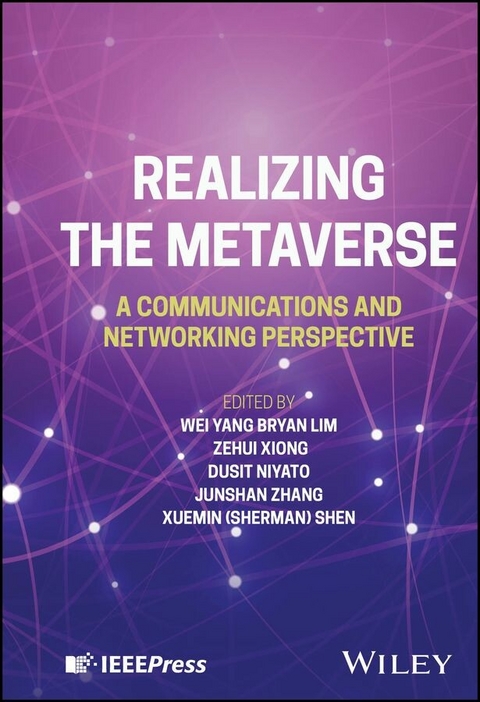
Realizing the Metaverse (eBook)
206 Seiten
Wiley-IEEE Press (Verlag)
9781394188925 (ISBN)
A guide to the challenges in making virtual reality, reality
The Metaverse, a version of the internet in which online interactions take place in real time within fully realized virtual spaces, has been promised as the next frontier in wireless communication. It has drawn huge investment from Silicon Valley and widespread media attention. However, the technologies required to make the Metaverse a reality are still in their infancy, and significant barriers must be overcome if this massive step is to be taken.
Realizing the Metaverse provides a systematic overview of these challenges and their likely solutions. Focusing on five key areas-infrastructure, access, intelligence, security, and future developments-it offers one of the first comprehensive, formalized treatments of the Metaverse as a nascent reality. It promises to be an integral contribution to the future development of Metaverse technologies.
Realizing the Metaverse readers will also find:
- An editorial team with extensive research experience in the field
- Detailed discussion of topics such as augmented reality (AR) adaptation, haptic feedback, artificial intelligence, and more
- Enlightening discussion of open questions and future prospects for research
Realizing the Metaverse is ideal for graduate and advanced undergraduate students in wireless technology, network communications, and related fields, as well as for researchers and industry professionals involved with the Metaverse or adjacent technologies.
Wei Yang Bryan Lim, PhD, is a Wallenberg-NTU Presidential Postdoctoral Fellow, Nanyang Technological University, Singapore. He has received Best Paper Awards from the IEEE Wireless Communications and Networking Conference and the IEEE SPCC Technical Committee, and regularly serves as a reviewer for leading journals.
Zehui Xiong, PhD, is an Assistant Professor at Singapore University of Technology and Design. He has published extensively, won many prestigious career/paper awards, and served as the editor for many leading journals in the areas of Internet of Things, edge computing and intelligence. He serves as the Associate Director of Future Communications R&D Programme. He was featured on the list of Forbes Asia 30 under 30 in 2023.
Dusit Niyato, PhD, is a Professor in the School of Computer and Engineering, Nanyang Technological University, Singapore. He is an IEEE Fellow and serves as editor of numerous prestigious journals, including as editor-in-chief of IEEE Communications Surveys and Tutorials.
Junshan Zhang, PhD, is a Professor in the Electrical and Computer Engineering Department at the University of California, Davis, USA. He has researched and published extensively on information networks, data science, 5g, wireless communications, and related subjects, and currently serves as editor-in-chief for IEEE Transactions on Wireless Communication.
Xuemin (Sherman) Shen, PhD, is a University Professor in the Department of Electrical and Computer Engineering, University of Waterloo, Canada. He has published extensively on network resource management, wireless network security, Internet of Things, 5G, and more. He is a Fellow of the Engineering Institute of Canada, the Canadian Academy of Engineering, and the Royal Society of Canada, among others.
A guide to the challenges in making virtual reality, reality The Metaverse, a version of the internet in which online interactions take place in real time within fully realized virtual spaces, has been promised as the next frontier in wireless communication. It has drawn huge investment from Silicon Valley and widespread media attention. However, the technologies required to make the Metaverse a reality are still in their infancy, and significant barriers must be overcome if this massive step is to be taken. Realizing the Metaverse provides a systematic overview of these challenges and their likely solutions. Focusing on five key areas infrastructure, access, intelligence, security, and future developments it offers one of the first comprehensive, formalized treatments of the Metaverse as a nascent reality. It promises to be an integral contribution to the future development of Metaverse technologies. Realizing the Metaverse readers will also find: An editorial team with extensive research experience in the field Detailed discussion of topics such as augmented reality (AR) adaptation, haptic feedback, artificial intelligence, and more Enlightening discussion of open questions and future prospects for research Realizing the Metaverse is ideal for graduate and advanced undergraduate students in wireless technology, network communications, and related fields, as well as for researchers and industry professionals involved with the Metaverse or adjacent technologies.
| Erscheint lt. Verlag | 20.11.2024 |
|---|---|
| Sprache | englisch |
| Themenwelt | Mathematik / Informatik ► Informatik ► Theorie / Studium |
| Schlagworte | Artificial Intelligence • artificial reality • Blockchain • Covert Communications • data analytics • data fusion • Digital Twins • distributed learning • haptic feedback • low-latency collaboration • machine learning • Nvidia Omniverse • Virtual Reality |
| ISBN-13 | 9781394188925 / 9781394188925 |
| Informationen gemäß Produktsicherheitsverordnung (GPSR) | |
| Haben Sie eine Frage zum Produkt? |
 PDF (Adobe DRM)
Kopierschutz: Adobe-DRM
Adobe-DRM ist ein Kopierschutz, der das eBook vor Mißbrauch schützen soll. Dabei wird das eBook bereits beim Download auf Ihre persönliche Adobe-ID autorisiert. Lesen können Sie das eBook dann nur auf den Geräten, welche ebenfalls auf Ihre Adobe-ID registriert sind.
Details zum Adobe-DRM
Dateiformat: PDF (Portable Document Format)
Mit einem festen Seitenlayout eignet sich die PDF besonders für Fachbücher mit Spalten, Tabellen und Abbildungen. Eine PDF kann auf fast allen Geräten angezeigt werden, ist aber für kleine Displays (Smartphone, eReader) nur eingeschränkt geeignet.
Systemvoraussetzungen:
PC/Mac: Mit einem PC oder Mac können Sie dieses eBook lesen. Sie benötigen eine
eReader: Dieses eBook kann mit (fast) allen eBook-Readern gelesen werden. Mit dem amazon-Kindle ist es aber nicht kompatibel.
Smartphone/Tablet: Egal ob Apple oder Android, dieses eBook können Sie lesen. Sie benötigen eine
Geräteliste und zusätzliche Hinweise
Buying eBooks from abroad
For tax law reasons we can sell eBooks just within Germany and Switzerland. Regrettably we cannot fulfill eBook-orders from other countries.
aus dem Bereich