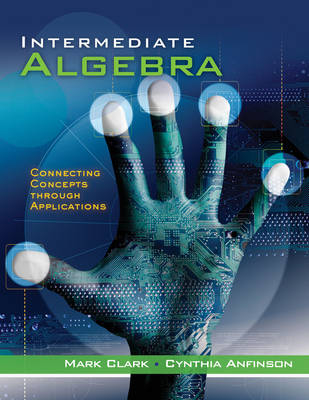
Intermediate Algebra
Brooks/Cole (Verlag)
978-0-534-49636-4 (ISBN)
- Titel erscheint in neuer Auflage
- Artikel merken

First, the authors integrate applications, drawing on real-world data to show students why they need to know and how to apply math. The applications help students develop the skills needed to explain the meaning of answers in the context of the application.
Second, they emphasize strong algebra skills. These skills support the applications and enhance student comprehension.
Third, the authors use an eyeball best-fit approach to modeling. Doing models by hand helps students focus on the characteristics of each function type.
Fourth, the text underscores the importance of graphs and graphing. Students learn graphing by hand, while the graphing calculator is used to display real-life data problems.
In short, INTERMEDIATE ALGEBRA: CONNECTING CONCEPTS THROUGH APPLICATIONS takes an application-driven approach to algebra, using appropriate calculator technology as students master algebraic concepts and skills.
Mark Clark graduated from California State University, Long Beach, and holds bachelor's and master's degrees in Mathematics. A full-time associate professor at Palomar College, since 1996, Mark is committed to teaching using applications and technology to help students understand mathematics in context and communicate results clearly. Intermediate algebra is one of his favorite courses to teach and he continues to teach several sections of this course each year. He is co-author of BEGINNING ALGEBRA: CONNECTING CONCEPTS THROUGH APPLICATIONS, INTERMEDIATE ALGEBRA: CONNECTING CONCEPTS THROUGH APPLICATIONS, and BEGINNING AND INTERMEDIATE ALGEBRA: CONNECTING CONCEPTS THROUGH APPLICATIONS published by Cengage. Mark shares his passion for using applications to teach mathematical concepts by delivering workshops and talks to other instructors at local and national conferences. Cynthia (Cindy) Anfinson graduated from UCSD's Revelle College in 1985, summa cum laude, with a Bachelor of Arts Degree in Mathematics and is a member of Phi Beta Kappa. She went to graduate school at Cornell University under the Army Science and Technology Graduate Fellowship. She graduated from Cornell in 1989 with a Master of Science Degree in Applied Mathematics. She is currently an Associate Professor of Mathematics at Palomar College and has been teaching there since 1995. Cindy Anfinson was a finalist in Palomar College's 2002 Distinguished Faculty Award.
Note – Each chapter contains Summary, Review Exercises, Chapter Test, and Projects.
1. LINEAR FUNCTIONS.
Solving Linear Equations. Using Data to Create Scatterplots. Using Data to Create Scatterplots. Graphical Models. Intercepts, Domain, and Range. Fundamentals of Graphing and Slope. Introduction to Graphing Functions. Slope-Intercept Form of a Line. The Meaning of Slope in an Application. Graphing Lines Using Slope and Intercept. Intercepts and Graphing. The General Form of Lines. Finding Intercepts and Their Meaning. Graphing Lines Using Intercepts. Horizontal and Vertical Lines. Finding Equations of Lines. Finding Equations of Lines. Parallel and Perpendicular Lines. Interpreting the Characteristics of a Line, a Review. Finding Linear Models. Using a Calculator to Create Scatterplots. Finding Linear Models. Functions and Function Notation. Relations and Functions. Function Notation. Writing Models in Function Notation. Domain and Range of Functions.
2. SYSTEMS OF LINEAR EQUATIONS AND INEQUALITIES.
Systems of Linear Equations. Definition of Systems. Graphical and Numerical Solutions. Types of Systems. Solving Systems of Equations Using the Substitution Method. Substitution Method. Dependent and Inconsistent Systems. Solving Systems of Equations Using the Elimination Method. Elimination Method. Solving Linear Inequalities. Introduction to Inequalities. Solving Inequalities. Systems as Inequalities. Solving Inequalities Numerically and Graphically. Absolute Value Equations and Inequalities. Absolute Value Equations. Absolute Value Inequalities Involving Less Than, or Less Than or Equal To. Absolute Value Inequalities Involving Greater Than, or Greater Than or Equal To. Solving Systems of Linear Inequalities. Graphing Linear Inequalities in Two Variables. Solving Systems of Linear Inequalities.
3. EXPONENTS, POLYNOMIAL AND FUNCTIONS.
Rules for Exponents. Rules for Exponents. Negative Exponents and Zero as an Exponent. Rational Exponents. Combining Functions. Defining Polynomials. Adding and Subtracting Functions. Multiplying and Dividing Functions. Composing Functions. Composing Functions. Factoring Polynomials. Factoring Using the AC Method. Factoring Using Trial and Error. Prime Polynomials. Special Factoring Techniques. Perfect Square Trinomials. Difference of Squares. Difference and Sum of Cubes. Multi-Step Factorizations.
4. QUADRATIC FUNCTIONS.
Quadratic Functions and Parabolas. Introduction to Quadratics and Identifying the Vertex. Identifying a Quadratic Function. Recognizing Graphs of Quadratic Functions and Indentifying the Vertex. Solving Quadratics Using the Graph. Graphing Quadratics in Vertex Form. Vertex Form. Graphing Quadratics in Vertex Form. Finding Quadratic Models. Finding Quadratic Models. Domain and Range. Solving Quadratic Equations by Square Root Property and Completing the Square. Solving from Vertex Form. Completing the Square. Converting to Vertex Form. Graphing from Vertex From with x-Intercepts. Solving Quadratic Equations by Factoring. Solving by Factoring. Finding an Equation from the Graph. Solving Quadratic Equations Using the Quadratic Formula. Determining Which Algebraic Method to Use. Solving Systems of Equations with Quadratics. Graphing Quadratics from Standard Form. Graphing from Standard Form. Graphing Quadratic Inequalities in Two Variables.
5. EXPONENTIAL FUNCTIONS.
Exponential Functions: Patterns of Growth and Decay. Exploring Exponential Growth and Decay. Recognizing Exponential Patterns. Solving Equations Using Exponent Rules. Recap of the Rules for Exponents. Solving Simple Exponential Equations. Solve Power Equations. Graphing Exponential Functions. Exploring Graphs of Exponentials. Domain and Range of Exponential Functions. Finding Exponential Models. Finding Exponential Models. Domain and Range for Exponential Models. Exponential Growth and Decay Rates and Compounding Interest. Exponential Growth and Decay Rates. Compounding Interest.
6. LOGARITHMIC FUNCTIONS.
Functions and Their Inverses. Introduction to Inverse Functions. One-to-One Functions. Logarithmic Functions. Definition of Logarithms. Basic Rules for Logarithms. Change of Base Formula. Inverses. Solving Simple Logarithmic Equations. Graphing Logarithmic Functions. Graphing Logarithmic Functions. Domain and Range of Logarithmic Functions. Properties of Logarithms. Properties of Logarithms. Solving Exponential Equations. Solving Exponential Equations. Compounding Interest. Solving Logarithmic Equations. Applications of Logarithms. Solving Other Logarithmic Equations.
7. RATIONAL FUNCTIONS.
Rational Functions and Variation. Rational Functions. Direct and Inverse Variation. Domain. Simplifying Rational Expressions. Simplifying Rational Expressions. Long Division of Polynomials. Synthetic Division. Multiplying and Dividing Rational Expressions. Multiplying Rational Expressions. Dividing Rational Expressions. Adding and Subtracting Rational Expressions. Least Common Denominator. Adding Rational Expressions. Subtracting Rational Expressions. Simplifying Complex Fractions. Solving Rational Equations.
8. RADICAL FUNCTIONS.
Radical Functions. Modeling Data with Radical Functions. Domain and Range of Radical Functions. Simplifying, Adding, and Subtracting Radicals. Square Roots and Higher Roots. Simplifying Radicals. Adding and Subtracting Radicals. Multiplying and Dividing Radicals. Multiplying Radicals. Dividing Radicals and Rationalizing the Denominator. Conjugates. Solving Radical Equations. Solving Equations with Square Roots. Solving Equations with More than One Square Root. Solving Equations with Higher Order Radicals. Complex Numbers. Definition of Imaginary and Complex Numbers. Operations with Complex Numbers. Solving Equations with Complex Solutions.
9. CONICS, SEQUENCES AND SERIES.
Parabolas and Circles. Introduction to Conic Sections. Equations and Graphs of Circles. Ellipses and Hyperbolas. Equations and Graphs of the Ellipse. Equations and Graphs of the Hyperbola. Arithmetic Sequences. Introduction to Sequences. Arithmetic Sequences. Geometric Sequences. Geometric Sequences. Series. Introduction to Series. Arithmetic Series. Geometric Series.
APPENDIX A.
Basic Algebra Review. Review of Number Systems. Operations with Integers. Operations with Rationals. Review of Solving Linear Equations. Scientific Notation. Interval Notation.
APPENDIX B.
Matrices. Solving Systems of Three Equations. Introduction to Matrices. Matrix Row Reduction. Solving Systems with Matrices. Using Systems of Three Equations to Model Quadratics.
APPENDIX C.
Using the Graphing Calculator. Steps for Using the Graphing Calculator. Troubleshooting Error Messages.
APPENDIX D.
Answers to Odd-Numbered Exercises.
APPENDIX E.
Answers to the Example Practice Problems.
| Erscheint lt. Verlag | 1.1.2011 |
|---|---|
| Verlagsort | CA |
| Sprache | englisch |
| Maße | 225 x 284 mm |
| Gewicht | 1700 g |
| Themenwelt | Mathematik / Informatik ► Mathematik ► Algebra |
| ISBN-10 | 0-534-49636-9 / 0534496369 |
| ISBN-13 | 978-0-534-49636-4 / 9780534496364 |
| Zustand | Neuware |
| Informationen gemäß Produktsicherheitsverordnung (GPSR) | |
| Haben Sie eine Frage zum Produkt? |
aus dem Bereich