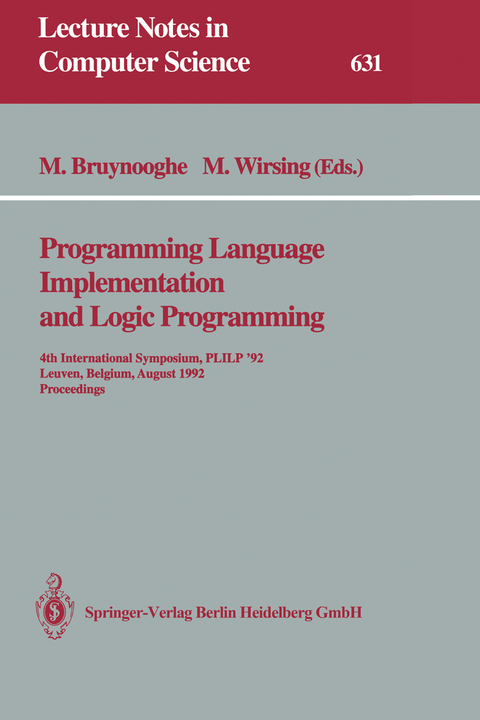
Programming Language Implementation and Logic Programming
Springer Berlin (Verlag)
978-3-540-55844-6 (ISBN)
Prof. Dr. Martin Wirsing ist Leiter des Lehrstuhls für Programmierung und Software-Technik des Instituts für Informatik der LMU München und Vizepräsident der LMU für den Bereich Studium.
Improving control of logic programs by using functional logic languages.- Independent AND-parallel implementation of narrowing.- Binding techniques and garbage collection for OR-parallel CLP systems.- Path analysis for lazy data structures.- Why the occur-check is not a problem.- Incremental evaluation of natural semantics specifications.- Subsumption-oriented Push-Down Automata.- Unlimp uniqueness as a leitmotiv for implementation.- Using cached functions and constructors for incremental attribute evaluation.- Strictness analysis for attribute grammars.- Checking and debugging of two-level grammars.- On safe folding.- Unfold/fold transformations preserving termination properties.- A technique for transforming logic programs by fold-unfold transformations.- FOLON: An environment for declarative construction of logic programs.- A complete indexing scheme for WAM-based abstract machines.- Fast prolog with a VAM1p based Prolog compiler.- Metastructures vs. attributed variables in the context of extensible unification.- Comparing the Galois connection and widening/narrowing approaches to abstract interpretation.- Derivation of linear size relations by abstract interpretation.- Generic abstract interpretation algorithms for prolog: Two optimization techniques and their experimental evaluation.- A bottom-up interpreter for a higher-order logic programming language.- Camel: An extension of the categorical abstract machine to compile functional/logic programs.- On the interaction of lazy evaluation and backtracking.- Interprocedural dynamic slicing.- Algorithmic debugging for lazy functional languages.- A general trace query mechanism based on Prolog.- Fully declarative logic programming.- Our LIPS are sealed: Interfacing functional and logic programming systems.- Analyses of inconsistency for incremental equational logic programming.- I/O trees and interactive lazy functional programming.- UCG-E: An equational logic programming system.- A relational programming system with inferred representations.- An implementation of action semantics (Summary).- BinProlog: A continuation passing style Prolog engine.- LaToKi: A language toolkit for bottom-Up evaluation of functional programs.- Implementing higher-order functions in an algebraic specification language with narrowing.- Implementing attribute grammars by computational models.- ProQuery: Logical access to an OODB.- Inference of inheritance relationships from Prolog programs: a system developed with PrologIII.- CLP(PB).
| Erscheint lt. Verlag | 12.8.1992 |
|---|---|
| Reihe/Serie | Lecture Notes in Computer Science |
| Zusatzinfo | XI, 494 p. 27 illus. |
| Verlagsort | Berlin |
| Sprache | englisch |
| Maße | 170 x 244 mm |
| Gewicht | 751 g |
| Themenwelt | Mathematik / Informatik ► Informatik ► Programmiersprachen / -werkzeuge |
| Informatik ► Theorie / Studium ► Künstliche Intelligenz / Robotik | |
| Schlagworte | algorithm • algorithms • Compiler • Compilerbau • Functional Programming • Funktionelles Programmieren • Hardcover, Softcover / Informatik, EDV/Programmiersprachen • HC/Informatik, EDV/Programmiersprachen • Implementierung • Implmentation • Logic • Logic Programming • Logische Programmierung • Logisches Programmieren • object-oriented programming • Programmierkonzepte • Programmiersprache • Programmierung • programming • Programming language |
| ISBN-10 | 3-540-55844-6 / 3540558446 |
| ISBN-13 | 978-3-540-55844-6 / 9783540558446 |
| Zustand | Neuware |
| Informationen gemäß Produktsicherheitsverordnung (GPSR) | |
| Haben Sie eine Frage zum Produkt? |
aus dem Bereich