


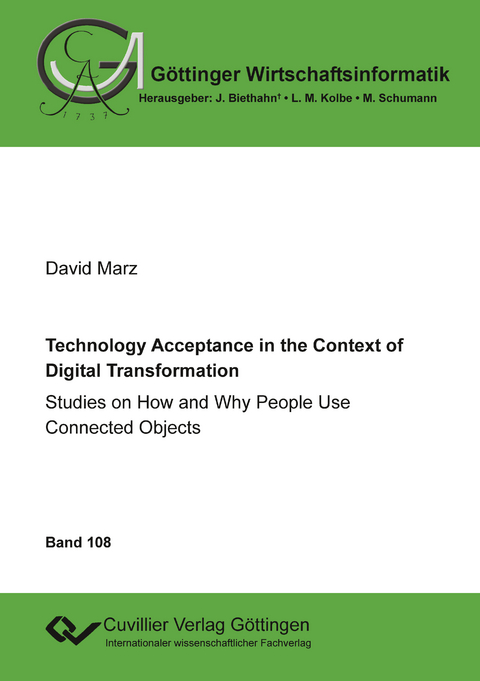
Technology Acceptance in the Context of Digital Transformation
Seiten
2021
Cuvillier Verlag
978-3-7369-7370-1 (ISBN)
Cuvillier Verlag
978-3-7369-7370-1 (ISBN)
- Keine Verlagsinformationen verfügbar
- Artikel merken
The widespread diffusion of digital, connected objects such as smartphones or tablets as well as the increasing integration of computing and connectivity capabilities into everyday artifacts like TVs and cars have significantly changed individual behavior in recent decades: it has become the norm to interact with technology and to be connected with online resources regardless of time and place. Social interactions have increasingly become intertwined with technology, making it almost impossible to fully participate in everyday life activities without IT. As a final example, with the integration of network connectivity, digital technologies, products, and services are not used in isolation anymore, but working together as assemblages, thereby expanding the range of what they and their users can do. Overall, we have witnessed that IT has become deeply socially embedded in everyday life and routines.
Understanding individual behavior has a long tradition in information systems research. However, given the fundamental changes in recent years related to technology use, it is questionable whether traditional models and theories are still applicable in the digital age. The goal of this dissertation is to address respective shortcomings. As a first step, a comprehensive review of the literature on digital transformation is performed for a better understanding of this phenomenon surrounding the changes we have witnessed regarding individual behavior. Afterwards, new concepts to explain and measure individual behavior and expectations related to connected objects are developed and examined. Furthermore, as the topic of connected objects is closely connected to the concept of personalization, a design study is performed that 1) provides an artifact to handle the efficiency-personalization trade-off in the provision of firm offerings and 2) illustrates how personalization influences the user perceptions of respective products and services. Based on the findings, a framework for the study of connected objects is synthesized and presented. Overall, the findings of this dissertation have relevant implications for research and practice in the fields of technology acceptance, digital life, and digital transformation.
Understanding individual behavior has a long tradition in information systems research. However, given the fundamental changes in recent years related to technology use, it is questionable whether traditional models and theories are still applicable in the digital age. The goal of this dissertation is to address respective shortcomings. As a first step, a comprehensive review of the literature on digital transformation is performed for a better understanding of this phenomenon surrounding the changes we have witnessed regarding individual behavior. Afterwards, new concepts to explain and measure individual behavior and expectations related to connected objects are developed and examined. Furthermore, as the topic of connected objects is closely connected to the concept of personalization, a design study is performed that 1) provides an artifact to handle the efficiency-personalization trade-off in the provision of firm offerings and 2) illustrates how personalization influences the user perceptions of respective products and services. Based on the findings, a framework for the study of connected objects is synthesized and presented. Overall, the findings of this dissertation have relevant implications for research and practice in the fields of technology acceptance, digital life, and digital transformation.
| Erscheinungsdatum | 28.02.2021 |
|---|---|
| Reihe/Serie | Göttinger Wirtschaftsinformatik ; 108 |
| Verlagsort | Göttingen |
| Sprache | englisch |
| Maße | 148 x 210 mm |
| Themenwelt | Mathematik / Informatik ► Mathematik ► Finanz- / Wirtschaftsmathematik |
| Wirtschaft ► Betriebswirtschaft / Management | |
| Schlagworte | Affordance • Angebotscharakter • Autonome Fahrzeuge • Autonomous Vehicles • conflicting objectives • connectivity • construct development • contextualization • Customer-centricity • Customer Satisfaction • digital business • Digital Connectivity • digital ecosystems • Digitale Individuen • Digitale Innovationen • Digitale Ökosysteme • Digitales Leben • Digitales Zeitalter • digitale Technologien • digitale Transformation • Digitale Verbundenheit • Digitalgeschäft • digital individuals • Digital Life • Digital technologies • Ecosystem Perspective • Empirical Study • Empirische Untersuchung • Forschungsagenda • framework development • Frameworkentwicklung • Human-Computer interaction • Individual Behaviour • Individuelles Verhalten • Informationssysteme • information systems • Internet der Dinge • internet of things • Konnektivität • Konstruktentwicklung • Kontextualisierung • kundenzentrierung • Kundenzufriedenheit • Literaturanalyse • literature review • machine learning • Maschinelles Lernen • Mensch-Computer-Interaktion • networked objects • Networking • Netzwerkverbindung • Ökosystemperspektive • Online-Ressourcen • Organisational Change • Organisatorischer Wandel • Personalisation • Personalisierung • private digital ecosystems • Private digitale Ökosysteme • Psychologie • Psychology • Research Agenda • Selbstbestimmungstheorie • Self-Determination Theory • sharing business models • Sharing Geschäftsmodelle • social change • Sozialer Wandel • structural equation models • Strukturgleichungsmodelle • Technologieakzeptanz • Technologieakzeptanzmodell • Technology Acceptance • Technology Acceptance Model • Trade-offs • Typologie • Typology • Vernetzte Objekte • Zielkonflikte |
| ISBN-10 | 3-7369-7370-5 / 3736973705 |
| ISBN-13 | 978-3-7369-7370-1 / 9783736973701 |
| Zustand | Neuware |
| Informationen gemäß Produktsicherheitsverordnung (GPSR) | |
| Haben Sie eine Frage zum Produkt? |
Mehr entdecken
aus dem Bereich


aus dem Bereich


