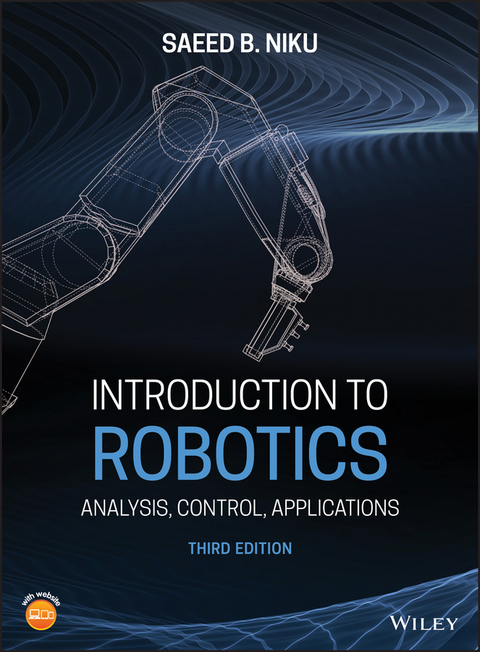
Introduction to Robotics (eBook)
John Wiley & Sons (Verlag)
978-1-119-52760-2 (ISBN)
The revised text to the analysis, control, and applications of robotics
The revised and updated third edition of Introduction to Robotics: Analysis, Control, Applications, offers a guide to the fundamentals of robotics, robot components and subsystems and applications. The author-a noted expert on the topic-covers the mechanics and kinematics of serial and parallel robots, both with the Denavit-Hartenberg approach as well as screw-based mechanics. In addition, the text contains information on microprocessor applications, control systems, vision systems, sensors, and actuators.
Introduction to Robotics gives engineering students and practicing engineers the information needed to design a robot, to integrate a robot in appropriate applications, or to analyze a robot. The updated third edition contains many new subjects and the content has been streamlined throughout the text. The new edition includes two completely new chapters on screw-based mechanics and parallel robots. The book is filled with many new illustrative examples and includes homework problems designed to enhance learning. This important text:
- Offers a revised and updated guide to the fundamental of robotics
- Contains information on robot components, robot characteristics, robot languages, and robotic applications
- Covers the kinematics of serial robots with Denavit-Hartenberg methodology and screw-based mechanics
- Includes the fundamentals of control engineering, including analysis and design tools
- Discusses kinematics of parallel robots
Written for students of engineering as well as practicing engineers, Introduction to Robotics, Third Edition reviews the basics of robotics, robot components and subsystems, applications, and has been revised to include the most recent developments in the field.
SAEED BENJAMIN NIKU, PHD, P.E., is a Professor of Mechanical Engineering at California Polytechnic State University, San Luis Obispo, California. He has taught courses in mechanics, robotics, design, and creativity.
SAEED BENJAMIN NIKU, PHD, P.E., is a Professor of Mechanical Engineering at California Polytechnic State University, San Luis Obispo, California. He has taught courses in mechanics, robotics, design, and creativity.
1
Fundamentals
1.1 Introduction
Robotics, the fascinating world of creating devices that mimic living creatures and are capable of performing tasks and behaving as if they are almost alive and able to understand the world around them, has been on humans' minds since the time we could build things. You may have seen machines made by artisans, which try to mimic humans' motions and behavior. Examples include the statues in Venice's San Marcos clock tower that hit the clock on the hour, figurines that tell a story in the fifteenth century astronomical clock on the side of the Old Town Hall tower in Prague, and the systems that Leonardo da Vinci sketched in his notebooks. Toys, from very simple types to very sophisticated machines with repeating movements, are other examples. In Hollywood, movies have even portrayed robots and humanoids as superior to humans.
Although humanoids, autonomous cars, and mobile robots are fundamentally robots and are designed and governed by the same basics, in this book we primarily study industrial manipulator‐type robots. This book covers some basic introductory material that familiarizes you with the subject; presents an analysis of the mechanics of robots including kinematics, dynamics, and trajectory planning; and discusses the elements that are used in robots and in robotics, such as actuators, sensors, vision systems, and so on. Robot rovers are no different, although they usually have fewer degrees of freedom (DOF) and generally move in a plane. Exoskeletal and humanoid robots, walking machines, and robots that mimic animals and insects have many DOF and may possess unique capabilities. However, the same principles we learn about manipulators apply to robot rovers too, whether kinematics, differential motions, dynamics, or control.
Robots are very powerful elements of today's industry. They are capable of performing many different tasks and operations, are accurate, and do not require common safety and comfort elements humans need, including in hazardous environments such as underwater, disaster areas, and space. However, it takes much effort and many resources to make a robot function properly. Most of the hundreds of companies that made robots in the mid‐1980s are gone; and, with few exceptions, only companies that make real industrial robots have remained in the market (such as OMRON Adept, Stäubli, ABB, FANUC, KUKA, Epson, Motoman, DENSO, Fuji, Yaskawa, Kawasaki, and Universal Robots, as well as specialty robotic companies such as MAKO Surgical Corp., and Intuitive). Although there are several million robots working in factories, and the numbers are growing, early industrialists' predictions about the possible number of robots in industry never materialized because high expectations could not be met with the present robots. Innovations such as artificial intelligence embedded in robots, and new types of robots (such as parallel robots), have improved the situation and will continue to do so. However, robots are used where they are useful. Like humans, robots can do certain things but not others. As long as they are designed properly for the intended purposes, they are very useful and continue to be used. Current predictions indicate sustained growth in the number of robots used in industry in many different forms, from manufacturing and assembly to self‐driving delivery robots, and from autonomous vehicles to domestic workers [1–4].
The subject of robotics covers many different areas. Robots alone are hardly ever useful: they are used together with peripheral devices and other manufacturing machines. They are generally integrated into a system, which as a whole is designed to perform a task or do an operation. In this book, we will refer to some of these other devices and systems that are used with robots.
1.2 What Is a Robot?
If you compare a conventional robot manipulator with a crane attached to, let's say, a utility or towing vehicle, you will notice that the robot manipulator is very similar to the crane. Both possess a number of links attached serially to each other with joints, where each joint can be moved by some type of actuator. In both systems, the “hand” of the manipulator can be moved in space and placed in any desired location within the workspace of the system. Each one can carry a certain load, and in each, a central controller controls the actuators. However, one is called a robot, and the other is called a manipulator (or, in this case, a crane). Similarly, material‐handling manipulators that move heavy objects in manufacturing plants look just like robots, but they are not robots. The fundamental difference between the two is that the crane and the manipulator are controlled by a human who operates and controls the actuators, whereas the robot manipulator is controlled by a computer or microprocessor that runs a program (Figure 1.1). This difference determines whether a device is a simple manipulator or a robot. In general, robots are designed and meant to be controlled by a computer or similar device. The motions of the robot are controlled through a controller under the supervision of the computer, which is running some type of program. Therefore, if the program is changed, the actions of the robot will change accordingly. The intention is to have a device that can perform many different tasks; consequently, it is very flexible in what it can do without having to be redesigned. Therefore, the robot is designed to be able to perform many tasks based on the running program(s) simply by changing the program. The simple manipulator (or the crane) cannot do this without an operator running it all the time.
Different countries have different standards for what they consider a robot. In American standards, a device must be easily reprogrammable to be considered a robot. Therefore, manual handling devices (devices that have multiple degrees of freedom and are actuated by an operator) and fixed‐sequence robots (devices controlled by hard stops to control actuator motions on a fixed sequence, which is difficult to change) are not considered robots.
Figure 1.1 (a) A Dalmec manipulator; (b) a KUKA robot. Although they are both handling large loads, one is controlled by a human operator and the other is controlled by a controller.
Source: Reproduced with permission from Dalmec USA and Kuka Robotics.
1.3 Classification of Robots
The following is a general list of classifications of devices that are considered robots. Different countries have different classifications, and, consequently, the number of robots in use in a country may be influenced by the definition:
- Fixed‐sequence robot: A device that performs the successive stages of a task according to a predetermined, unchanging method that is hard to modify.
- Playback robot: A human operator performs a task manually by leading the robot, which records the motions for later playback. The robot repeats the same motions according to the recorded information.
- Numerical‐control robot: The operator supplies the robot with a movement program rather than teaching it the task manually.
- Intelligent robot: A robot with the means to understand its environment and the ability to successfully complete a task despite changes in the surrounding conditions under which it is to be performed.
1.4 What Is Robotics?
Robotics is the art, knowledge base, and know‐how of designing, applying, and using robots in human endeavors. Robotic systems consist of not just robots, but also other devices and systems that are used together with the robots. Robots may be used in manufacturing environments, in underwater and space exploration, in researching human and animal behavior, for aiding the disabled, for transportation and delivery, for military purposes, or even for fun. In any capacity, robots can be useful but need to be programmed and controlled. Robotics is an interdisciplinary subject that benefits from mechanical engineering, electrical and electronic engineering, computer science, cognitive sciences, biology, and many other disciplines.
1.5 History of Robotics
Disregarding the early machines that were made to mimic humans and their actions, and concentrating on recent history, we can see a close relationship between the state of industry, the revolution in numeric and computer control of machinery, nuclear material handling, space exploration, and the vivid imagination of creative people. Starting with Karel Capek and his play R.U.R. (Rossum's Universal Robots) [5], and later, movies like Flash Gordon, Metropolis, Lost in Space, The Day the Earth Stood Still, and Forbidden Planet [6], the stage was set for a machine to be built to do a human's job (and, of course, R2D2, C3PO, Robocop, Transformers, the Bicentennial Man, and others continued the trend).
Capek dreamed of a scenario where a bioprocess could create human‐like machines, devoid of emotions and souls, who were strong beyond their masters and could be produced quickly and cheaply. Soon, the market grew tremendously when all major countries wanted to “equip” their armies with hundreds of thousands of slave robotic soldiers, who would fight with dedication but whose death would not matter. Eventually, the robots decided that they were actually superior to the humans, took over the whole world, and killed everyone. In this story, the word rabota or...
| Erscheint lt. Verlag | 17.12.2019 |
|---|---|
| Sprache | englisch |
| Themenwelt | Informatik ► Theorie / Studium ► Künstliche Intelligenz / Robotik |
| Technik ► Elektrotechnik / Energietechnik | |
| Technik ► Maschinenbau | |
| Schlagworte | analysis of robotics • Applications of Robotics • Control Process & Measurements • Control Systems Technology • differential motions and velocities of robotics • dynamic and force analysis of robotics • Electrical & Electronics Engineering • Elektrotechnik u. Elektronik • Fuzzy Logic • guide to robotics • Introduction to robotics • kinematics of parallel robots • kinematics of serial robots • Maschinenbau • mechanical engineering • Mess- u. Regeltechnik • Regelungstechnik • robot actuators • Robotics • Robotik • sensors • text on robotics • Trajectories • understanding robotics • vision systems |
| ISBN-10 | 1-119-52760-0 / 1119527600 |
| ISBN-13 | 978-1-119-52760-2 / 9781119527602 |
| Informationen gemäß Produktsicherheitsverordnung (GPSR) | |
| Haben Sie eine Frage zum Produkt? |
 EPUB (Adobe DRM)
Kopierschutz: Adobe-DRM
Adobe-DRM ist ein Kopierschutz, der das eBook vor Mißbrauch schützen soll. Dabei wird das eBook bereits beim Download auf Ihre persönliche Adobe-ID autorisiert. Lesen können Sie das eBook dann nur auf den Geräten, welche ebenfalls auf Ihre Adobe-ID registriert sind.
Details zum Adobe-DRM
Dateiformat: EPUB (Electronic Publication)
EPUB ist ein offener Standard für eBooks und eignet sich besonders zur Darstellung von Belletristik und Sachbüchern. Der Fließtext wird dynamisch an die Display- und Schriftgröße angepasst. Auch für mobile Lesegeräte ist EPUB daher gut geeignet.
Systemvoraussetzungen:
PC/Mac: Mit einem PC oder Mac können Sie dieses eBook lesen. Sie benötigen eine
eReader: Dieses eBook kann mit (fast) allen eBook-Readern gelesen werden. Mit dem amazon-Kindle ist es aber nicht kompatibel.
Smartphone/Tablet: Egal ob Apple oder Android, dieses eBook können Sie lesen. Sie benötigen eine
Geräteliste und zusätzliche Hinweise
Buying eBooks from abroad
For tax law reasons we can sell eBooks just within Germany and Switzerland. Regrettably we cannot fulfill eBook-orders from other countries.
aus dem Bereich