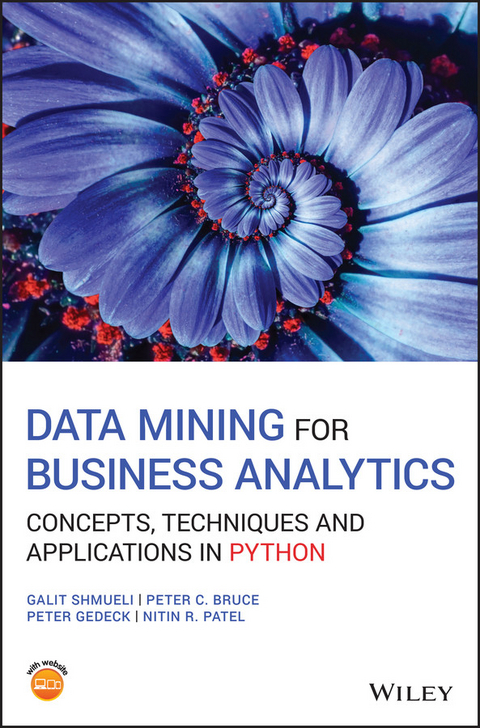
Data Mining for Business Analytics (eBook)
John Wiley & Sons (Verlag)
978-1-119-54986-4 (ISBN)
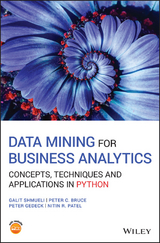
Data Mining for Business Analytics: Concepts, Techniques, and Applications in Python presents an applied approach to data mining concepts and methods, using Python software for illustration
Readers will learn how to implement a variety of popular data mining algorithms in Python (a free and open-source software) to tackle business problems and opportunities.
This is the sixth version of this successful text, and the first using Python. It covers both statistical and machine learning algorithms for prediction, classification, visualization, dimension reduction, recommender systems, clustering, text mining and network analysis. It also includes:
- A new co-author, Peter Gedeck, who brings both experience teaching business analytics courses using Python, and expertise in the application of machine learning methods to the drug-discovery process
- A new section on ethical issues in data mining
- Updates and new material based on feedback from instructors teaching MBA, undergraduate, diploma and executive courses, and from their students
- More than a dozen case studies demonstrating applications for the data mining techniques described
- End-of-chapter exercises that help readers gauge and expand their comprehension and competency of the material presented
- A companion website with more than two dozen data sets, and instructor materials including exercise solutions, PowerPoint slides, and case solutions
Data Mining for Business Analytics: Concepts, Techniques, and Applications in Python is an ideal textbook for graduate and upper-undergraduate level courses in data mining, predictive analytics, and business analytics. This new edition is also an excellent reference for analysts, researchers, and practitioners working with quantitative methods in the fields of business, finance, marketing, computer science, and information technology.
'This book has by far the most comprehensive review of business analytics methods that I have ever seen, covering everything from classical approaches such as linear and logistic regression, through to modern methods like neural networks, bagging and boosting, and even much more business specific procedures such as social network analysis and text mining. If not the bible, it is at the least a definitive manual on the subject.'
-Gareth M. James, University of Southern California and co-author (with Witten, Hastie and Tibshirani) of the best-selling book An Introduction to Statistical Learning, with Applications in R
GALIT SHMUELI, PHD, is Distinguished Professor at National Tsing Hua University's Institute of Service Science. She has designed and instructed data mining courses since 2004 at University of Maryland, Statistics.com, Indian School of Business, and National Tsing Hua University, Taiwan. Professor Shmueli is known for her research and teaching in business analytics, with a focus on statistical and data mining methods in information systems and healthcare. She has authored over 100 publications including books.
PETER C. BRUCE is President and Founder of the Institute for Statistics Education at Statistics.com. He has written multiple journal articles and is the developer of Resampling Stats software. He is the author of Introductory Statistics and Analytics: A Resampling Perspective (Wiley) and co-author of Practical Statistics for Data Scientists: 50 Essential Concepts (O'Reilly).
PETER GEDECK, PHD, is a Senior Data Scientist at Collaborative Drug Discovery, where he helps develop cloud-based software to manage the huge amount of data involved in the drug discovery process. He also teaches data mining at Statistics.com.
NITIN R. PATEL, PhD, is cofounder and board member of Cytel Inc., based in Cambridge, Massachusetts. A Fellow of the American Statistical Association, Dr. Patel has also served as a Visiting Professor at the Massachusetts Institute of Technology and at Harvard University. He is a Fellow of the Computer Society of India and was a professor at the Indian Institute of Management, Ahmedabad, for 15 years.
Data Mining for Business Analytics: Concepts, Techniques, and Applications in Python presents an applied approach to data mining concepts and methods, using Python software for illustration Readers will learn how to implement a variety of popular data mining algorithms in Python (a free and open-source software) to tackle business problems and opportunities. This is the sixth version of this successful text, and the first using Python. It covers both statistical and machine learning algorithms for prediction, classification, visualization, dimension reduction, recommender systems, clustering, text mining and network analysis. It also includes: A new co-author, Peter Gedeck, who brings both experience teaching business analytics courses using Python, and expertise in the application of machine learning methods to the drug-discovery process A new section on ethical issues in data mining Updates and new material based on feedback from instructors teaching MBA, undergraduate, diploma and executive courses, and from their students More than a dozen case studies demonstrating applications for the data mining techniques described End-of-chapter exercises that help readers gauge and expand their comprehension and competency of the material presented A companion website with more than two dozen data sets, and instructor materials including exercise solutions, PowerPoint slides, and case solutions Data Mining for Business Analytics: Concepts, Techniques, and Applications in Python is an ideal textbook for graduate and upper-undergraduate level courses in data mining, predictive analytics, and business analytics. This new edition is also an excellent reference for analysts, researchers, and practitioners working with quantitative methods in the fields of business, finance, marketing, computer science, and information technology. This book has by far the most comprehensive review of business analytics methods that I have ever seen, covering everything from classical approaches such as linear and logistic regression, through to modern methods like neural networks, bagging and boosting, and even much more business specific procedures such as social network analysis and text mining. If not the bible, it is at the least a definitive manual on the subject. Gareth M. James, University of Southern California and co-author (with Witten, Hastie and Tibshirani) of the best-selling book An Introduction to Statistical Learning, with Applications in R
GALIT SHMUELI, PHD, is Distinguished Professor at National Tsing Hua University's Institute of Service Science. She has designed and instructed data mining courses since 2004 at University of Maryland, Statistics.com, Indian School of Business, and National Tsing Hua University, Taiwan. Professor Shmueli is known for her research and teaching in business analytics, with a focus on statistical and data mining methods in information systems and healthcare. She has authored over 100 publications including books. PETER C. BRUCE is President and Founder of the Institute for Statistics Education at Statistics.com. He has written multiple journal articles and is the developer of Resampling Stats software. He is the author of Introductory Statistics and Analytics: A Resampling Perspective (Wiley) and co-author of Practical Statistics for Data Scientists: 50 Essential Concepts (O'Reilly). PETER GEDECK, PHD, is a Senior Data Scientist at Collaborative Drug Discovery, where he helps develop cloud-based software to manage the huge amount of data involved in the drug discovery process. He also teaches data mining at Statistics.com. NITIN R. PATEL, PhD, is cofounder and board member of Cytel Inc., based in Cambridge, Massachusetts. A Fellow of the American Statistical Association, Dr. Patel has also served as a Visiting Professor at the Massachusetts Institute of Technology and at Harvard University. He is a Fellow of the Computer Society of India and was a professor at the Indian Institute of Management, Ahmedabad, for 15 years.
CHAPTER 1
Introduction
1.1 What Is Business Analytics?
Business Analytics (BA) is the practice and art of bringing quantitative data to bear on decision-making. The term means different things to different organizations.
Consider the role of analytics in helping newspapers survive the transition to a digital world. One tabloid newspaper with a working-class readership in Britain had launched a web version of the paper, and did tests on its home page to determine which images produced more hits: cats, dogs, or monkeys. This simple application, for this company, was considered analytics. By contrast, the Washington Post has a highly influential audience that is of interest to big defense contractors: it is perhaps the only newspaper where you routinely see advertisements for aircraft carriers. In the digital environment, the Post can track readers by time of day, location, and user subscription information. In this fashion, the display of the aircraft carrier advertisement in the online paper may be focused on a very small group of individuals—say, the members of the House and Senate Armed Services Committees who will be voting on the Pentagon’s budget.
Business Analytics, or more generically, analytics, include a range of data analysis methods. Many powerful applications involve little more than counting, rule-checking, and basic arithmetic. For some organizations, this is what is meant by analytics.
The next level of business analytics, now termed Business Intelligence (BI), refers to data visualization and reporting for understanding “what happened and what is happening.” This is done by use of charts, tables, and dashboards to display, examine, and explore data. BI, which earlier consisted mainly of generating static reports, has evolved into more user-friendly and effective tools and practices, such as creating interactive dashboards that allow the user not only to access real-time data, but also to directly interact with it. Effective dashboards are those that tie directly into company data, and give managers a tool to quickly see what might not readily be apparent in a large complex database. One such tool for industrial operations managers displays customer orders in a single two-dimensional display, using color and bubble size as added variables, showing customer name, type of product, size of order, and length of time to produce.
Business Analytics now typically includes BI as well as sophisticated data analysis methods, such as statistical models and data mining algorithms used for exploring data, quantifying and explaining relationships between measurements, and predicting new records. Methods like regression models are used to describe and quantify “on average” relationships (e.g., between advertising and sales), to predict new records (e.g., whether a new patient will react positively to a medication), and to forecast future values (e.g., next week’s web traffic).
Readers familiar with earlier editions of this book may have noticed that the book title has changed from Data Mining for Business Intelligence to Data Mining for Business Analytics in this edition. The change reflects the more recent term BA, which overtook the earlier term BI to denote advanced analytics. Today, BI is used to refer to data visualization and reporting.
Who uses predictive analytics?
The widespread adoption of predictive analytics, coupled with the accelerating availability of data, has increased organizations’ capabilities throughout the economy. A few examples:
Credit scoring: One long-established use of predictive modeling techniques for business prediction is credit scoring. A credit score is not some arbitrary judgment of credit-worthiness; it is based mainly on a predictive model that uses prior data to predict repayment behavior.
Future purchases: A more recent (and controversial) example is Target’s use of predictive modeling to classify sales prospects as “pregnant” or “not-pregnant.” Those classified as pregnant could then be sent sales promotions at an early stage of pregnancy, giving Target a head start on a significant purchase stream.
Tax evasion: The US Internal Revenue Service found it was 25 times more likely to find tax evasion when enforcement activity was based on predictive models, allowing agents to focus on the most-likely tax cheats (Siegel, 2013).
The Business Analytics toolkit also includes statistical experiments, the most common of which is known to marketers as A/B testing. These are often used for pricing decisions:
- Orbitz, the travel site, found that it could price hotel options higher for Mac users than Windows users.
- Staples online store found it could charge more for staplers if a customer lived far from a Staples store.
Beware the organizational setting where analytics is a solution in search of a problem: a manager, knowing that business analytics and data mining are hot areas, decides that her organization must deploy them too, to capture that hidden value that must be lurking somewhere. Successful use of analytics and data mining requires both an understanding of the business context where value is to be captured, and an understanding of exactly what the data mining methods do.
1.2 What Is Data Mining?
In this book, data mining refers to business analytics methods that go beyond counts, descriptive techniques, reporting, and methods based on business rules. While we do introduce data visualization, which is commonly the first step into more advanced analytics, the book focuses mostly on the more advanced data analytics tools. Specifically, it includes statistical and machine-learning methods that inform decision-making, often in an automated fashion. Prediction is typically an important component, often at the individual level. Rather than “what is the relationship between advertising and sales,” we might be interested in “what specific advertisement, or recommended product, should be shown to a given online shopper at this moment?” Or we might be interested in clustering customers into different “personas” that receive different marketing treatment, then assigning each new prospect to one of these personas.
The era of Big Data has accelerated the use of data mining. Data mining methods, with their power and automaticity, have the ability to cope with huge amounts of data and extract value.
1.3 Data Mining and Related Terms
The field of analytics is growing rapidly, both in terms of the breadth of applications, and in terms of the number of organizations using advanced analytics. As a result, there is considerable overlap and inconsistency of definitions.
The term data mining itself means different things to different people. To the general public, it may have a general, somewhat hazy and pejorative meaning of digging through vast stores of (often personal) data in search of something interesting. One major consulting firm has a “data mining department,” but its responsibilities are in the area of studying and graphing past data in search of general trends. And, to confuse matters, their more advanced predictive models are the responsibility of an “advanced analytics department.” Other terms that organizations use are predictive analytics, predictive modeling, and machine learning.
Data mining stands at the confluence of the fields of statistics and machine learning (also known as artificial intelligence). A variety of techniques for exploring data and building models have been around for a long time in the world of statistics: linear regression, logistic regression, discriminant analysis, and principal components analysis, for example. But the core tenets of classical statistics—computing is difficult and data are scarce—do not apply in data mining applications where both data and computing power are plentiful.
This gives rise to Daryl Pregibon’s description of data mining as “statistics at scale and speed” (Pregibon, 1999). Another major difference between the fields of statistics and machine learning is the focus in statistics on inference from a sample to the population regarding an “average effect”—for example, “a $1 price increase will reduce average demand by 2 boxes.” In contrast, the focus in machine learning is on predicting individual records—“the predicted demand for person i given a $1 price increase is 1 box, while for person j it is 3 boxes.” The emphasis that classical statistics places on inference (determining whether a pattern or interesting result might have happened by chance in our sample) is absent from data mining.
In comparison to statistics, data mining deals with large datasets in an open-ended fashion, making it impossible to put the strict limits around the question being addressed that inference would require. As a result, the general approach to data mining is vulnerable to the danger of overfitting, where a model is fit so closely to the available sample of data that it describes not merely structural characteristics of the data, but random peculiarities as well. In engineering terms, the model is fitting the noise, not just the signal.
In this book, we use the term machine learning to refer to algorithms that learn directly from data, especially...
| Erscheint lt. Verlag | 28.10.2019 |
|---|---|
| Sprache | englisch |
| Themenwelt | Mathematik / Informatik ► Mathematik ► Statistik |
| Mathematik / Informatik ► Mathematik ► Wahrscheinlichkeit / Kombinatorik | |
| Schlagworte | algorithms • Big Data • Business & Management • Business Analytics • Computer Code • Computer Science • Data • Data Analysis • Database & Data Warehousing Technologies • Data Mining • Data Mining Statistics • Data Science • DataSets • Datenbanken u. Data Warehousing • Decision Sciences • dimension reduction • Entscheidungsfindung • Informatik • Prediction • predictive analytics • programming • Python • R software • Software • Statistical Methods • Statistics • Statistik • Theorie der Entscheidungsfindung • Wirtschaft u. Management |
| ISBN-10 | 1-119-54986-8 / 1119549868 |
| ISBN-13 | 978-1-119-54986-4 / 9781119549864 |
| Informationen gemäß Produktsicherheitsverordnung (GPSR) | |
| Haben Sie eine Frage zum Produkt? |
 EPUB (Adobe DRM)
Kopierschutz: Adobe-DRM
Adobe-DRM ist ein Kopierschutz, der das eBook vor Mißbrauch schützen soll. Dabei wird das eBook bereits beim Download auf Ihre persönliche Adobe-ID autorisiert. Lesen können Sie das eBook dann nur auf den Geräten, welche ebenfalls auf Ihre Adobe-ID registriert sind.
Details zum Adobe-DRM
Dateiformat: EPUB (Electronic Publication)
EPUB ist ein offener Standard für eBooks und eignet sich besonders zur Darstellung von Belletristik und Sachbüchern. Der Fließtext wird dynamisch an die Display- und Schriftgröße angepasst. Auch für mobile Lesegeräte ist EPUB daher gut geeignet.
Systemvoraussetzungen:
PC/Mac: Mit einem PC oder Mac können Sie dieses eBook lesen. Sie benötigen eine
eReader: Dieses eBook kann mit (fast) allen eBook-Readern gelesen werden. Mit dem amazon-Kindle ist es aber nicht kompatibel.
Smartphone/Tablet: Egal ob Apple oder Android, dieses eBook können Sie lesen. Sie benötigen eine
Geräteliste und zusätzliche Hinweise
Buying eBooks from abroad
For tax law reasons we can sell eBooks just within Germany and Switzerland. Regrettably we cannot fulfill eBook-orders from other countries.
aus dem Bereich