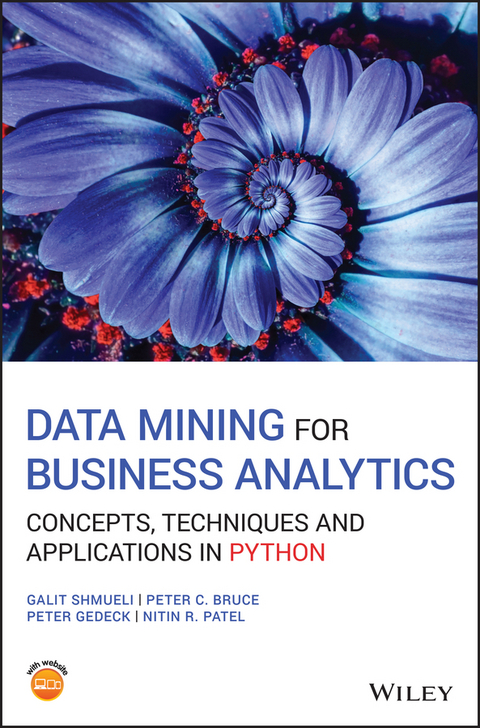
Data Mining for Business Analytics (eBook)
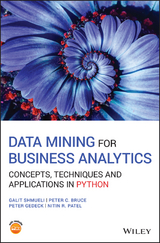
Data Mining for Business Analytics: Concepts, Techniques, and Applications in Python presents an applied approach to data mining concepts and methods, using Python software for illustration
Readers will learn how to implement a variety of popular data mining algorithms in Python (a free and open-source software) to tackle business problems and opportunities.
This is the sixth version of this successful text, and the first using Python. It covers both statistical and machine learning algorithms for prediction, classification, visualization, dimension reduction, recommender systems, clustering, text mining and network analysis. It also includes:
- A new co-author, Peter Gedeck, who brings both experience teaching business analytics courses using Python, and expertise in the application of machine learning methods to the drug-discovery process
- A new section on ethical issues in data mining
- Updates and new material based on feedback from instructors teaching MBA, undergraduate, diploma and executive courses, and from their students
- More than a dozen case studies demonstrating applications for the data mining techniques described
- End-of-chapter exercises that help readers gauge and expand their comprehension and competency of the material presented
- A companion website with more than two dozen data sets, and instructor materials including exercise solutions, PowerPoint slides, and case solutions
Data Mining for Business Analytics: Concepts, Techniques, and Applications in Python is an ideal textbook for graduate and upper-undergraduate level courses in data mining, predictive analytics, and business analytics. This new edition is also an excellent reference for analysts, researchers, and practitioners working with quantitative methods in the fields of business, finance, marketing, computer science, and information technology.
'This book has by far the most comprehensive review of business analytics methods that I have ever seen, covering everything from classical approaches such as linear and logistic regression, through to modern methods like neural networks, bagging and boosting, and even much more business specific procedures such as social network analysis and text mining. If not the bible, it is at the least a definitive manual on the subject.'
-Gareth M. James, University of Southern California and co-author (with Witten, Hastie and Tibshirani) of the best-selling book An Introduction to Statistical Learning, with Applications in R
GALIT SHMUELI, PHD, is Distinguished Professor at National Tsing Hua University's Institute of Service Science. She has designed and instructed data mining courses since 2004 at University of Maryland, Statistics.com, Indian School of Business, and National Tsing Hua University, Taiwan. Professor Shmueli is known for her research and teaching in business analytics, with a focus on statistical and data mining methods in information systems and healthcare. She has authored over 100 publications including books.
PETER C. BRUCE is President and Founder of the Institute for Statistics Education at Statistics.com. He has written multiple journal articles and is the developer of Resampling Stats software. He is the author of Introductory Statistics and Analytics: A Resampling Perspective (Wiley) and co-author of Practical Statistics for Data Scientists: 50 Essential Concepts (O'Reilly).
PETER GEDECK, PHD, is a Senior Data Scientist at Collaborative Drug Discovery, where he helps develop cloud-based software to manage the huge amount of data involved in the drug discovery process. He also teaches data mining at Statistics.com.
NITIN R. PATEL, PhD, is cofounder and board member of Cytel Inc., based in Cambridge, Massachusetts. A Fellow of the American Statistical Association, Dr. Patel has also served as a Visiting Professor at the Massachusetts Institute of Technology and at Harvard University. He is a Fellow of the Computer Society of India and was a professor at the Indian Institute of Management, Ahmedabad, for 15 years.
Data Mining for Business Analytics: Concepts, Techniques, and Applications in Python presents an applied approach to data mining concepts and methods, using Python software for illustration Readers will learn how to implement a variety of popular data mining algorithms in Python (a free and open-source software) to tackle business problems and opportunities. This is the sixth version of this successful text, and the first using Python. It covers both statistical and machine learning algorithms for prediction, classification, visualization, dimension reduction, recommender systems, clustering, text mining and network analysis. It also includes: A new co-author, Peter Gedeck, who brings both experience teaching business analytics courses using Python, and expertise in the application of machine learning methods to the drug-discovery process A new section on ethical issues in data mining Updates and new material based on feedback from instructors teaching MBA, undergraduate, diploma and executive courses, and from their students More than a dozen case studies demonstrating applications for the data mining techniques described End-of-chapter exercises that help readers gauge and expand their comprehension and competency of the material presented A companion website with more than two dozen data sets, and instructor materials including exercise solutions, PowerPoint slides, and case solutions Data Mining for Business Analytics: Concepts, Techniques, and Applications in Python is an ideal textbook for graduate and upper-undergraduate level courses in data mining, predictive analytics, and business analytics. This new edition is also an excellent reference for analysts, researchers, and practitioners working with quantitative methods in the fields of business, finance, marketing, computer science, and information technology. This book has by far the most comprehensive review of business analytics methods that I have ever seen, covering everything from classical approaches such as linear and logistic regression, through to modern methods like neural networks, bagging and boosting, and even much more business specific procedures such as social network analysis and text mining. If not the bible, it is at the least a definitive manual on the subject. Gareth M. James, University of Southern California and co-author (with Witten, Hastie and Tibshirani) of the best-selling book An Introduction to Statistical Learning, with Applications in R
GALIT SHMUELI, PHD, is Distinguished Professor at National Tsing Hua University's Institute of Service Science. She has designed and instructed data mining courses since 2004 at University of Maryland, Statistics.com, Indian School of Business, and National Tsing Hua University, Taiwan. Professor Shmueli is known for her research and teaching in business analytics, with a focus on statistical and data mining methods in information systems and healthcare. She has authored over 100 publications including books. PETER C. BRUCE is President and Founder of the Institute for Statistics Education at Statistics.com. He has written multiple journal articles and is the developer of Resampling Stats software. He is the author of Introductory Statistics and Analytics: A Resampling Perspective (Wiley) and co-author of Practical Statistics for Data Scientists: 50 Essential Concepts (O'Reilly). PETER GEDECK, PHD, is a Senior Data Scientist at Collaborative Drug Discovery, where he helps develop cloud-based software to manage the huge amount of data involved in the drug discovery process. He also teaches data mining at Statistics.com. NITIN R. PATEL, PhD, is cofounder and board member of Cytel Inc., based in Cambridge, Massachusetts. A Fellow of the American Statistical Association, Dr. Patel has also served as a Visiting Professor at the Massachusetts Institute of Technology and at Harvard University. He is a Fellow of the Computer Society of India and was a professor at the Indian Institute of Management, Ahmedabad, for 15 years.
| Erscheint lt. Verlag | 14.10.2019 |
|---|---|
| Sprache | englisch |
| Themenwelt | Mathematik / Informatik ► Mathematik ► Statistik |
| Mathematik / Informatik ► Mathematik ► Wahrscheinlichkeit / Kombinatorik | |
| Schlagworte | algorithms • Big Data • Business & Management • Business Analytics • Computer Code • Computer Science • Data • Data Analysis • Database & Data Warehousing Technologies • Data Mining • Data Mining Statistics • Data Science • DataSets • Datenbanken u. Data Warehousing • Decision Sciences • dimension reduction • Entscheidungsfindung • Informatik • Prediction • predictive analytics • programming • Python • R software • Software • Statistical Methods • Statistics • Statistik • Theorie der Entscheidungsfindung • Wirtschaft u. Management |
| ISBN-10 | 1-119-54985-X / 111954985X |
| ISBN-13 | 978-1-119-54985-7 / 9781119549857 |
| Informationen gemäß Produktsicherheitsverordnung (GPSR) | |
| Haben Sie eine Frage zum Produkt? |
 PDF (Adobe DRM)
Kopierschutz: Adobe-DRM
Adobe-DRM ist ein Kopierschutz, der das eBook vor Mißbrauch schützen soll. Dabei wird das eBook bereits beim Download auf Ihre persönliche Adobe-ID autorisiert. Lesen können Sie das eBook dann nur auf den Geräten, welche ebenfalls auf Ihre Adobe-ID registriert sind.
Details zum Adobe-DRM
Dateiformat: PDF (Portable Document Format)
Mit einem festen Seitenlayout eignet sich die PDF besonders für Fachbücher mit Spalten, Tabellen und Abbildungen. Eine PDF kann auf fast allen Geräten angezeigt werden, ist aber für kleine Displays (Smartphone, eReader) nur eingeschränkt geeignet.
Systemvoraussetzungen:
PC/Mac: Mit einem PC oder Mac können Sie dieses eBook lesen. Sie benötigen eine
eReader: Dieses eBook kann mit (fast) allen eBook-Readern gelesen werden. Mit dem amazon-Kindle ist es aber nicht kompatibel.
Smartphone/Tablet: Egal ob Apple oder Android, dieses eBook können Sie lesen. Sie benötigen eine
Geräteliste und zusätzliche Hinweise
Buying eBooks from abroad
For tax law reasons we can sell eBooks just within Germany and Switzerland. Regrettably we cannot fulfill eBook-orders from other countries.
aus dem Bereich