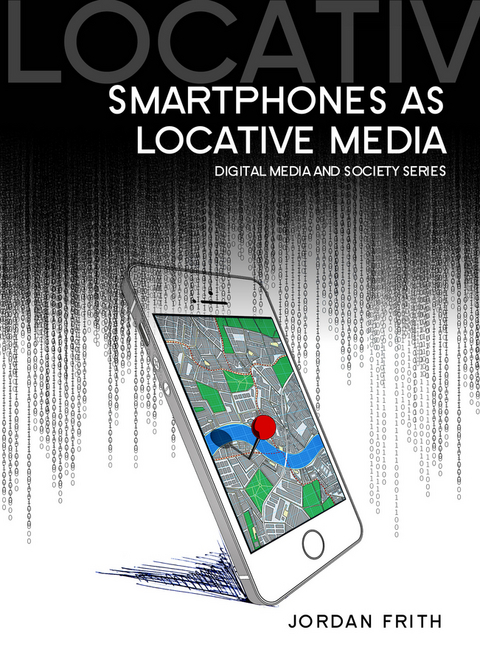
Smartphones as Locative Media (eBook)
John Wiley & Sons (Verlag)
978-0-7456-8502-1 (ISBN)
Smartphone adoption has surpassed 50% of the population in more than 15 countries, and there are now more than one million mobile applications people can download to their phones. Many of these applications take advantage of smartphones as locative media, which is what allows smartphones to be located in physical space. Applications that take advantage of people's location are called location-based services, and they are the focus of this book.
Smartphones as locative media raise important questions about how we understand the complicated relationship between the Internet and physical space. This book addresses these questions through an interdisciplinary theoretical framework and a detailed analysis of how various popular mobile applications including Google Maps, Facebook, Instagram, Yelp, and Foursquare use people's location to provide information about their surrounding space.
The topics explored in this book are essential reading for anyone interested in how smartphones and location-based services have begun to impact the ways we navigate and engage with the physical world.
Jordan Frith is assistant professor of Technical Communication at the University of North Texas.
Jordan Frith is assistant professor of Technical Communication at the University of North Texas.
title page 4
Imprint 5
Contents 8
Acknowledgments 10
1 From Atoms to Bits and Back Again 12
2 Mobilities and the Spatial Turn 23
3 The Infrastructure of Locative Media 38
4 Wayfinding through Mobile Interfaces 56
5 Location and Social Networks 73
6 Writing and Archiving Space 92
7 Market Forces and the Shaping of Location-based Services 107
8 The Negotiation of Locational Privacy 123
Conclusion: The Future of Locative Media 142
Notes 158
References 163
Index 187
"A useful road map for readers seeking to obtain an in-depth understanding of the relevance and impacts of locative media on society. The book is well-structured, innovative in its thinking, and contains a number of original case studies and rich theoretical discussions that will be equally interesting for experienced academic audiences and the general public."
LSE Review of Books
"Concise and accessible, Frith's Smartphones as Locative Media could serve as an important stanchion for expanding this area of mobile studies, bringing people into important places, showing them around the highlights, and setting up engaging discussions."
Brett Oppegaard, University of Hawaii
"We are increasingly using location-enabled phones to find our way, locate services and find one another. All the while, their traces raise basic questions of privacy. Jordan Frith provides an excellent and finely-tuned analysis that helps us to understand the nuances of this fundamental social transition."
Richard Ling, Nanyang Technological University
"Smartphones as Locative Media is a fine book that offers an engagingly written, accessible, up-to-date, and thorough account of contemporary location-based services. Taking our embrace of the smartphone as a point of entry, Frith considers the rise and emerging capabilities of mobile location-based services, their still evolving social uses, and the political economic dimensions and privacy implications of these services. The book makes an important contribution to the literature on locative media, and forms a valuable resource for anyone studying or teaching on the development, growth, and wider impacts of location-enabled mobile technologies."
Rowan Wilken, Swinburne University of Technology, Australia
| Erscheint lt. Verlag | 6.6.2018 |
|---|---|
| Reihe/Serie | Digital Media and Society | DMS - Digital Media and Society |
| Sprache | englisch |
| Themenwelt | Informatik ► Weitere Themen ► Smartphones / Tablets |
| Sozialwissenschaften ► Kommunikation / Medien ► Medienwissenschaft | |
| Sozialwissenschaften ► Politik / Verwaltung | |
| Schlagworte | cell phones, mobile phones, GPS, mapping, phone tracking, tracking devices, location based media • Communication & Media Studies • Communication Studies • Communication technology • Electrical & Electronics Engineering • Elektrotechnik u. Elektronik • Kommunikationstechnik • Kommunikationswissenschaft • Kommunikation u. Medienforschung • Media Studies • Medienforschung • Smartphone |
| ISBN-10 | 0-7456-8502-1 / 0745685021 |
| ISBN-13 | 978-0-7456-8502-1 / 9780745685021 |
| Informationen gemäß Produktsicherheitsverordnung (GPSR) | |
| Haben Sie eine Frage zum Produkt? |
 PDF (Adobe DRM)
Kopierschutz: Adobe-DRM
Adobe-DRM ist ein Kopierschutz, der das eBook vor Mißbrauch schützen soll. Dabei wird das eBook bereits beim Download auf Ihre persönliche Adobe-ID autorisiert. Lesen können Sie das eBook dann nur auf den Geräten, welche ebenfalls auf Ihre Adobe-ID registriert sind.
Details zum Adobe-DRM
Dateiformat: PDF (Portable Document Format)
Mit einem festen Seitenlayout eignet sich die PDF besonders für Fachbücher mit Spalten, Tabellen und Abbildungen. Eine PDF kann auf fast allen Geräten angezeigt werden, ist aber für kleine Displays (Smartphone, eReader) nur eingeschränkt geeignet.
Systemvoraussetzungen:
PC/Mac: Mit einem PC oder Mac können Sie dieses eBook lesen. Sie benötigen eine
eReader: Dieses eBook kann mit (fast) allen eBook-Readern gelesen werden. Mit dem amazon-Kindle ist es aber nicht kompatibel.
Smartphone/Tablet: Egal ob Apple oder Android, dieses eBook können Sie lesen. Sie benötigen eine
Geräteliste und zusätzliche Hinweise
Buying eBooks from abroad
For tax law reasons we can sell eBooks just within Germany and Switzerland. Regrettably we cannot fulfill eBook-orders from other countries.
aus dem Bereich