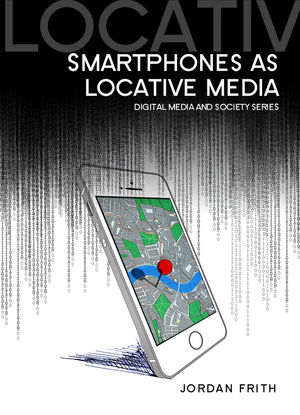
Smartphones as Locative Media (eBook)
John Wiley & Sons (Verlag)
978-0-7456-8504-5 (ISBN)
Smartphone adoption has surpassed 50% of the population in more than 15 countries, and there are now more than one million mobile applications people can download to their phones. Many of these applications take advantage of smartphones as locative media, which is what allows smartphones to be located in physical space. Applications that take advantage of people's location are called location-based services, and they are the focus of this book.
Smartphones as locative media raise important questions about how we understand the complicated relationship between the Internet and physical space. This book addresses these questions through an interdisciplinary theoretical framework and a detailed analysis of how various popular mobile applications including Google Maps, Facebook, Instagram, Yelp, and Foursquare use people's location to provide information about their surrounding space.
The topics explored in this book are essential reading for anyone interested in how smartphones and location-based services have begun to impact the ways we navigate and engage with the physical world.
Jordan Frith is assistant professor of Technical Communication at the University of North Texas.
Smartphone adoption has surpassed 50% of the population in more than 15 countries, and there are now more than one million mobile applications people can download to their phones. Many of these applications take advantage of smartphones as locative media, which is what allows smartphones to be located in physical space. Applications that take advantage of people s location are called location-based services, and they are the focus of this book. Smartphones as locative media raise important questions about how we understand the complicated relationship between the Internet and physical space. This book addresses these questions through an interdisciplinary theoretical framework and a detailed analysis of how various popular mobile applications including Google Maps, Facebook, Instagram, Yelp, and Foursquare use people s location to provide information about their surrounding space. The topics explored in this book are essential reading for anyone interested in how smartphones and location-based services have begun to impact the ways we navigate and engage with the physical world.
Jordan Frith is assistant professor of Technical Communication at the University of North Texas.
Acknowledgments
Chapter 1: From atoms to bits and back again
Chapter 2: Mobilities and the spatial turn
Chapter 3: The infrastructure of locative media
Chapter 4: Wayfinding through mobile interfaces
Chapter 5: Location and social networks
Chapter 6: Writing and archiving space
Chapter 7: Market forces and the shaping of location-based services
Chapter 8: The negotiation of locational privacy
Conclusion: The future of locative media
Notes
References
"A useful road map for readers seeking to obtain an in-depth understanding of the relevance and impacts of locative media on society. The book is well-structured, innovative in its thinking, and contains a number of original case studies and rich theoretical discussions that will be equally interesting for experienced academic audiences and the general public."
LSE Review of Books
"Concise and accessible, Frith's Smartphones as Locative Media could serve as an important stanchion for expanding this area of mobile studies, bringing people into important places, showing them around the highlights, and setting up engaging discussions."
Brett Oppegaard, University of Hawaii
"We are increasingly using location-enabled phones to find our way, locate services and find one another. All the while, their traces raise basic questions of privacy. Jordan Frith provides an excellent and finely-tuned analysis that helps us to understand the nuances of this fundamental social transition."
Richard Ling, Nanyang Technological University
"Smartphones as Locative Media is a fine book that offers an engagingly written, accessible, up-to-date, and thorough account of contemporary location-based services. Taking our embrace of the smartphone as a point of entry, Frith considers the rise and emerging capabilities of mobile location-based services, their still evolving social uses, and the political economic dimensions and privacy implications of these services. The book makes an important contribution to the literature on locative media, and forms a valuable resource for anyone studying or teaching on the development, growth, and wider impacts of location-enabled mobile technologies."
Rowan Wilken, Swinburne University of Technology, Australia
1
From Atoms to Bits and Back Again
Writing about emerging media presents a unique set of challenges. Whatever one writes will take long enough to complete and publish that many of the emerging media technologies analyzed will have changed. In few areas is that truer than in the study of mobile applications. In June, 2008, the Apple app store was still a month from being released; the Google app store did not exist. Slightly more than half a decade has now passed, and the mobile ecosystem has changed. Apple’s app store has more than 1 million applications available for download, and the Android counterpart – the Google Play Store – now has over 1 million available applications that have been downloaded 50 billion times (Fiegerman, 2013).
Mobile applications are a key part of the move from basic feature phones to smartphones. Smartphones are mobile devices that allow people to place phone calls, send text messages, browse the Internet, use GPS and other forms of location awareness, and run third-party applications. Over half of all mobile phone users in at least 15 countries now own smartphones (Google, 2014), and the growth rates have been impressive. In the United States, 33 percent of the general population owned smartphones in 2011 compared to 56 percent just two years later (Smith, 2013); smartphone ownership rates in the UK nearly doubled over the same period (Ofcom, 2013). While many parts of the world have seen slower smartphone adoption, the International Telecommunication Union (ITU) points out that “In developing countries, the number of mobile broadband subscriptions more than doubled from 2011 to 2013” (ITU, 2013: 6). The increasing adoption of these miniature computers impacts the time and place of the Internet. Many people no longer only use the Internet in certain places at certain times. Instead, the mobile Internet becomes intertwined with people’s everyday practices, operating in the background of many of their conversations and travels through physical space (Gordon and de Souza e Silva, 2011).
Smartphone usage does not represent a simple extension of older Internet practices. People do use their phones to accomplish many of the same tasks as they would with desktop and laptop computers. They check Facebook to see what their friends are doing; they go to Wikipedia to settle arguments; they browse their favorite websites. However, many smartphone applications add an important element to the way people interact with digital information: physical location. They do so because smartphones are examples of locative media. Locative media refers to any form of media – ranging from in-car GPS displays to RFID tags – that feature location awareness, which is a device’s ability to be located in physical space and provide users with information about their surroundings. As covered in chapter 2, smartphones rely on a variety of techniques for location awareness, and these techniques are what enable applications like Google Maps and Yelp to know where a smartphone is on a map of physical space. Not all mobile applications take advantage of smartphones as locative media, but many do, and these mobile applications are called location-based services. They are the focus of this book.
Location-based services include everything from mapping services like Waze to popular social applications like Instagram that enable people to tag photos with location information. The applications are able to map different types of information because the pieces of digital information include latitude and longitude metadata, meaning they can be precisely placed on digital maps and positioned relationally to the location of the smartphone. Location is only one of many types of metadata included in the information with which users interact, but the argument throughout this book is that location data is an increasingly crucial piece of digital information (Gordon and de Souza e Silva, 2011). When people open up a smartphone application to provide them with information about their surroundings, they access digital information as an informational layer intertwined with the physical space they experience. Consequently, possibly the major social consequence of location-based services is that they not only impact the types of digital information people access, but they can also affect the way people navigate physical space and interact with those around them.
Smartphones as locative media show how physical places have begun to affect the mobile Internet and how the mobile Internet has begun to affect physical places. In some ways, the growth of location-based information seems like an obvious step in the maturation of the Internet. After all, why would people not use the information at their fingertips to learn more about the places they inhabit? However, to understand why smartphones as locative media represent a change in how the Internet is understood, it helps to examine how the Internet was originally conceived as “placeless.” As the next section shows, many people argued that the Internet would make place less important. People would move their social lives online, spend most of their time in virtual communities, work from home, and congregate in and travel through physical space less and less (Kellerman, 2006). The implicit assumption, still present in expressions like “in real life” that oppose the offline to the online, is that the Internet represents a separate space from the physical world. The examples of location-based services detailed throughout this book show why the conceptual separation of the physical and digital into two separate spheres is untenable. Instead, the digital and physical are being merged in new ways, and this chapter concludes by explaining how the intertwining of the digital and physical is addressed in the rest of the book.
Communication media and the annihilation of space and place
Human beings can only cover a limited distance with their physical bodies. If people attempt to communicate a message with no outside assistance, the distance they can communicate is limited by how loud they can yell. People overcome this limitation through media technologies. Written language allowed people to transcribe messages that were transported to other places. The printing press allowed for the mass distribution of the same communication across physical space (Eisenstein, 1979). People even experimented with non-textual, non-verbal media to overcome physical distance. For example, African tribes developed an intricate language of “talking drum” beats that allowed towns to communicate across distance using sound (Gleick, 2011).
The growth of electronic media, first with the telegraph and then the radio and telephone, also enabled messages to overcome great distances. The telegraph was an important development in communication media and represented the first instance of people sharing textual messages across physical space without the need for physical travel (Carey, 1989). To send a letter or distribute a book, a human body had to physically transport the document. Telegraphs removed bodies from the equation, and the importance of that change did not go unnoticed by contemporary observers. For instance, an 1844 article in the Baltimore Sun about the completion of the Washington– Baltimore telegraph line claimed that “Time and space has been completely annihilated” (Rosen, 2012). This same feeling – that space was being annihilated through new communication media – was later echoed when people could transmit their voices through the telephone (Fischer, 1994; Marvin, 1988), broadcast messages into homes using the radio (Peters, 1999), and watch live events taking place on the other side of the world on television (Meyrowitz, 1985; Parks, 2005). These media, along with physical transportation technologies such as the railroad and airplanes (Schivelbusch, 1986), all contributed to the experience that physical space was being overcome. The far was brought near, the absent made present.
The Internet contributed to the same feeling of the annihilation of physical space, possibly to an even greater degree. With the development of the World Wide Web in the early 1990s, people were able to create chat rooms and Multi-User Domains to build relationships with distant others (Baym, 2010), companies built global networks of information flows that lessened the importance of national borders (Castells, 2000), and many scholars and popular sources argued that the Web would lessen the importance of physical space (Gordon and de Souza e Silva, 2011). This sentiment can be seen in a famous 1994 MCI commercial about the Internet. The commercial featured a 12-year-old Anna Paquin describing the “Information Super Highway” as a road that will connect all points on the globe. The most famous statement from the commercial is when Paquin says this road “will not go from here to there. There will be no more there. We will all only be here” (“No More There,” 1994). Few quotes better encapsulate the belief that distinct places would be made meaningless by the new communication technology of the Internet. The Internet would allow people to be everywhere all at once, overcoming distance and lessening the importance of being in any one place at a given time.
Even...
| Erscheint lt. Verlag | 26.3.2015 |
|---|---|
| Reihe/Serie | Digital Media and Society |
| DMS - Digital Media and Society | DMS - Digital Media and Society |
| Sprache | englisch |
| Themenwelt | Informatik ► Weitere Themen ► Smartphones / Tablets |
| Sozialwissenschaften ► Kommunikation / Medien ► Medienwissenschaft | |
| Sozialwissenschaften ► Politik / Verwaltung | |
| Schlagworte | cell phones, mobile phones, GPS, mapping, phone tracking, tracking devices, location based media • Communication & Media Studies • Communication Studies • Communication technology • Electrical & Electronics Engineering • Elektrotechnik u. Elektronik • Kommunikationstechnik • Kommunikationswissenschaft • Kommunikation u. Medienforschung • Media Studies • Medienforschung • Smartphone |
| ISBN-10 | 0-7456-8504-8 / 0745685048 |
| ISBN-13 | 978-0-7456-8504-5 / 9780745685045 |
| Informationen gemäß Produktsicherheitsverordnung (GPSR) | |
| Haben Sie eine Frage zum Produkt? |
 EPUB (Adobe DRM)
Kopierschutz: Adobe-DRM
Adobe-DRM ist ein Kopierschutz, der das eBook vor Mißbrauch schützen soll. Dabei wird das eBook bereits beim Download auf Ihre persönliche Adobe-ID autorisiert. Lesen können Sie das eBook dann nur auf den Geräten, welche ebenfalls auf Ihre Adobe-ID registriert sind.
Details zum Adobe-DRM
Dateiformat: EPUB (Electronic Publication)
EPUB ist ein offener Standard für eBooks und eignet sich besonders zur Darstellung von Belletristik und Sachbüchern. Der Fließtext wird dynamisch an die Display- und Schriftgröße angepasst. Auch für mobile Lesegeräte ist EPUB daher gut geeignet.
Systemvoraussetzungen:
PC/Mac: Mit einem PC oder Mac können Sie dieses eBook lesen. Sie benötigen eine
eReader: Dieses eBook kann mit (fast) allen eBook-Readern gelesen werden. Mit dem amazon-Kindle ist es aber nicht kompatibel.
Smartphone/Tablet: Egal ob Apple oder Android, dieses eBook können Sie lesen. Sie benötigen eine
Geräteliste und zusätzliche Hinweise
Buying eBooks from abroad
For tax law reasons we can sell eBooks just within Germany and Switzerland. Regrettably we cannot fulfill eBook-orders from other countries.
aus dem Bereich