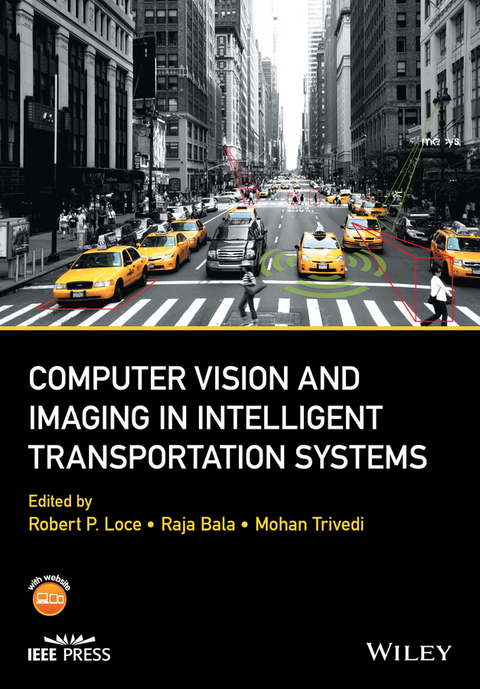
Computer Vision and Imaging in Intelligent Transportation Systems (eBook)
John Wiley & Sons (Verlag)
978-1-118-97165-9 (ISBN)
Acts as single source reference providing readers with an overview of how computer vision can contribute to the different applications in the field of road transportation
This book presents a survey of computer vision techniques related to three key broad problems in the roadway transportation domain: safety, efficiency, and law enforcement. The individual chapters present significant applications within those problem domains, each presented in a tutorial manner, describing the motivation for and benefits of the application, and a description of the state of the art.
Key features:
- Surveys the applications of computer vision techniques to road transportation system for the purposes of improving safety and efficiency and to assist law enforcement.
- Offers a timely discussion as computer vision is reaching a point of being useful in the field of transportation systems.
- Available as an enhanced eBook with video demonstrations to further explain the concepts discussed in the book, as well as links to publically available software and data sets for testing and algorithm development.
The book will benefit the many researchers, engineers and practitioners of computer vision, digital imaging, automotive and civil engineering working in intelligent transportation systems. Given the breadth of topics covered, the text will present the reader with new and yet unconceived possibilities for application within their communities.
Robert P. Loce, Conduent Labs, USA
Dr. Robert P. Loce is a Fellow of SPIE and a Senior Member of IEEE. His publications include a book on enhancement and restoration of digital documents, and 8 book chapters on digital halftoning and digital document processing, 28 refereed journal publications, and 53 conference proceedings. He is currently an associate editor for Journal of Electronic Imaging, where he recently guest-edited a special topic issue on the subject matter of the proposed book. He also chairs a conference within the SPIE/IS&T Electronic Imaging symposium on the subject matter of the proposed book. He has also been an associate editor for Real-Time Imaging, and IEEE Transactions on Image Processing.
Raja Bala, Samsung Research America, USA
Dr. Bala has authored over 100 publications, including several book chapters, and holds over 120 U.S. patents in the field of digital and color imaging. He has served as adjunct faculty member at the Rochester Institute of Technology, and has taught many short courses and guest lectures on a variety of topics in digital imaging. From 2008-12, he served as Vice President of Publications for the Society for Imaging Science and Technology, where he led the Editorial Board for the IS&T/Wiley Book Series. He has served as Associate Editor of the Journal of Imaging Science and Technology, and is a frequent reviewer for IEEE Transactions on Image Processing, Journal of Electronic Imaging, and Journal of Imaging Science and Technology. Dr. Bala is a Fellow of IS&T and Senior Member of IEEE.
Prof. Mohan Trivedi is the Head of UCSD's Computer Vision and Robotics Research laboratory, overseeing projects such as a robotic, sensor-based traffic-incident monitoring and response system (sponsored by Caltrans). Prof. Trivedi is leading an interdisciplinary effort, as UCSD layer leader for intelligent transportation and telematics for the California Institute for Telecommunications and Information Technology [Cal-(IT)2]. Prof. Trivedi is a recipient of the Pioneer Award and the Meritorious Service Award from the IEEE Computer Society; and the Distinguished Alumnus Award from Utah State University. He is a Fellow of the International Society for Optical Engineering (SPIE). He is a founding member of the Executive Committee of the UC System-wide Digital Media Innovation Program (DiMI). He is also Editor-in-Chief of Machine Vision & Applications (Springer).
Acts as single source reference providing readers with an overview of how computer vision can contribute to the different applications in the field of road transportation This book presents a survey of computer vision techniques related to three key broad problems in the roadway transportation domain: safety, efficiency, and law enforcement. The individual chapters present significant applications within those problem domains, each presented in a tutorial manner, describing the motivation for and benefits of the application, and a description of the state of the art. Key features: Surveys the applications of computer vision techniques to road transportation system for the purposes of improving safety and efficiency and to assist law enforcement. Offers a timely discussion as computer vision is reaching a point of being useful in the field of transportation systems. Available as an enhanced eBook with video demonstrations to further explain the concepts discussed in the book, as well as links to publically available software and data sets for testing and algorithm development. The book will benefit the many researchers, engineers and practitioners of computer vision, digital imaging, automotive and civil engineering working in intelligent transportation systems. Given the breadth of topics covered, the text will present the reader with new and yet unconceived possibilities for application within their communities.
Robert P. Loce, Conduent Labs, USA Dr. Robert P. Loce is a Fellow of SPIE and a Senior Member of IEEE. His publications include a book on enhancement and restoration of digital documents, and 8 book chapters on digital halftoning and digital document processing, 28 refereed journal publications, and 53 conference proceedings. He is currently an associate editor for Journal of Electronic Imaging, where he recently guest-edited a special topic issue on the subject matter of the proposed book. He also chairs a conference within the SPIE/IS&T Electronic Imaging symposium on the subject matter of the proposed book. He has also been an associate editor for Real-Time Imaging, and IEEE Transactions on Image Processing. Raja Bala, Samsung Research America, USA Dr. Bala has authored over 100 publications, including several book chapters, and holds over 120 U.S. patents in the field of digital and color imaging. He has served as adjunct faculty member at the Rochester Institute of Technology, and has taught many short courses and guest lectures on a variety of topics in digital imaging. From 2008-12, he served as Vice President of Publications for the Society for Imaging Science and Technology, where he led the Editorial Board for the IS&T/Wiley Book Series. He has served as Associate Editor of the Journal of Imaging Science and Technology, and is a frequent reviewer for IEEE Transactions on Image Processing, Journal of Electronic Imaging, and Journal of Imaging Science and Technology. Dr. Bala is a Fellow of IS&T and Senior Member of IEEE. Mohan Trivedi, Jacobs School of Engineering, University of California, San Diego, USA Prof. Mohan Trivedi is the Head of UCSD's Computer Vision and Robotics Research laboratory, overseeing projects such as a robotic, sensor-based traffic-incident monitoring and response system (sponsored by Caltrans). Prof. Trivedi is leading an interdisciplinary effort, as UCSD layer leader for intelligent transportation and telematics for the California Institute for Telecommunications and Information Technology [Cal-(IT)2]. Prof. Trivedi is a recipient of the Pioneer Award and the Meritorious Service Award from the IEEE Computer Society; and the Distinguished Alumnus Award from Utah State University. He is a Fellow of the International Society for Optical Engineering (SPIE). He is a founding member of the Executive Committee of the UC System-wide Digital Media Innovation Program (DiMI). He is also Editor-in-Chief of Machine Vision & Applications (Springer).
Preface
There is a worldwide effort to develop smart transportation networks that can provide travelers with enhanced safety and comfort, reduced travel time and cost, energy savings, and effective traffic law enforcement. Computer vision and imaging is playing a pivotal role in this transportation evolution. The forefront of this technological evolution can be seen in the growth of scientific publications and conferences produced through substantial university and corporate research laboratory projects. The editors of this book have assembled topics and authors that are representative of the core technologies coming out of these research projects. This text offers the reader with a broad comprehensive exposition of computer vision technologies addressing important roadway transportation problems. Each chapter is authored by world‐renowned authorities discussing a specific transportation application, the practical challenges involved, a broad survey of state‐of‐the‐art approaches, an in‐depth treatment of a few exemplary techniques, and a perspective on future directions. The material is presented in a lucid tutorial style, balancing fundamental theoretical concepts and pragmatic real‐world considerations. Each chapter ends with an abundant collection of references for the reader requiring additional depth.
The book is intended to benefit researchers, engineers, and practitioners of computer vision, digital imaging, automotive, and civil engineering working on intelligent transportation systems. Urban planners, government agencies, and other decision‐ and policy‐making bodies will also benefit from an enhanced awareness of the opportunities and challenges afforded by computer vision in the transportation domain. While each chapter provides the requisite background required to learn a given problem and application, it is helpful for the reader to have some familiarity with the fundamental concepts in image processing and computer vision. For those who are entirely new to this field, appropriate background reading is recommended in Chapter 1. It is hoped that the material presented in the book will not only enhance the reader’s knowledge of today’s state of the art but also prompt new and yet‐unconceived applications and solutions for transportation networks of the future.
The text is organized into Chapter 1 that provides a brief overview of the field and Chapters 2–15 divided into two parts. In Part I, Chapters 2–9 present applications relying upon the infrastructure, that is, cameras that are installed on roadway structures such as bridges, poles and gantries. In Part II, Chapters 10–15 discuss techniques to monitor driver and vehicle behavior from cameras and sensors placed within the vehicle.
In Chapter 2, Burry and Kozitsky present the problem of license plate recognition—a fundamental technology that underpins many transportation applications, notably ones pertaining to law enforcement. The basic computer vision pipeline and state‐of‐the‐art solutions for plate recognition are described. Muron, Deshpande, and Cai present automatic vehicle classification (AVC) in Chapter 3. AVC is a method for automatically categorizing types of motor vehicles based on the predominant characteristics of their features such as length, height, axle count, existence of a trailer, and specific contours. AVC is also an important part of intelligent transportation system (ITS) in applications such as automatic toll collection, management of traffic density, and estimation of road usage and wear.
Chapters 2, 4, 5, and 8 present aspects of law enforcement based on imaging from the infrastructure. Detection of passenger compartment violations is presented in Chapter 4 by Bulan, Xu, Loce, and Paul. The chapter presents imaging systems capable of gathering passenger compartment images and computer vision methods of extracting the desired information from the images. The applications it presents are detection of seat belt usage, detection of mobile phone usage, and occupancy detection for high‐occupancy lane tolling and violation detection. The chapter also covers several approaches, while providing depth on a classification‐based method that is yielding very good results. Detection of moving violations is presented in Chapter 5 by Wu, Bulan, Bernal, and Loce. Two prominent applications—speed detection and stop light/sign enforcement—are covered in detail, while several other violations are briefly reviewed.
A major concern for urban planners is traffic flow analysis and optimization. In Chapter 6, Fernandez, Yousaf, Ellis, Chen, and Velastin present a model for traffic flow from a transportation engineer’s perspective. They consider flow analysis using computer vision techniques, with emphasis given to specific challenges encountered in developing countries. Intersection modeling is taught by Morris and Shirazi in Chapter 7 for the applications of understanding capacity, delay, and safety. Intersections are planned conflict points with complex interactions of vehicles, pedestrians, and bicycles. Vision‐based sensing and computer vision analysis bring a level of depth of understanding that other sensing modalities alone cannot provide. In Chapter 8, Sidla and Lipetski examine the state of the art in visual parking space monitoring. The task of the automatic parking management is becoming increasingly essential. The number of annually produced cars has grown by 55% in the past 7 years. Most large cities have a problem of insufficient availability of parking space. Automatic determination of available parking space coupled with a communication network holds great promise in alleviating this urban burden.
While computer vision algorithms can be trained to recognize common patterns in traffic, vehicle, and pedestrian behavior, it is often an unusual event such as an accident or traffic violation that warrants special attention and action. Chapter 9 by Bala and Monga is devoted to the problem of detecting anomalous traffic events from video. A broad survey of state‐of‐the‐art anomaly detection models is followed by an in‐depth treatment of a robust method based on sparse signal representations.
In Part II of the text, attention is turned to in‐vehicle imaging and analysis. The focus of Chapters 10–12 are technologies that are being applied to driver assistance systems. Chapter 10 by Deshpande and Cai deals with the problem of detecting pedestrians from road‐facing cameras installed on the vehicle. Pedestrian detection is critical to intelligent transportation systems, ranging from autonomous driving to infrastructure surveillance, traffic management, and transit safety and efficiency, as well as law enforcement. In Chapter 11, Casavola, Cario, and Lupia present lane detection (LD) and lane tracking (LT) problems arising in lane departure warning systems (LDWSs). LWDSs refer to specific forms of advanced driver assistant systems (ADAS) designed to help the driver to stay into the lane, by warning her/him with a sufficient advance that an imminent and possibly unintentional lane departure is going to take place so that she/he can take the necessary corrective measures. Chapter 12 by Satzoda and Trivedi teaches the technologies associated with vision‐based integrated techniques for collision avoidance systems. The chapter surveys related technologies and focuses on an integrated approach called efficient lane and vehicle detection using integrated synergies (ELVIS) that incorporates the lane information to detect vehicles more efficiently in an informed manner using a novel two part–based vehicle detection technique.
Driver inattention is a major cause of traffic fatalities worldwide. Chapter 13 by Bala and Bernal presents an overview of in‐vehicle technologies to proactively monitor driver behavior and provide appropriate feedback and intervention to enhance safety and comfort. A broad survey of the state of the art is complemented with a detailed treatment of a few selected driver monitoring techniques including methods to fuse video with nonvisual data such as motion and bio‐signals.
Traffic sign recognition is present in Chapter 14 by Fleyeh. Sign recognition is a field‐concerned detection and recognition of traffic signs in traffic scenes as acquired by a vehicle‐mounted camera. Computer vision and artificial intelligence are used to extract the traffic signs from outdoor images taken in uncontrolled lighting conditions. The signs may be occluded by other objects and may suffer from various problems such as color fading, disorientation, and variations in shape and size. It is the field of study that can be used either to aid the development of an inventory system (for which real‐time recognition is not required), or to aid the development of an in‐car advisory system (when real‐time recognition is necessary). Road condition monitoring is presented in Chapter 15 by Kutila, Pyykönen, Casselgren, and Jonsson. The chapter reviews proposed measurement principles in the road traction monitoring area and provides examples of sensor solutions that are feasible for vehicle on‐board and road sensing. The chapter also reviews opportunities to improve performance with the use of sensor data fusion and discusses future opportunities. We do have an enhanced eBook available with integrated video demonstrations to further explain the concepts discussed in the book.
Robert P....
| Erscheint lt. Verlag | 20.3.2017 |
|---|---|
| Reihe/Serie | IEEE Press |
| Wiley - IEEE | Wiley - IEEE |
| Sprache | englisch |
| Themenwelt | Informatik ► Grafik / Design ► Digitale Bildverarbeitung |
| Informatik ► Theorie / Studium ► Künstliche Intelligenz / Robotik | |
| Technik ► Elektrotechnik / Energietechnik | |
| Technik ► Fahrzeugbau / Schiffbau | |
| Schlagworte | application • Applications • ART • Bildgebende Systeme u. Verfahren • Chapters • computer vision • Description • Different • domains • Electrical & Electronics Engineering • Elektrotechnik u. Elektronik • Imaging Systems & Technology • Individual • Maschinelles Sehen • Motivation • Overview • present • Problem • providing • Readers • Reference • significant • Single • source • State • Transportation • tutorial manner |
| ISBN-10 | 1-118-97165-5 / 1118971655 |
| ISBN-13 | 978-1-118-97165-9 / 9781118971659 |
| Informationen gemäß Produktsicherheitsverordnung (GPSR) | |
| Haben Sie eine Frage zum Produkt? |
 EPUB (Adobe DRM)
Kopierschutz: Adobe-DRM
Adobe-DRM ist ein Kopierschutz, der das eBook vor Mißbrauch schützen soll. Dabei wird das eBook bereits beim Download auf Ihre persönliche Adobe-ID autorisiert. Lesen können Sie das eBook dann nur auf den Geräten, welche ebenfalls auf Ihre Adobe-ID registriert sind.
Details zum Adobe-DRM
Dateiformat: EPUB (Electronic Publication)
EPUB ist ein offener Standard für eBooks und eignet sich besonders zur Darstellung von Belletristik und Sachbüchern. Der Fließtext wird dynamisch an die Display- und Schriftgröße angepasst. Auch für mobile Lesegeräte ist EPUB daher gut geeignet.
Systemvoraussetzungen:
PC/Mac: Mit einem PC oder Mac können Sie dieses eBook lesen. Sie benötigen eine
eReader: Dieses eBook kann mit (fast) allen eBook-Readern gelesen werden. Mit dem amazon-Kindle ist es aber nicht kompatibel.
Smartphone/Tablet: Egal ob Apple oder Android, dieses eBook können Sie lesen. Sie benötigen eine
Geräteliste und zusätzliche Hinweise
Buying eBooks from abroad
For tax law reasons we can sell eBooks just within Germany and Switzerland. Regrettably we cannot fulfill eBook-orders from other countries.
aus dem Bereich