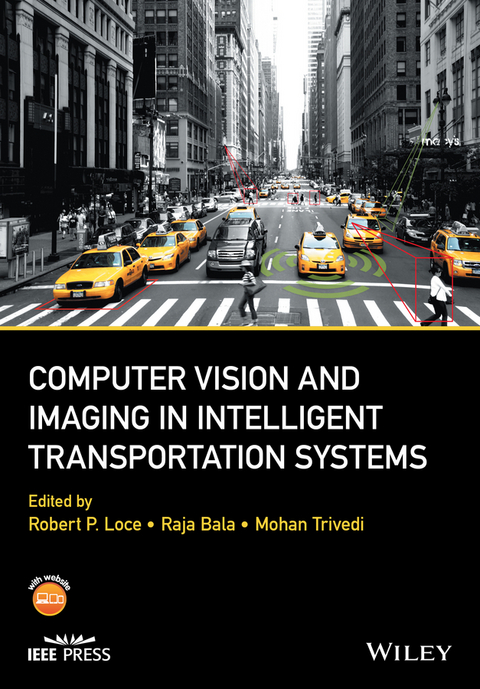
Computer Vision and Imaging in Intelligent Transportation Systems (eBook)
John Wiley & Sons (Verlag)
978-1-118-97164-2 (ISBN)
Acts as single source reference providing readers with an overview of how computer vision can contribute to the different applications in the field of road transportation
This book presents a survey of computer vision techniques related to three key broad problems in the roadway transportation domain: safety, efficiency, and law enforcement. The individual chapters present significant applications within those problem domains, each presented in a tutorial manner, describing the motivation for and benefits of the application, and a description of the state of the art.
Key features:
- Surveys the applications of computer vision techniques to road transportation system for the purposes of improving safety and efficiency and to assist law enforcement.
- Offers a timely discussion as computer vision is reaching a point of being useful in the field of transportation systems.
- Available as an enhanced eBook with video demonstrations to further explain the concepts discussed in the book, as well as links to publically available software and data sets for testing and algorithm development.
The book will benefit the many researchers, engineers and practitioners of computer vision, digital imaging, automotive and civil engineering working in intelligent transportation systems. Given the breadth of topics covered, the text will present the reader with new and yet unconceived possibilities for application within their communities.
Robert P. Loce, Conduent Labs, USA
Dr. Robert P. Loce is a Fellow of SPIE and a Senior Member of IEEE. His publications include a book on enhancement and restoration of digital documents, and 8 book chapters on digital halftoning and digital document processing, 28 refereed journal publications, and 53 conference proceedings. He is currently an associate editor for Journal of Electronic Imaging, where he recently guest-edited a special topic issue on the subject matter of the proposed book. He also chairs a conference within the SPIE/IS&T Electronic Imaging symposium on the subject matter of the proposed book. He has also been an associate editor for Real-Time Imaging, and IEEE Transactions on Image Processing.
Raja Bala, Samsung Research America, USA
Dr. Bala has authored over 100 publications, including several book chapters, and holds over 120 U.S. patents in the field of digital and color imaging. He has served as adjunct faculty member at the Rochester Institute of Technology, and has taught many short courses and guest lectures on a variety of topics in digital imaging. From 2008-12, he served as Vice President of Publications for the Society for Imaging Science and Technology, where he led the Editorial Board for the IS&T/Wiley Book Series. He has served as Associate Editor of the Journal of Imaging Science and Technology, and is a frequent reviewer for IEEE Transactions on Image Processing, Journal of Electronic Imaging, and Journal of Imaging Science and Technology. Dr. Bala is a Fellow of IS&T and Senior Member of IEEE.
Prof. Mohan Trivedi is the Head of UCSD's Computer Vision and Robotics Research laboratory, overseeing projects such as a robotic, sensor-based traffic-incident monitoring and response system (sponsored by Caltrans). Prof. Trivedi is leading an interdisciplinary effort, as UCSD layer leader for intelligent transportation and telematics for the California Institute for Telecommunications and Information Technology [Cal-(IT)2]. Prof. Trivedi is a recipient of the Pioneer Award and the Meritorious Service Award from the IEEE Computer Society; and the Distinguished Alumnus Award from Utah State University. He is a Fellow of the International Society for Optical Engineering (SPIE). He is a founding member of the Executive Committee of the UC System-wide Digital Media Innovation Program (DiMI). He is also Editor-in-Chief of Machine Vision & Applications (Springer).
Acts as single source reference providing readers with an overview of how computer vision can contribute to the different applications in the field of road transportation This book presents a survey of computer vision techniques related to three key broad problems in the roadway transportation domain: safety, efficiency, and law enforcement. The individual chapters present significant applications within those problem domains, each presented in a tutorial manner, describing the motivation for and benefits of the application, and a description of the state of the art. Key features: Surveys the applications of computer vision techniques to road transportation system for the purposes of improving safety and efficiency and to assist law enforcement. Offers a timely discussion as computer vision is reaching a point of being useful in the field of transportation systems. Available as an enhanced eBook with video demonstrations to further explain the concepts discussed in the book, as well as links to publically available software and data sets for testing and algorithm development. The book will benefit the many researchers, engineers and practitioners of computer vision, digital imaging, automotive and civil engineering working in intelligent transportation systems. Given the breadth of topics covered, the text will present the reader with new and yet unconceived possibilities for application within their communities.
Robert P. Loce, Conduent Labs, USA Dr. Robert P. Loce is a Fellow of SPIE and a Senior Member of IEEE. His publications include a book on enhancement and restoration of digital documents, and 8 book chapters on digital halftoning and digital document processing, 28 refereed journal publications, and 53 conference proceedings. He is currently an associate editor for Journal of Electronic Imaging, where he recently guest-edited a special topic issue on the subject matter of the proposed book. He also chairs a conference within the SPIE/IS&T Electronic Imaging symposium on the subject matter of the proposed book. He has also been an associate editor for Real-Time Imaging, and IEEE Transactions on Image Processing. Raja Bala, Samsung Research America, USA Dr. Bala has authored over 100 publications, including several book chapters, and holds over 120 U.S. patents in the field of digital and color imaging. He has served as adjunct faculty member at the Rochester Institute of Technology, and has taught many short courses and guest lectures on a variety of topics in digital imaging. From 2008-12, he served as Vice President of Publications for the Society for Imaging Science and Technology, where he led the Editorial Board for the IS&T/Wiley Book Series. He has served as Associate Editor of the Journal of Imaging Science and Technology, and is a frequent reviewer for IEEE Transactions on Image Processing, Journal of Electronic Imaging, and Journal of Imaging Science and Technology. Dr. Bala is a Fellow of IS&T and Senior Member of IEEE. Mohan Trivedi, Jacobs School of Engineering, University of California, San Diego, USA Prof. Mohan Trivedi is the Head of UCSD's Computer Vision and Robotics Research laboratory, overseeing projects such as a robotic, sensor-based traffic-incident monitoring and response system (sponsored by Caltrans). Prof. Trivedi is leading an interdisciplinary effort, as UCSD layer leader for intelligent transportation and telematics for the California Institute for Telecommunications and Information Technology [Cal-(IT)2]. Prof. Trivedi is a recipient of the Pioneer Award and the Meritorious Service Award from the IEEE Computer Society; and the Distinguished Alumnus Award from Utah State University. He is a Fellow of the International Society for Optical Engineering (SPIE). He is a founding member of the Executive Committee of the UC System-wide Digital Media Innovation Program (DiMI). He is also Editor-in-Chief of Machine Vision & Applications (Springer).
Title Page 5
Copyright Page 6
Contents 7
List of Contributors 15
Preface 19
Acknowledgments 23
About the Companion Website 25
Chapter 1 Introduction 27
1.1 Law Enforcement and Security 27
1.2 Efficiency 30
1.3 Driver Safety and Comfort 31
1.4 A Computer Vision Framework for Transportation Applications 33
1.4.1 Image and Video Capture 34
1.4.2 Data Preprocessing 34
1.4.3 Feature Extraction 35
1.4.4 Inference Engine 36
1.4.5 Data Presentation and Feedback 37
References 38
Part I Imaging from the Roadway Infrastructure 41
Chapter 2 Automated License Plate Recognition 43
2.1 Introduction 43
2.2 Core ALPR Technologies 44
2.2.1 License Plate Localization 45
2.2.1.1 Color-Based Methods 46
2.2.1.2 Edge-Based Methods 46
2.2.1.3 Machine Learning–Based Approaches 49
2.2.2 Character Segmentation 50
2.2.2.1 Preprocessing for Rotation, Crop, and Shear 51
2.2.2.2 Character-Level Segmentation 54
2.2.3 Character Recognition 54
2.2.3.1 Character Harvesting and Sorting 56
2.2.3.2 Data Augmentation 57
2.2.3.3 Feature Extraction 58
2.2.3.4 Classifiers and Training 60
2.2.3.5 Classifier Evaluation 63
2.2.4 State Identification 64
References 68
Chapter 3 Vehicle Classification 73
3.1 Introduction 73
3.2 Overview of the Algorithms 74
3.3 Existing AVC Methods 74
3.4 LiDAR Imaging-Based 75
3.4.1 LiDAR Sensors 75
3.4.2 Fusion of LiDAR and Vision Sensors 76
3.5 Thermal Imaging-Based 79
3.5.1 Thermal Signatures 79
3.5.2 Intensity Shape-Based 82
3.6 Shape- and Profile?Based 84
3.6.1 Silhouette Measurements 86
3.6.2 Edge-Based Classification 91
3.6.3 Histogram of Oriented Gradients 93
3.6.4 Haar Features 94
3.6.5 Principal Component Analysis 95
3.7 Intrinsic Proportion Model 98
3.8 3D Model-Based Classification 100
3.9 SIFT-Based Classification 100
3.10 Summary 101
References 101
Chapter 4 Detection of Passenger Compartment Violations 107
4.1 Introduction 107
4.2 Sensing within the Passenger Compartment 108
4.2.1 Seat Belt Usage Detection 108
4.2.2 Cell Phone Usage Detection 109
4.2.3 Occupancy Detection 109
4.3 Roadside Imaging 110
4.3.1 Image Acquisition Setup 110
4.3.2 Image Classification Methods 111
4.3.2.1 Windshield and Side Window Detection from HOV/HOT Images 112
4.3.2.2 Image Classification for Violation Detection 116
4.3.3 Detection-Based Methods 120
4.3.3.1 Multiband Approaches for Occupancy Detection 120
4.3.3.2 Single Band Approaches 121
References 122
Chapter 5 Detection of Moving Violations 127
5.1 Introduction 127
5.2 Detection of Speed Violations 127
5.2.1 Speed Estimation from Monocular Cameras 128
5.2.2 Speed Estimation from Stereo Cameras 134
5.2.2.1 Depth Estimation in Binocular Camera Systems 135
5.2.2.2 Vehicle Detection from Sequences of Depth Maps 136
5.2.2.3 Vehicle Tracking from Sequences of Depth Maps 139
5.2.2.4 Speed Estimation from Tracking Data 140
5.2.3 Discussion 141
5.3 Stop Violations 141
5.3.1 Red Light Cameras 141
5.3.1.1 RLCs, Evidentiary Systems 142
5.3.1.2 RLC, Computer Vision Systems 144
5.3.2 Stop Sign Enforcement Systems 149
5.4 Other Violations 151
5.4.1 Wrong-Way Driver Detection 151
5.4.2 Crossing Solid Lines 152
References 152
Chapter 6 Traffic Flow Analysis 157
6.1 What is Traffic Flow Analysis? 157
6.1.1 Traffic Conflicts and Traffic Analysis 157
6.1.2 Time Observation 158
6.1.3 Space Observation 159
6.1.4 The Fundamental Equation 159
6.1.5 The Fundamental Diagram 159
6.1.6 Measuring Traffic Variables 160
6.1.7 Road Counts 161
6.1.8 Junction Counts 161
6.1.9 Passenger Counts 162
6.1.10 Pedestrian Counts 162
6.1.11 Speed Measurement 162
6.2 The Use of Video Analysis in Intelligent Transportation Systems 163
6.2.1 Introduction 163
6.2.2 General Framework for Traffic Flow Analysis 163
6.2.2.1 Foreground Estimation/Segmentation 165
6.2.2.2 Segmentation 166
6.2.2.3 Shadow Removal 166
6.2.2.4 Morphological Operations 167
6.2.2.5 Approaches Based on Object Recognition 167
6.2.2.6 Interest-Point Feature Descriptors 167
6.2.2.7 Appearance Shape–Based Descriptors 168
6.2.2.8 Classification 168
6.2.2.9 Analysis 169
6.2.3 Application Domains 169
6.3 Measuring Traffic Flow from Roadside CCTV Video 170
6.3.1 Video Analysis Framework 170
6.3.2 Vehicle Detection 172
6.3.3 Background Model 172
6.3.4 Counting Vehicles 175
6.3.5 Tracking 176
6.3.6 Camera Calibration 176
6.3.7 Feature Extraction and Vehicle Classification 178
6.3.8 Lane Detection 179
6.3.9 Results 181
6.4 Some Challenges 182
References 185
Chapter 7 Intersection Monitoring Using Computer Vision Techniques for Capacity, Delay, and Safety Analysis 189
Vision-Based Intersection Monitoring 189
7.1 Vision-Based Intersection Analysis: Capacity, Delay, and Safety 189
7.1.1 Intersection Monitoring 189
7.1.2 Computer Vision Application 190
7.2 System Overview 191
7.2.1 Tracking Road Users 192
7.2.2 Camera Calibration 195
7.3 Count Analysis 197
7.3.1 Vehicular Counts 197
7.3.2 Nonvehicular Counts 199
7.4 Queue Length Estimation 199
7.4.1 Detection-Based Methods 200
7.4.2 Tracking-Based Methods 201
7.5 Safety Analysis 203
7.5.1 Behaviors 204
7.5.1.1 Turning Prediction 205
7.5.1.2 Abnormality Detection 205
7.5.1.3 Pedestrian Crossing Violation 205
7.5.1.4 Pedestrian Crossing Speed 207
7.5.1.5 Pedestrian Waiting Time 208
7.5.2 Accidents 208
7.5.3 Conflicts 211
7.6 Challenging Problems and Perspectives 213
7.6.1 Robust Detection and Tracking 213
7.6.2 Validity of Prediction Models for Conflict and Collisions 214
7.6.3 Cooperating Sensing Modalities 215
7.6.4 Networked Traffic Monitoring Systems 215
7.7 Conclusion 215
References 216
Chapter 8 Video-Based Parking Management 221
8.1 Introduction 221
8.2 Overview of Parking Sensors 223
8.3 Introduction to Vehicle Occupancy Detection Methods 226
8.4 Monocular Vehicle Detection 226
8.4.1 Advantages of Simple 2D Vehicle Detection 226
8.4.2 Background Model–Based Approaches 226
8.4.3 Vehicle Detection Using Local Feature Descriptors 228
8.4.4 Appearance-Based Vehicle Detection 229
8.4.5 Histograms of Oriented Gradients 230
8.4.6 LBP Features and LBP Histograms 233
8.4.7 Combining Detectors into Cascades and Complex Descriptors 234
8.4.8 Case Study: Parking Space Monitoring Using a Combined Feature Detector 234
8.4.9 Detection Using Artificial Neural Networks 237
8.5 Introduction to Vehicle Detection with 3D Methods 239
8.6 Stereo Vision Methods 241
8.6.1 Introduction to Stereo Methods 241
8.6.2 Limits on the Accuracy of Stereo Reconstruction 242
8.6.3 Computing the Stereo Correspondence 243
8.6.4 Simple Stereo for Volume Occupation Measurement 244
8.6.5 A Practical System for Parking Space Monitoring Using a Stereo System 244
8.6.6 Detection Methods Using Sparse 3D Reconstruction 246
Acknowledgment 249
References 249
Chapter 9 Video Anomaly Detection 253
9.1 Introduction 253
9.2 Event Encoding 254
9.2.1 Trajectory Descriptors 255
9.2.2 Spatiotemporal Descriptors 257
9.3 Anomaly Detection Models 259
9.3.1 Classification Methods 259
9.3.2 Hidden Markov Models 260
9.3.3 Contextual Methods 260
9.4 Sparse Representation Methods for Robust Video Anomaly Detection 262
9.4.1 Structured Anomaly Detection 263
9.4.1.1 A Joint Sparsity Model for Anomaly Detection 264
9.4.1.2 Supervised Anomaly Detection as Event Classification 268
9.4.1.3 Unsupervised Anomaly Detection via Outlier Rejection 268
9.4.2 Unstructured Video Anomaly Detection 269
9.4.3 Experimental Setup and Results 271
9.4.3.1 Anomaly Detection in Structured Scenarios 272
9.4.3.2 Detection Rates for Single-Object Anomaly Detection 272
9.4.3.3 Detection Rates for Multiple-Object Anomaly Detection 272
9.4.3.4 Anomaly Detection in Unstructured Scenarios 276
9.5 Conclusion and Future Research 279
References 280
Part II Imaging from and within the Vehicle 283
Chapter 10 Pedestrian Detection 285
10.1 Introduction 285
10.2 Overview of the Algorithms 285
10.3 Thermal Imaging 286
10.4 Background Subtraction Methods 287
10.4.1 Frame Subtraction 287
10.4.2 Approximate Median 288
10.4.3 Gaussian Mixture Model 289
10.5 Polar Coordinate Profile 289
10.6 Image-Based Features 291
10.6.1 Histogram of Oriented Gradients 291
10.6.2 Deformable Parts Model 292
10.6.3 LiDAR and Camera Fusion–Based Detection 292
10.7 LiDAR Features 294
10.7.1 Preprocessing Module 294
10.7.2 Feature Extraction Module 294
10.7.3 Fusion Module 294
10.7.4 LIPD Dataset 296
10.7.5 Overview of the Algorithm 296
10.7.6 LiDAR Module 298
10.7.7 Vision Module 301
10.7.8 Results and Discussion 302
10.7.8.1 LiDAR Module 302
10.7.8.2 Vision Module 302
10.8 Summary 306
References 306
Chapter 11 Lane Detection and Tracking Problems in Lane Departure Warning Systems 309
11.1 Introduction 309
11.1.1 Basic LDWS Algorithm Structure 310
11.2 LD: Algorithms for a Single Frame 311
11.2.1 Image Preprocessing 311
11.2.1.1 Gray-Level Optimization 312
11.2.1.2 Image Smoothing 312
11.2.2 Edge Extraction 313
11.2.2.1 Second-Order Derivative Operators 314
11.2.2.2 Canny’s Algorithm 316
11.2.2.3 Comparison of Edge-Detection Algorithms 317
11.2.3 Stripe Identification 317
11.2.3.1 Edge Distribution Function 318
11.2.3.2 Hough Transform 318
11.2.4 Line Fitting 320
11.2.4.1 Linear Fitting 321
11.2.4.2 LP Fitting 321
11.3 LT Algorithms 323
11.3.1 Recursive Filters on Subsequent N frames 324
11.3.2 Kalman Filter 324
11.4 Implementation of an LD and LT Algorithm 325
Lane Detection 325
Lane Tracking 326
11.4.1 Simulations 326
11.4.2 Test Driving Scenario 326
11.4.3 Driving Scenario: Lane Departures at Increasing Longitudinal Speed 326
11.4.4 The Proposed Algorithm 328
11.4.5 Conclusions 329
References 329
Chapter 12 Vision-Based Integrated Techniques for Collision Avoidance Systems 331
12.1 Introduction 331
12.2 Related Work 333
12.3 Context Definition for Integrated Approach 333
12.4 ELVIS: Proposed Integrated Approach 334
12.4.1 Vehicle Detection Using Lane Information 335
12.4.2 Improving Lane Detection using On-Road Vehicle Information 338
12.5 Performance Evaluation 339
12.5.1 Vehicle Detection in ELVIS 339
12.5.1.1 Accuracy Analysis 339
12.5.1.2 Computational Efficiency 340
12.5.2 Lane Detection in ELVIS 342
12.6 Concluding Remarks 345
References 345
Chapter 13 Driver Monitoring 347
13.1 Introduction 347
13.2 Video Acquisition 348
13.3 Face Detection and Alignment 349
13.4 Eye Detection and Analysis 351
13.5 Head Pose and Gaze Estimation 352
13.5.1 Head Pose Estimation 352
13.5.2 Gaze Estimation 354
13.6 Facial Expression Analysis 358
13.7 Multimodal Sensing and Fusion 360
13.8 Conclusions and Future Directions 362
References 363
Chapter 14 Traffic Sign Detection and Recognition 369
14.1 Introduction 369
14.2 Traffic Signs 370
14.2.1 The European Road and Traffic Signs 370
14.2.2 The American Road and Traffic Signs 373
14.3 Traffic Sign Recognition 373
14.4 Traffic Sign Recognition Applications 374
14.5 Potential Challenges 375
14.6 Traffic Sign Recognition System Design 375
14.6.1 Traffic Signs Datasets 378
14.6.2 Colour Segmentation 380
14.6.3 Traffic Sign’s Rim Analysis 385
14.6.4 Pictogram Extraction 390
14.6.5 Pictogram Classification Using Features 391
14.6.5.1 Effect of Number of Features 393
14.6.5.2 Classifying Disoriented Traffic Signs 394
14.6.5.3 Training and Testing Time 394
14.7 Working Systems 395
References 397
Chapter 15 Road Condition Monitoring 401
15.1 Introduction 401
15.2 Measurement Principles 402
15.3 Sensor Solutions 403
15.3.1 Camera-Based Friction Estimation Systems 403
15.3.2 Pavement Sensors 405
15.3.3 Spectroscopy 406
15.3.4 Roadside Fog Sensing 408
15.3.5 In-Vehicle Sensors 409
15.4 Classification and Sensor Fusion 412
15.5 Field Studies 416
15.6 Cooperative Road Weather Services 420
15.7 Discussion and Future Work 421
References 422
Index 425
EULA 431
| Erscheint lt. Verlag | 20.3.2017 |
|---|---|
| Reihe/Serie | IEEE Press | Wiley - IEEE |
| Sprache | englisch |
| Themenwelt | Informatik ► Grafik / Design ► Digitale Bildverarbeitung |
| Informatik ► Theorie / Studium ► Künstliche Intelligenz / Robotik | |
| Technik ► Elektrotechnik / Energietechnik | |
| Technik ► Fahrzeugbau / Schiffbau | |
| Schlagworte | application • Applications • ART • Bildgebende Systeme u. Verfahren • Chapters • computer vision • Description • Different • domains • Electrical & Electronics Engineering • Elektrotechnik u. Elektronik • Imaging Systems & Technology • Individual • Maschinelles Sehen • Motivation • Overview • present • Problem • providing • Readers • Reference • significant • Single • source • State • Transportation • tutorial manner |
| ISBN-10 | 1-118-97164-7 / 1118971647 |
| ISBN-13 | 978-1-118-97164-2 / 9781118971642 |
| Informationen gemäß Produktsicherheitsverordnung (GPSR) | |
| Haben Sie eine Frage zum Produkt? |
 PDF (Adobe DRM)
Kopierschutz: Adobe-DRM
Adobe-DRM ist ein Kopierschutz, der das eBook vor Mißbrauch schützen soll. Dabei wird das eBook bereits beim Download auf Ihre persönliche Adobe-ID autorisiert. Lesen können Sie das eBook dann nur auf den Geräten, welche ebenfalls auf Ihre Adobe-ID registriert sind.
Details zum Adobe-DRM
Dateiformat: PDF (Portable Document Format)
Mit einem festen Seitenlayout eignet sich die PDF besonders für Fachbücher mit Spalten, Tabellen und Abbildungen. Eine PDF kann auf fast allen Geräten angezeigt werden, ist aber für kleine Displays (Smartphone, eReader) nur eingeschränkt geeignet.
Systemvoraussetzungen:
PC/Mac: Mit einem PC oder Mac können Sie dieses eBook lesen. Sie benötigen eine
eReader: Dieses eBook kann mit (fast) allen eBook-Readern gelesen werden. Mit dem amazon-Kindle ist es aber nicht kompatibel.
Smartphone/Tablet: Egal ob Apple oder Android, dieses eBook können Sie lesen. Sie benötigen eine
Geräteliste und zusätzliche Hinweise
Buying eBooks from abroad
For tax law reasons we can sell eBooks just within Germany and Switzerland. Regrettably we cannot fulfill eBook-orders from other countries.
aus dem Bereich