


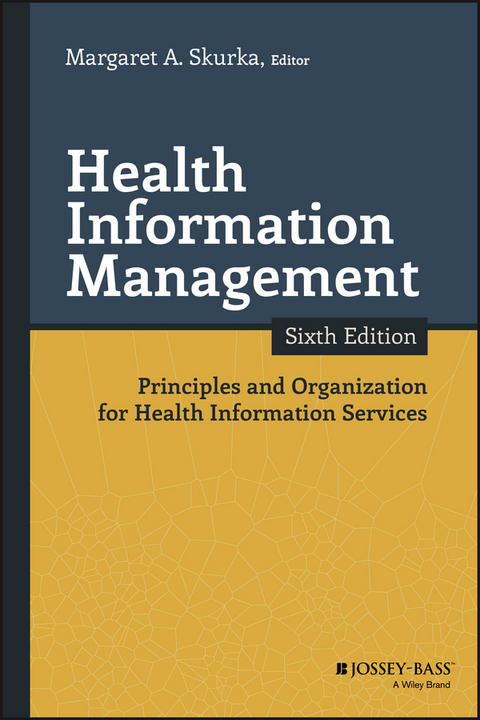
Health Information Management (eBook)
John Wiley & Sons (Verlag)
978-1-119-15121-0 (ISBN)
The Updated and Extensively Revised Guide to Developing Efficient Health Information Management Systems
Health Information Management is the most comprehensive introduction to the study and development of health information management (HIM), Students in all areas of health care gain an unmatched understanding of the entire HIM profession and how it currently relates to the complex and continuously evolving field of health care in the United States,
This brand-new Sixth Edition represents the most thorough revision to date of this cornerstone resource, Inside, a group of hand-picked HIM educators and practitioners representing the vanguard of the field provide fundamental guidelines on content and structure, analysis, assessment, and enhanced information, Fully modernized to reflect recent changes in the theory and practice of HIM, this latest edition features all-new illustrative examples and in-depth case studies, along with:
- Fresh and contemporary examinations of both electronic and print health records, data management, data privacy and security, health informatics and analytics, and coding and classification systems
- An engaging and user-friendly pedagogy, complete with learning objectives, key terms, case studies, and problems with workable solutions in every chapter
- Ready-to-use PowerPoint slides for lectures, full lesson plans, and a test bank for turnkey assessments
A must-have resource for everyone in health care, Health Information Management, Sixth Edition, puts everything you need at your fingertips,
MARGARET A, SKURKA, MS, RHIA, CCS is a Professor and Director of the Health Information Technology Program at Indiana University Northwest in Gary, She has served as Assistant Dean and Department Chair of HIM for the past 40-plus years at the university, She has been actively involved in the American Health Information Management Association for her entire career and is a recipient of its highest honor of Distinguished Member, Most recently, she was named a Chancellor's Professor by Indiana University Northwest, one of its highest honors,
The Updated and Extensively Revised Guide to Developing Efficient Health Information Management Systems Health Information Management is the most comprehensive introduction to the study and development of health information management (HIM). Students in all areas of health care gain an unmatched understanding of the entire HIM profession and how it currently relates to the complex and continuously evolving field of health care in the United States. This brand-new Sixth Edition represents the most thorough revision to date of this cornerstone resource. Inside, a group of hand-picked HIM educators and practitioners representing the vanguard of the field provide fundamental guidelines on content and structure, analysis, assessment, and enhanced information. Fully modernized to reflect recent changes in the theory and practice of HIM, this latest edition features all-new illustrative examples and in-depth case studies, along with: Fresh and contemporary examinations of both electronic and print health records, data management, data privacy and security, health informatics and analytics, and coding and classification systems An engaging and user-friendly pedagogy, complete with learning objectives, key terms, case studies, and problems with workable solutions in every chapter Ready-to-use PowerPoint slides for lectures, full lesson plans, and a test bank for turnkey assessments A must-have resource for everyone in health care, Health Information Management, Sixth Edition, puts everything you need at your fingertips.
MARGARET A. SKURKA, MS, RHIA, CCS is a Professor and Director of the Health Information Technology Program at Indiana University Northwest in Gary. She has served as Assistant Dean and Department Chair of HIM for the past 40-plus years at the university. She has been actively involved in the American Health Information Management Association for her entire career and is a recipient of its highest honor of Distinguished Member. Most recently, she was named a Chancellor's Professor by Indiana University Northwest, one of its highest honors.
About the Editor vii
About the Contributors ix
Preface xv
Acknowledgments xvii
1 Health Information Management and the Healthcare Institution 1
Felecia Williams
2 Health Record Content and Structure of the Health Record 25
Linda Galocy
3 The Health Record: Electronic and Paper 55
Linda Galocy
4 Healthcare Topics in Data Governance and Data Management 81
Dilhari R. DeAlmeida and Suzanne Paone
5 Health Law, Data Privacy and Security, Fraud, and Abuse 105
Dorinda M. Sattler
6 Informatics, Analytics, Data Use, and System Support 143
Dorinda M. Sattler
7 Coding, Compliance, and Classification Systems 171
Sandra K. Rains, Margaret A. Skurka, and Margie White
8 Clinical Documentation Improvement 205
Sandra K. Rains
9 Revenue Cycle and Reimbursement 227
Karen Wright
10 Strategic, Financial, and Organizational Management 253
Janelle Wapola and Katie Kerr
Index 283
CHAPTER 1
Health Information Management and the Healthcare Institution
Felecia Williams
The more things change, the more they stay the same.
—Jean‐Baptiste Alphonse Karr
To say that the field of health care has evolved over the past decade would be an understatement, but the quote from Mr. Karr is as true today as it was the day he made the statement. But with all that has changed, some things have remained the same. People still get sick and seek care at the hospital or clinic and physicians, nurses, therapists, and a host of other health professionals continue to provide care, in hopes of a healthier world. Additionally, the terms health and medical are still used interchangeably; this is even more pronounced when speaking of health/medical records in an electronic format.
In reality, medical and health are very different colors in the wide spectrum of the field of medicine. Health care, much like the health record, is not limited by the activities or documentation of activities that take place under the care of a physician and/or hospital. Health care not only includes services provided by a physician, but also includes a patient's lifestyle (i.e., food choices, physical activity, sleep patterns) and genetic predispositions. Where health incorporates outside forces, medical care and the medical record are driven by services provided under the care of health professionals.
Advancements in technology have changed the manner in which health information management (HIM) professionals perform their work, but it hasn't changed the work. Timely, accurate, and complete health records are still the foundations for high‐functioning HIM departments, which contribute to the overall success of a hospital.
In this chapter the discussion will focus on the roles and responsibilities of professionals that work within or for the hospital and their relationship to the HIM department. This will include the Board of Trustees, the CEO/President and the Medical Staff. This chapter will also discuss the functional areas of the HIM department, the HIM professional, and finally, the interactions between HIM and other departments and healthcare professionals within the facility.
Figure 1.1 shows a sample hospital organization chart. In this case, the HIM department's executive reporting structure falls under the medical staff. This is not always the case. To begin the discussion on the hospital hierarchy and roles of key players, it should be noted that the role of HIM is not restricted to a single reporting line.
Figure 1.1. Sample Hospital Organization Chart.
Note: The HIM executive reporting structure falls under the medical staff.
RESPONSIBILITY OF THE BOARD OF DIRECTORS
At the top of a hospital hierarchy resides the Board of Directors. The board of directors for a hospital, or any organization for that matter, has the ultimate responsibility for the success and/or failure of the organization. Members of the Board of Directors are generally leaders in their professional area of study, which is not restricted to health care, and are also considered to be upstanding citizens in the community. These members may be appointed to their position, but most are elected to serve for a specific time frame (term).
The hospital Board of Directors is responsible for the strategic vision casting activities such as planning for expansions, increased quality care through community outreach, as well as policy development for the hospitals' services. The board also has the responsibility of assigning the President or Chief Executive Officer (CEO) to take on the responsibility of the day‐to‐day activities within the hospital.
The board has regular communication with the President/CEO. These communications keep the board apprised of changes to local, state, and federal regulations that may impact the way the hospital is doing business. In addition to working with the CEO, the board may work directly with other departments' leadership when a strategic plan directly involves resources for that area. The board expects the CEO to work with the medical staff to ensure enforcement of policies and procedures and their bylaws. Reporting of activities of the medical staff and other departments are directed to the CEO, who then shares this information with the Board of Directors.
Information shared with the board is used for continuous improvement of policies and procedures, as well as future strategic activities. Strategic planning activities at the board level may be planned for as many as 10 years ahead. Using reports from the CEO allows the board to define visionary opportunities to improve the quality of care provided, and allows providers on staff to offer increased services and partner with the community to increase their presence and improve the overall health of the community.
RESPONSIBILITY OF THE PRESIDENT/CHIEF EXECUTIVE OFFICER (CEO)
The President/CEO of the hospital, generally an appointed position, is responsible for the day‐to‐day activities taking place within the hospital. This individual addresses the quality of care from all aspects, including the completion of medical records. Areas of patient satisfaction, patient safety, and employee satisfaction are not merely items on a checklist when it comes to their responsibilities; these items are just as important as the legal and ethical aspects of running a hospital, including health record compliance.
Given all the technology and patient accessibility to rating tools, ensuring patients are comfortable and satisfied is a priority. Unhappy patients and families use social media as well as the local news stations to report any incidence of discomfort. Contrary to the promotional statement claiming that “any publicity is good publicity,” in the hospital business bad publicity is just that, bad publicity, and can negatively impact patient counts and therefore the financial status of the facility. The CEO works with the marketing and public relations staff to increase awareness of any new programs being offered, the latest accreditation requirements, and any other accomplishments to help build a positive reputation for the hospital.
Because the CEO is ultimately responsible for the day‐to‐day workflow, this individual generally has hired some of the best and brightest in the areas of medicine, technology, finance, and law to handle the ground‐level activities. In the area of medicine, an appointed Medical Director takes on the responsibility of hiring decisions, including credentialing criteria, residency programs, quality improvement, continuing education, and committee assignments. This is not an exhaustive list of the medical director's responsibilities. The medical director may have constant communication with the HIM director, as the subject matter expert (SME) for health record development, maintenance, laws, rules, and regulations. The Chief Financial Officer (CFO) is responsible for ensuring the hospital is in good financial standing, and this includes keeping the lights on. Keeping the lights on may seem like a trivial phrase to attach to such a major responsibility. This is more than just the physical lights in the build, but encompasses determining all available funding sources, working with the actuarial area for predictive modeling, and meeting payroll according to the schedule developed by the facility. The CFO may also interact regularly with the HIM department, as the coding of health records generates revenue.
The Chief Information Officer (CIO) is responsible for all aspects of technology being used in the hospital. If the entire hospital used a single system, this would be a relatively easy task; however, given the nature of hospital work, it is quite possible that areas like registration, laboratory, and radiology are working on completely independent systems. They may be interfaced to communicate with one another, but maintenance schedules and unplanned system downtime can seriously complicate these responsibilities. Additionally, the HIM department may have a completely separate system.
RESPONSIBILITY OF THE MEDICAL STAFF
The rules, regulations, and bylaws for a hospital command the ethical terms by which a provider is expected to perform, but also address the areas pertaining to the maintenance of health records. In the technology‐driven world in which we currently live, the expectation for a provider to maintain the HIM tenants of timely, accurate, and complete health records is significantly heightened. Although the terms electronic health record (EHR) and electronic medical record (EMR) are continuously exchanged, what most hospitals have is an EMR. The lack of interoperability keeps facilities from having a true EHR. The medical staff and the HIM department play a major role in the format and design of paper forms, as well as screen design and navigation in an electronic environment. As a member of the forms committee, the medical staff is able to provide feedback on the most efficient way for providers to use the record.
Credentialing and Privileges
Any provider seeking to offer care at a hospital must go through the credentialing process. The Joint Commission's Comprehensive Accreditation Manual for Hospitals (CAMH) contains a section that is very specific to medical staff. Per Standard MS.01.01.01, medical staff bylaws will dictate the privileges granted to the provider (The Joint Commission, 2015). ...
| Erscheint lt. Verlag | 7.3.2017 |
|---|---|
| Reihe/Serie | Jossey-Bass Public Health |
| Jossey-Bass Public Health/Health Services Text | Jossey-Bass Public Health/Health Services Text |
| Sprache | englisch |
| Themenwelt | Informatik ► Weitere Themen ► Bioinformatik |
| Medizin / Pharmazie ► Allgemeines / Lexika | |
| Studium ► Querschnittsbereiche ► Prävention / Gesundheitsförderung | |
| Veterinärmedizin | |
| Schlagworte | Areas • brandnew • Care • Comprehensive • cornerstone • currently • Educators • Efficient • entire • extensively • Field • fundamental • Gesundheitsdaten • Gesundheits- u. Sozialwesen • Guide • Guidelines • Health • Health & Social Care • Information • Öffentlicher Gesundheitsdienst u. Gesundheitspolitik • Profession • Public Health Services & Policy • represents • resource • Revision • sixth • thorough • unmatched • Vanguard |
| ISBN-10 | 1-119-15121-X / 111915121X |
| ISBN-13 | 978-1-119-15121-0 / 9781119151210 |
| Informationen gemäß Produktsicherheitsverordnung (GPSR) | |
| Haben Sie eine Frage zum Produkt? |
 EPUB (Adobe DRM)
Kopierschutz: Adobe-DRM
Adobe-DRM ist ein Kopierschutz, der das eBook vor Mißbrauch schützen soll. Dabei wird das eBook bereits beim Download auf Ihre persönliche Adobe-ID autorisiert. Lesen können Sie das eBook dann nur auf den Geräten, welche ebenfalls auf Ihre Adobe-ID registriert sind.
Details zum Adobe-DRM
Dateiformat: EPUB (Electronic Publication)
EPUB ist ein offener Standard für eBooks und eignet sich besonders zur Darstellung von Belletristik und Sachbüchern. Der Fließtext wird dynamisch an die Display- und Schriftgröße angepasst. Auch für mobile Lesegeräte ist EPUB daher gut geeignet.
Systemvoraussetzungen:
PC/Mac: Mit einem PC oder Mac können Sie dieses eBook lesen. Sie benötigen eine
eReader: Dieses eBook kann mit (fast) allen eBook-Readern gelesen werden. Mit dem amazon-Kindle ist es aber nicht kompatibel.
Smartphone/Tablet: Egal ob Apple oder Android, dieses eBook können Sie lesen. Sie benötigen eine
Geräteliste und zusätzliche Hinweise
Buying eBooks from abroad
For tax law reasons we can sell eBooks just within Germany and Switzerland. Regrettably we cannot fulfill eBook-orders from other countries.


