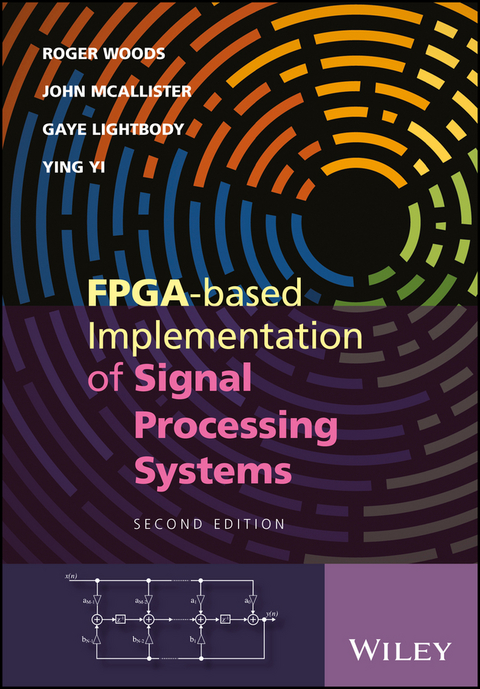
FPGA-based Implementation of Signal Processing Systems (eBook)
John Wiley & Sons (Verlag)
978-1-119-07796-1 (ISBN)
An important working resource for engineers and researchers involved in the design, development, and implementation of signal processing systems
The last decade has seen a rapid expansion of the use of field programmable gate arrays (FPGAs) for a wide range of applications beyond traditional digital signal processing (DSP) systems. Written by a team of experts working at the leading edge of FPGA research and development, this second edition of FPGA-based Implementation of Signal Processing Systems has been extensively updated and revised to reflect the latest iterations of FPGA theory, applications, and technology. Written from a system-level perspective, it features expert discussions of contemporary methods and tools used in the design, optimization and implementation of DSP systems using programmable FPGA hardware. And it provides a wealth of practical insights-along with illustrative case studies and timely real-world examples-of critical concern to engineers working in the design and development of DSP systems for radio, telecommunications, audio-visual, and security applications, as well as bioinformatics, Big Data applications, and more. Inside you will find up-to-date coverage of:
- FPGA solutions for Big Data Applications, especially as they apply to huge data sets
- The use of ARM processors in FPGAs and the transfer of FPGAs towards heterogeneous computing platforms
- The evolution of High Level Synthesis tools-including new sections on Xilinx's HLS Vivado tool flow and Altera's OpenCL approach
- Developments in Graphical Processing Units (GPUs), which are rapidly replacing more traditional DSP systems
FPGA-based Implementation of Signal Processing Systems, 2nd Edition is an indispensable guide for engineers and researchers involved in the design and development of both traditional and cutting-edge data and signal processing systems. Senior-level electrical and computer engineering graduates studying signal processing or digital signal processing also will find this volume of great interest.
Roger Woods is a full professor and Research Director for the Electronics and Computer Engineering Cluster at Queen's University Belfast, Northern Ireland, UK.
John McAllister is an academic at Queen's University Belfast, Northern Ireland, UK.
Gaye Lightbody is a Lecturer within the School of Computing and Mathematics at Ulster University, Northern Ireland, UK.
Ying Yi is currently a Senior Software Engineer at SN Systems, a wholly owned subsidiary of Sony Interactive Entertainment Inc, England, UK.
An important working resource for engineers and researchers involved in the design, development, and implementation of signal processing systems The last decade has seen a rapid expansion of the use of field programmable gate arrays (FPGAs) for a wide range of applications beyond traditional digital signal processing (DSP) systems. Written by a team of experts working at the leading edge of FPGA research and development, this second edition of FPGA-based Implementation of Signal Processing Systems has been extensively updated and revised to reflect the latest iterations of FPGA theory, applications, and technology. Written from a system-level perspective, it features expert discussions of contemporary methods and tools used in the design, optimization and implementation of DSP systems using programmable FPGA hardware. And it provides a wealth of practical insights along with illustrative case studies and timely real-world examples of critical concern to engineers working in the design and development of DSP systems for radio, telecommunications, audio-visual, and security applications, as well as bioinformatics, Big Data applications, and more. Inside you will find up-to-date coverage of: FPGA solutions for Big Data Applications, especially as they apply to huge data sets The use of ARM processors in FPGAs and the transfer of FPGAs towards heterogeneous computing platforms The evolution of High Level Synthesis tools including new sections on Xilinx's HLS Vivado tool flow and Altera's OpenCL approach Developments in Graphical Processing Units (GPUs), which are rapidly replacing more traditional DSP systems FPGA-based Implementation of Signal Processing Systems, 2nd Edition is an indispensable guide for engineers and researchers involved in the design and development of both traditional and cutting-edge data and signal processing systems. Senior-level electrical and computer engineering graduates studying signal processing or digital signal processing also will find this volume of great interest.
Roger Woods is a full professor and Research Director for the Electronics and Computer Engineering Cluster at Queen's University Belfast, Northern Ireland, UK. John McAllister is an academic at Queen's University Belfast, Northern Ireland, UK. Gaye Lightbody is a Lecturer within the School of Computing and Mathematics at Ulster University, Northern Ireland, UK. Ying Yi is currently a Senior Software Engineer at SN Systems, a wholly owned subsidiary of Sony Interactive Entertainment Inc, England, UK.
Preface
DSP and FPGAs
Digital signal processing (DSP) is the cornerstone of many products and services in the digital age. It is used in applications such as high-definition TV, mobile telephony, digital audio, multimedia, digital cameras, radar, sonar detectors, biomedical imaging, global positioning, digital radio, speech recognition, to name but a few! The evolution of DSP solutions has been driven by application requirements which, in turn, have only been possible to realize because of developments in silicon chip technology. Currently, a mix of programmable and dedicated system-on-chip (SoC) solutions are required for these applications and thus this has been a highly active area of research and development over the past four decades.
The result has been the emergence of numerous technologies for DSP implementation, ranging from simple microcontrollers right through to dedicated SoC solutions which form the basis of high-volume products such as smartphones. With the architectural developments that have occurred in field programmable gate arrays (FPGAs) over the years, it is clear that they should be considered as a viable DSP technology. Indeed, developments made by FPGA vendors would support this view of their technology. There are strong commercial pressures driving adoption of FPGA technology across a range of applications and by a number of commercial drivers.
The increasing costs of developing silicon technology implementations have put considerable pressure on the ability to create dedicated SoC systems. In the mobile phone market, volumes are such that dedicated SoC systems are required to meet stringent energy requirements, so application-specific solutions have emerged which vary in their degree of programmability, energy requirements and cost. The need to balance these requirements suggests that many of these technologies will coexist in the immediate future, and indeed many hybrid technologies are starting to emerge. This, of course, creates a considerable interest in using technology that is programmable as this acts to considerably reduce risks in developing new technologies.
Commonly used DSP technologies encompass software programmable solutions such as microcontrollers and DSP microprocessors. With the inclusion of dedicated DSP processing engines, FPGA technology has now emerged as a strong DSP technology. Their key advantage is that they enable users to create system architectures which allow the resources to be best matched to the system processing needs. Whilst memory resources are limited, they have a very high-bandwidth, on-chip capability. Whilst the prefabricated aspect of FPGAs avoids many of the deep problems met when developing SoC implementations, the creation of an efficient implementation from a DSP system description remains a highly convoluted problem which is a core theme of this book.
Book Coverage
The book looks to address FPGA-based DSP systems, considering implementation at numerous levels.
- Circuit-level optimization techniques that allow the underlying FPGA fabric to be used more intelligently are reviewed first. By considering the detailed underlying FPGA platform, it is shown how system requirements can be mapped to provide an area-efficient, faster implementation. This is demonstrated for a number of DSP transforms and fixed coefficient filtering.
- Architectural solutions can be created from a signal flow graph (SFG) representation. In effect, this requires the user to exploit the highly regular, highly computative, data-independent nature of DSP systems to produce highly parallel, pipelined FPGA-based circuit architectures. This is demonstrated for filtering and beamforming applications.
- System solutions are now a challenge as FPGAs have now become a heterogeneous platform involving multiple hardware and software components and interconnection fabrics. There is a need for a higher-level system modeling language, e.g. dataflow which will facilitate architectural optimizations but also to address system-level considerations such as interconnection and memory.
The book covers these areas of FPGA implementation, but its key differentiating factor is that it concentrates on the second and third areas listed above, namely the creation of circuit architectures and system-level modeling; this is because circuit-level optimization techniques have been covered in greater detail elsewhere. The work is backed up with the authors’ experiences in implementing practical real DSP systems and covers numerous examples including an adaptive beamformer based on a QR-based recursive least squares (RLS) filter, finite impulse response (FIR) and infinite impulse response (IIR) filters, a full search motion estimation and a fast Fourier transform (FFT) system for electronic support measures. The book also considers the development of intellectual property (IP) cores as this has become a critical aspect in the creation of DSP systems. One chapter is given over to describing the creation of such IP cores and another to the creation of an adaptive filtering core.
Audience
The book is aimed at working engineers who are interested in using FPGA technology efficiently in signal and data processing applications. The earlier chapters will be of interest to graduates and students completing their studies, taking the readers through a number of simple examples that show the trade-off when mapping DSP systems into FPGA hardware. The middle part of the book contains a number of illustrative, complex DSP system examples that have been implemented using FPGAs and whose performance clearly illustrates the benefit of their use. They provide insights into how to best use the complex FPGA technology to produce solutions optimized for speed, area and power which the authors believe is missing from current literature. The book summarizes over 30 years of learned experience of implementing complex DSP systems undertaken in many cases with commercial partners.
Second Edition Updates
The second edition has been updated and improved in a number of ways. It has been updated to reflect technology evolutions in FPGA technology, to acknowledge developments in programming and synthesis tools, to reflect on algorithms for Big Data applications, and to include improvements to some background chapters. The text has also been updated using relevant examples where appropriate.
Technology update: As FPGAs are linked to silicon technology advances, their architecture continually changes, and this is reflected in Chapter 5. A major change is the inclusion of the ARM® processor core resulting in a shift for FPGAs to a heterogeneous computing platform. Moreover, the increased use of graphical processing units (GPUs) in DSP systems is reflected in Chapter 4.
Programming tools update: Since the first edition was published, there have been a number of innovations in tool developments, particularly in the creation of commercial C-based high-level synthesis (HLS) and open computing language (OpenCL) tools. The material in Chapter 7 has been updated to reflect these changes, and Chapter 10 has been changed to reflect the changes in model-based synthesis tools.
“Big Data” processing: DSP involves processing of data content such as audio, speech, music and video information, but there is now great interest in collating huge data sets from on-line facilities and processing them quickly. As FPGAs have started to gain some traction in this area, a new chapter, Chapter 12, has been added to reflect this development.
Organization
The FPGA is a heterogeneous platform comprising complex resources such as hard and soft processors, dedicated blocks optimized for processing DSP functions and processing elements connected by both programmable and fast, dedicated interconnections. The book focuses on the challenges of implementing DSP systems on such platforms with a concentration on the high-level mapping of DSP algorithms into suitable circuit architectures.
The material is organized into three main sections.
First Section: Basics of DSP, Arithmetic and Technologies
Chapter 2 starts with a DSP primer, covering both FIR and IIR filtering, transforms including the FFT and discrete cosine transform (DCT) and concluding with adaptive filtering algorithms, covering both the least mean squares (LMS) and RLS algorithms. Chapter 3 is dedicated to computer arithmetic and covers number systems, arithmetic functions and alternative number representations such as logarithmic number representations (LNS) and coordinate rotation digital computer (CORDIC). Chapter 4 covers the technologies available to implement DSP algorithms and includes microprocessors, DSP microprocessors, GPUs and SoC architectures, including systolic arrays. In Chapter 5, a detailed description of commercial FPGAs is given with a concentration on the two main vendors, namely Xilinx and Altera, specifically their UltraScaleTM/Zynq® and Stratix® 10 FPGA families respectively, but also covering technology offerings from Lattice and MicroSemi.
Second Section: Architectural/System-Level Implementation
This section covers efficient implementation from circuit architecture onto specific FPGA families; creation of circuit architecture from SFG representations; and system-level specification and implementation methodologies from high-level representations. Chapter 6 covers only briefly...
| Erscheint lt. Verlag | 14.2.2017 |
|---|---|
| Sprache | englisch |
| Themenwelt | Informatik ► Weitere Themen ► Hardware |
| Technik ► Elektrotechnik / Energietechnik | |
| Technik ► Nachrichtentechnik | |
| Schlagworte | applying acceleration using FPGAs • Circuit Theory & Design / VLSI / ULSI • Computer Science • Database & Data Warehousing Technologies • Datenbanken u. Data Warehousing • digital signal processing • Digital signal processing systems • digital signal processing systems development • digital signal process systems design • DSP • DSP systems design • DSP systems development • Electrical & Electronics Engineering • Elektrotechnik u. Elektronik • field programmable gate array hardware • field programmable gate array hardware for digital signal processing • field programmable gate arrays • FPGA applications • FPGA-based implementations for digital signal processing • FPGA-based implementations for Signal Processing • FPGA Big Data applications • FPGA Big Data applications for bioinformatics data sets • FPGA Big Data applications for oil and gas data sets • FPGA big data collation and analysis • FPGA Design • FPGA hardware in DSP • FPGAs • FPGAs applications for petroleum industry • FPGAs applications in bioinformatics • FPGAs for very large data sets • FPGAs in sensor arrays • FPGAs in telecommunications systems • FPGA theory • Informatik • programmable digital signal processing systems • programmable signal processing systems • Schaltkreise - Theorie u. Entwurf / VLSI / ULSI • Signal Processing • Signal Processing Systems • Signalverarbeitung • waves and wave mechanics |
| ISBN-10 | 1-119-07796-6 / 1119077966 |
| ISBN-13 | 978-1-119-07796-1 / 9781119077961 |
| Informationen gemäß Produktsicherheitsverordnung (GPSR) | |
| Haben Sie eine Frage zum Produkt? |
 EPUB (Adobe DRM)
Kopierschutz: Adobe-DRM
Adobe-DRM ist ein Kopierschutz, der das eBook vor Mißbrauch schützen soll. Dabei wird das eBook bereits beim Download auf Ihre persönliche Adobe-ID autorisiert. Lesen können Sie das eBook dann nur auf den Geräten, welche ebenfalls auf Ihre Adobe-ID registriert sind.
Details zum Adobe-DRM
Dateiformat: EPUB (Electronic Publication)
EPUB ist ein offener Standard für eBooks und eignet sich besonders zur Darstellung von Belletristik und Sachbüchern. Der Fließtext wird dynamisch an die Display- und Schriftgröße angepasst. Auch für mobile Lesegeräte ist EPUB daher gut geeignet.
Systemvoraussetzungen:
PC/Mac: Mit einem PC oder Mac können Sie dieses eBook lesen. Sie benötigen eine
eReader: Dieses eBook kann mit (fast) allen eBook-Readern gelesen werden. Mit dem amazon-Kindle ist es aber nicht kompatibel.
Smartphone/Tablet: Egal ob Apple oder Android, dieses eBook können Sie lesen. Sie benötigen eine
Geräteliste und zusätzliche Hinweise
Buying eBooks from abroad
For tax law reasons we can sell eBooks just within Germany and Switzerland. Regrettably we cannot fulfill eBook-orders from other countries.
aus dem Bereich