Digital Creativity Model and Its Relationship with Corporate Performance (eBook)
IX, 70 Seiten
Springer International Publishing (Verlag)
978-3-319-39991-1 (ISBN)
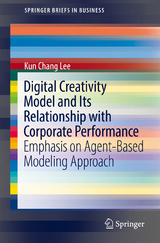
This book provides theoretical and practical backgrounds for the digital creativity management and related Agent-Based Modeling (ABM) results on the basis of a set of realistic assumptions in which several topics such as knowledge network, diversity, individual creativity, team creativity, exploration and exploitation, and organizational creativity are discussed. Until now, there has been no clear-cut methodology by which creativity management can be articulated and materialized into the business process management within companies and corporate performance. Though many approaches have been proposed to tackle the creativity research issues, this book adopts a new approach which assumes that the network structure formulated by interrelationships among team members decides individual creativity and team creativity as well, and ABM-based simulations lead to robust analysis of corporate performance over time. Typical examples of network structure under consideration in this study are degree centrality and structural hole (an opportunity to broker the flow of information between people, and control the projects that bring together people from opposite sides of the hole). This book suggests detailed analysis of source code used in implementing a prototype digital creativity simulation engine with related snap-shots and ABM results, so that readers can understand hard core of how to design and implement ABM tasks related to target problems, and extract implications from the ABM results.
Kun Chang Lee is a Professor in the Department of Interaction Science at the SKK Business School, Sungkyunkwan University in Seoul, South Korea. He earned his Ph.D. in Management Information Systems at the Korea Advanced Institute of Science and Technology, where he also earned his MSc. In Management Science. His research interests include creativity science, media effects on human behaviors, context modeling, intelligent design for artificial characters, and human-robot interaction.
Kun Chang Lee is a Professor in the SKK Business School and SAIHST (Samsung Advanced Institute for Health Sciences & Technology), Sungkyunkwan University in Seoul, South Korea. He earned his Ph.D. in Artificial Intelligence and Information Systems at the Korea Advanced Institute of Science and Technology, where he also earned his MSc. in Management Science. His research interests include creativity science, health informatics, neuroscience in decision-makings, media effects on human behaviors, context modeling, intelligent design for artificial characters, and human-robot interaction.
Chapter 1. Essentials of Digital Creativity in Contemporary Management.- Chapter 2. Agent-Based Modeling in Decision-Making.- Chapter 3. How to Adjust Corporate Decisions Effectively to Changing Markets.- Chapter 4. ABM-Driven Framework for Harnessing Digital Creativity to Corporate Performance.- Chapter 5. Discussions and Implications.- Chapter 6. Epilogue.
| Erscheint lt. Verlag | 25.7.2016 |
|---|---|
| Reihe/Serie | SpringerBriefs in Business | SpringerBriefs in Business |
| Zusatzinfo | IX, 70 p. 9 illus. in color. |
| Verlagsort | Cham |
| Sprache | englisch |
| Themenwelt | Mathematik / Informatik ► Informatik |
| Sozialwissenschaften ► Politik / Verwaltung | |
| Sozialwissenschaften ► Soziologie | |
| Wirtschaft ► Betriebswirtschaft / Management ► Logistik / Produktion | |
| Schlagworte | agent-based modeling • Creative Management • Degree Centrality • Knowledge Network • Multi-Agents Simulation • Organizational Learning • Structure Hole |
| ISBN-10 | 3-319-39991-8 / 3319399918 |
| ISBN-13 | 978-3-319-39991-1 / 9783319399911 |
| Informationen gemäß Produktsicherheitsverordnung (GPSR) | |
| Haben Sie eine Frage zum Produkt? |
 PDF (Wasserzeichen)
DRM: Digitales Wasserzeichen
Dieses eBook enthält ein digitales Wasserzeichen und ist damit für Sie personalisiert. Bei einer missbräuchlichen Weitergabe des eBooks an Dritte ist eine Rückverfolgung an die Quelle möglich.
Dateiformat: PDF (Portable Document Format)
Mit einem festen Seitenlayout eignet sich die PDF besonders für Fachbücher mit Spalten, Tabellen und Abbildungen. Eine PDF kann auf fast allen Geräten angezeigt werden, ist aber für kleine Displays (Smartphone, eReader) nur eingeschränkt geeignet.
Systemvoraussetzungen:
PC/Mac: Mit einem PC oder Mac können Sie dieses eBook lesen. Sie benötigen dafür einen PDF-Viewer - z.B. den Adobe Reader oder Adobe Digital Editions.
eReader: Dieses eBook kann mit (fast) allen eBook-Readern gelesen werden. Mit dem amazon-Kindle ist es aber nicht kompatibel.
Smartphone/Tablet: Egal ob Apple oder Android, dieses eBook können Sie lesen. Sie benötigen dafür einen PDF-Viewer - z.B. die kostenlose Adobe Digital Editions-App.
Buying eBooks from abroad
For tax law reasons we can sell eBooks just within Germany and Switzerland. Regrettably we cannot fulfill eBook-orders from other countries.
aus dem Bereich