


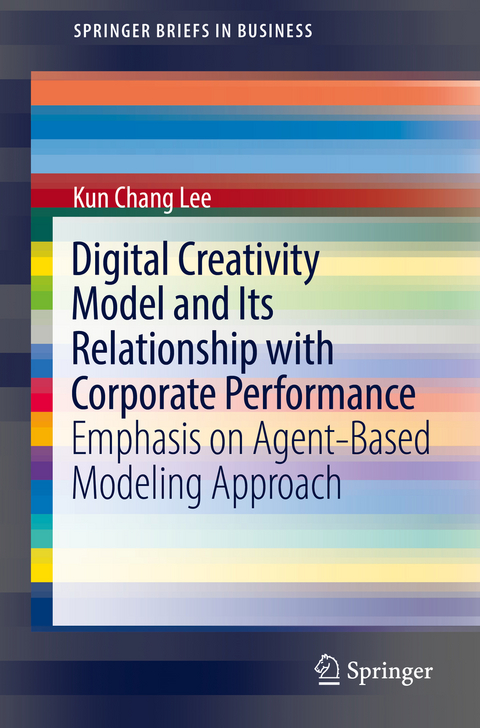
Digital Creativity Model and Its Relationship with Corporate Performance
Springer International Publishing (Verlag)
978-3-319-39989-8 (ISBN)
Kun Chang Lee is a Professor in the SKK Business School and SAIHST (Samsung Advanced Institute for Health Sciences & Technology), Sungkyunkwan University in Seoul, South Korea. He earned his Ph.D. in Artificial Intelligence and Information Systems at the Korea Advanced Institute of Science and Technology, where he also earned his MSc. in Management Science. His research interests include creativity science, health informatics, neuroscience in decision-makings, media effects on human behaviors, context modeling, intelligent design for artificial characters, and human-robot interaction.
Chapter 1. Essentials of Digital Creativity in Contemporary Management.- Chapter 2. Agent-Based Modeling in Decision-Making.- Chapter 3. How to Adjust Corporate Decisions Effectively to Changing Markets.- Chapter 4. ABM-Driven Framework for Harnessing Digital Creativity to Corporate Performance.- Chapter 5. Discussions and Implications.- Chapter 6. Epilogue.
| Erscheinungsdatum | 08.10.2016 |
|---|---|
| Reihe/Serie | SpringerBriefs in Business |
| Zusatzinfo | IX, 70 p. 9 illus. in color. |
| Verlagsort | Cham |
| Sprache | englisch |
| Maße | 155 x 235 mm |
| Themenwelt | Mathematik / Informatik ► Informatik |
| Mathematik / Informatik ► Mathematik ► Finanz- / Wirtschaftsmathematik | |
| Wirtschaft ► Betriebswirtschaft / Management | |
| Schlagworte | agent-based modeling • business and management • Business Information Systems • Creative Management • Degree Centrality • Innovation/Technology Management • Knowledge Network • Multi-Agents Simulation • Organizational Learning • Organizational Studies, Economic Sociology • Structure Hole |
| ISBN-10 | 3-319-39989-6 / 3319399896 |
| ISBN-13 | 978-3-319-39989-8 / 9783319399898 |
| Zustand | Neuware |
| Informationen gemäß Produktsicherheitsverordnung (GPSR) | |
| Haben Sie eine Frage zum Produkt? |
aus dem Bereich


