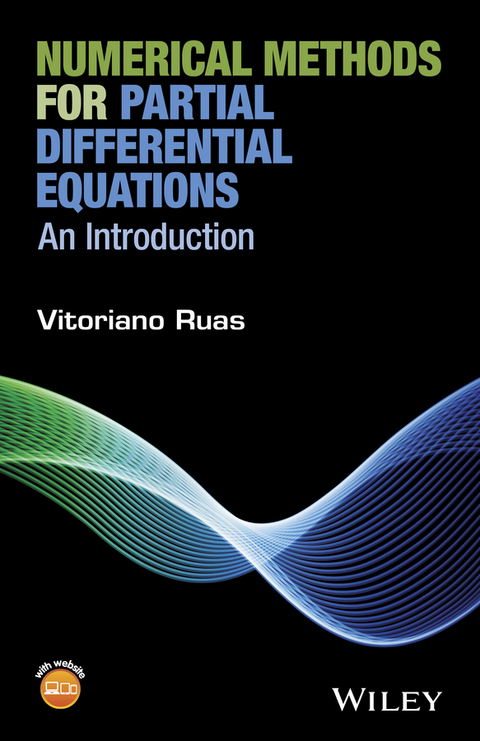
Numerical Methods for Partial Differential Equations (eBook)
John Wiley & Sons (Verlag)
978-1-119-11136-8 (ISBN)
Numerical Methods for Partial Differential Equations: An Introduction
Vitoriano Ruas, Sorbonne Universités, UPMC - Université Paris 6, France
A comprehensive overview of techniques for the computational solution of PDE's
Numerical Methods for Partial Differential Equations: An Introduction covers the three most popular methods for solving partial differential equations: the finite difference method, the finite element method and the finite volume method. The book combines clear descriptions of the three methods, their reliability, and practical implementation aspects. Justifications for why numerical methods for the main classes of PDE's work or not, or how well they work, are supplied and exemplified.
Aimed primarily at students of Engineering, Mathematics, Computer Science, Physics and Chemistry among others this book offers a substantial insight into the principles numerical methods in this class of problems are based upon. The book can also be used as a reference for research work on numerical methods for PDE's.
Key features:
- A balanced emphasis is given to both practical considerations and a rigorous mathematical treatment
- The reliability analyses for the three methods are carried out in a unified framework and in a structured and visible manner, for the basic types of PDE's
- Special attention is given to low order methods, as practitioner's overwhelming default options for everyday use
- New techniques are employed to derive known results, thereby simplifying their proof
- Supplementary material is available from a companion website.
Numerical Methods for Partial Differential Equations: An Introduction Vitoriano Ruas, Sorbonne Universit s, UPMC - Universit Paris 6, France A comprehensive overview of techniques for the computational solution of PDE'sNumerical Methods for Partial Differential Equations: An Introduction covers the three most popular methods for solving partial differential equations: the finite difference method, the finite element method and the finite volume method. The book combines clear descriptions of the three methods, their reliability, and practical implementation aspects. Justifications for why numerical methods for the main classes of PDE's work or not, or how well they work, are supplied and exemplified. Aimed primarily at students of Engineering, Mathematics, Computer Science, Physics and Chemistry among others this book offers a substantial insight into the principles numerical methods in this class of problems are based upon. The book can also be used as a reference for research work on numerical methods for PDE s.Key features: A balanced emphasis is given to both practical considerations and a rigorous mathematical treatment The reliability analyses for the three methods are carried out in a unified framework and in a structured and visible manner, for the basic types of PDE's Special attention is given to low order methods, as practitioner's overwhelming default options for everyday use New techniques are employed to derive known results, thereby simplifying their proof Supplementary material is available from a companion website.
Dr. Ruas is currently a researcher in the Jean Le Rond d'Alembert Institute at the University ofPierre and Marie Curie. He was previously a Visiting Professor in mechanics and mathematics departments at the University of Tokyo, University of Hamburg and the University of São Paulo. His main areas of research cover Numerical Methods, Applied Mathematics and Fluid Flow Modeling.
Introduction
In the realm of spirit, seek clarity; in the material world, seek utility.
Gottfried Wilhelm Leibniz
Since Leonhard Euler, numerical methods gradually became the currently widespread techniques to solve real-life problems governed by differential equations. It was, however, the invention of modern computers in the middle of the 20th century that significantly pushed this branch of applied science to play such a prominent role in contemporary technological development. Supercomputers among other high-performance machines became available since the 1980s, and this has favoured an even more spectacular evolution of numerical methods for differential equations, as tools capable of producing exploitable responses out of mathematical models of the kind.
In case a system of differential equations is expressed in terms of more than one independent variable, a system member is referred to as a partial differential equation (i.e. a PDE) and otherwise as an ordinary differential equation, (i.e. an ODE). About 100 years ago, numerical methods became practitioners' preferred alternative to solve PDEs, whose analytical solution is out of reach. This book is intended for presentation, to specialists acting in various technological and scientific fields, of basic elements on numerical methods to solve PDEs. Although the equations can be posed in any kind of spatial domain, here we confine ourselves to the case of boundary value problems, supplemented with initial conditions in case they are also time-dependent. This implies assuming that an equation's definition domain is bounded. Moreover, except for a few cases, the presentation is restricted to equations in terms of real independent variables, whose solution range is a subset of the real line.
It is well-known that PDEs model the behaviour of relevant unknown quantities in a large amount of situations of practical interest. These cover domains as diverse as engineering, physics, geo- and biomedical sciences, chemistry and economics, among many others. For example, in aircraft design the knowledge of the way air flows about fuselages is of paramount importance, as much as mastering the propagation of acoustic waves in vehicle interiors is a must in modern automobile design. Also in recent decades, more and more such models are being employed in the search for better understanding of human body systems. This is surely helping to prevent highly lethal diseases such as cardiovascular ones.
Of course, whenever possible, analytical methods should be employed to solve certain types of PDEs. Among these, the method of separation of variables is an outstanding example. However, for different reasons, including model complexity, irregular geometries or inaccurate field data, it is no point trying to determine exact analytical solutions to PDEs in most cases. Instead, numerical methods, naturally designed for use in a computational environment, provide a valid alternative to mathematical expressions representing solutions to the theoretical model. These can be as diverse as fluid velocity, blood pressure, electromagnetic fields, structural stresses, species fractions in biological evolution or chemical reactions, among many others having their behavior modelled by a PDE. That is why running a computer code, in which a numerical solution procedure is implemented, is called a numerical simulation. Indeed, the thus generated numerical values replace, in a way, a physical response to input data characterising a specific application.
Aim
The purpose of this book is to study numerical methods for solving PDEs, designed to possibly generate accurate substitutes of unknown fields, in terms of which the equations are expressed. Generally speaking, instead of values provided by a solution's analytical expression at every point of the physical domain in which a given phenomenon or process is being modelled by a PDE, in the numerical approach only solution's approximate values or related quantities at a finite number of points are determined. Owing to this feature, the underlying numerical method is also known as a discretisation method. Otherwise stated, the term discrete qualifies numerical solution techniques, as much as the terms analytical and continuous do for procedures aimed at finding exact mathematical expressions for a solution, when they exist.
To a large extent PDEs, being used in mathematical modelling, are of the second order, which means that the highest partial derivative order of the unknown fields appearing in the equations is two. For this reason, a particular emphasis is given to this class of PDEs throughout the text. However, for the sake of conciseness and clarity, we will confine the whole presentation of the numerical methods to the case of linear differential equations. Nevertheless, the types of linear PDEs to be studied are the most frequently encountered in practical applications, namely, elliptic, parabolic and hyperbolic equations. We assume throughout the text that the reader is familiar with basic concepts of linear PDEs of these representative types. Nevertheless, it would not be superfluous to recall the criteria that characterise them, by restricting the definitions to the case where the solution of a linear second-order PDE is a function of two independent variables and , and moreover to the case of constant coefficients, that is, an equation of the form
where is a given function and . Letting , we have:
- If , the equation is hyperbolic;
- If , the equation is parabolic;
- If , the equation is elliptic.
One of the main differences between the three types of equations relies on the boundary and/or initial conditions that must be prescribed, in order to ensure existence and uniqueness of a solution. This issue will be clarified in Chapter 3, as far as the first two types of PDEs are concerned, and in Chapter 4, whose purpose is the study of the Poisson equation, the most typical elliptic PDE.
As many authors believe, in starting from linear PDEs, it is easier to take on otherwise challenging and complicated problems in more advanced studies. Furthermore, this linear approach has an undeniable virtue: if a numerical method is unreliable to find solutions to a simplified linear (i.e. a linearised form), of a true nonlinear model, let alone its application to the latter.
Scope
First of all, we should emphasise that in contemporary numerical simulations of complex physical events, powerful computational tools such as graphics processing units (GPUs) are at practitioners' disposal. Moreover, high-performance techniques to optimise simulation codes, in order to save RAM and storage in general and make them run faster, have been in current use for the past few decades. Here one might think of vectorisation, a technique aimed at speeding up matrix and vector arithmetics, featuring more recent scientific computing-oriented programming languages such as FORTRAN 95 and MATLAB. Parallel computing based on distributed systems consisting of a computer network or several processors running concurrently in parallel, in order to accomplish different tasks of large-scale numerical processing, has been a facility in use in research centers and industries around the world for a few decades now. Although we are convinced that the reader should be aware of these possibilities, we do not address them at all because our book is an introductory one. In other words, its scope is limited to the study of numerical methods in the framework of rather simple model problems, whose solutions do not require sophisticated tools employed in intensive computer simulations.
The subject this book deals with is continuously evolving. New proposals for the numerical solution of PDEs of particular types are being published in specialised journals practically every week. However, a glance at the present state of the art suffices to show out that a milestone was reached about 50 years ago. At that time, the concepts lying behind three big families of discretisation methods to solve PDEs became well accepted in the worldwide scientific and industrial communities. More precisely, we mean the finite difference method (FDM), the finite element method (FEM) and the finite volume method (FVM), which we chose to study in detail in this book, as techniques playing central roles among several ingredients, in a recipe for the computational determination of numerical solutions to PDEs.
The FDM is the oldest and the simplest numerical method to solve differential equations. It has been known since Euler's work in the 18th century, and countless specialists in numerical mathematics contributed to its development up to now. Its routine use among specialists in the numerical solution of PDEs dates back to the beginning of the 20th century. Pioneering work of Courant, Friedrichs and Levy in Europe and in the United States (cf. [55]) set the bases to justify the method's effectiveness and reliability. Almost in parallel, Gerschgorin [85] derived decisive results in the framework of numerical analysis as applied to PDEs. Much later, other prominent members of the Russian school such as Godunov [91] and Marchuk [133] gave relevant contributions in this direction. The latter also collaborated hand in hand with Lions (cf. [127]), the respected founder of the prolific Paris school of analysis and numerical mathematics for PDEs in the late 1960s. However as Lions himself and his disciples realised...
| Erscheint lt. Verlag | 28.4.2016 |
|---|---|
| Sprache | englisch |
| Themenwelt | Mathematik / Informatik ► Mathematik ► Analysis |
| Technik ► Maschinenbau | |
| Schlagworte | Applied Mathematics in Engineering • computational methods • Computational / Numerical Methods • convergence • elliptic boundary value problems • finite differences • finite elements • Finite Volumes • Hyperbolic (partial) differential equations • Maschinenbau • Mathematics • Mathematik • Mathematik in den Ingenieurwissenschaften • mechanical engineering • Numerical Methods • numerische Methoden • Parabolic (partial) differential equations • Rechnergestützte / Numerische Verfahren im Maschinenbau • Stability and consistency |
| ISBN-10 | 1-119-11136-6 / 1119111366 |
| ISBN-13 | 978-1-119-11136-8 / 9781119111368 |
| Informationen gemäß Produktsicherheitsverordnung (GPSR) | |
| Haben Sie eine Frage zum Produkt? |
 EPUB (Adobe DRM)
Kopierschutz: Adobe-DRM
Adobe-DRM ist ein Kopierschutz, der das eBook vor Mißbrauch schützen soll. Dabei wird das eBook bereits beim Download auf Ihre persönliche Adobe-ID autorisiert. Lesen können Sie das eBook dann nur auf den Geräten, welche ebenfalls auf Ihre Adobe-ID registriert sind.
Details zum Adobe-DRM
Dateiformat: EPUB (Electronic Publication)
EPUB ist ein offener Standard für eBooks und eignet sich besonders zur Darstellung von Belletristik und Sachbüchern. Der Fließtext wird dynamisch an die Display- und Schriftgröße angepasst. Auch für mobile Lesegeräte ist EPUB daher gut geeignet.
Systemvoraussetzungen:
PC/Mac: Mit einem PC oder Mac können Sie dieses eBook lesen. Sie benötigen eine
eReader: Dieses eBook kann mit (fast) allen eBook-Readern gelesen werden. Mit dem amazon-Kindle ist es aber nicht kompatibel.
Smartphone/Tablet: Egal ob Apple oder Android, dieses eBook können Sie lesen. Sie benötigen eine
Geräteliste und zusätzliche Hinweise
Buying eBooks from abroad
For tax law reasons we can sell eBooks just within Germany and Switzerland. Regrettably we cannot fulfill eBook-orders from other countries.
aus dem Bereich