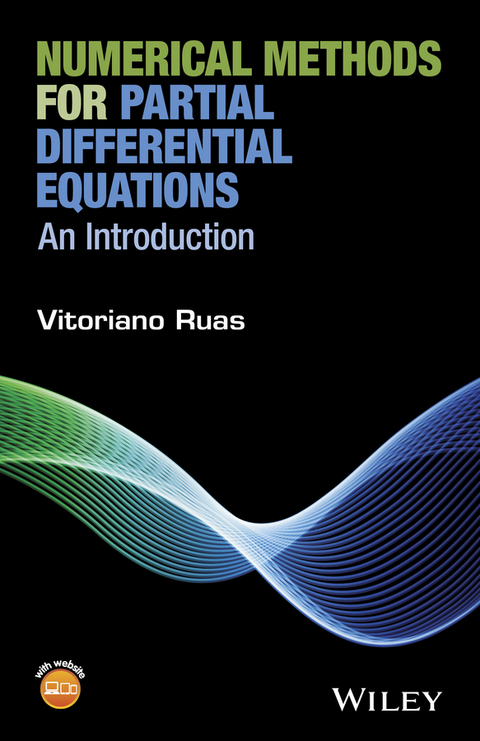
Numerical Methods for Partial Differential Equations (eBook)
John Wiley & Sons (Verlag)
978-1-119-11137-5 (ISBN)
Numerical Methods for Partial Differential Equations: An Introduction
Vitoriano Ruas, Sorbonne Universités, UPMC - Université Paris 6, France
A comprehensive overview of techniques for the computational solution of PDE's
Numerical Methods for Partial Differential Equations: An Introduction covers the three most popular methods for solving partial differential equations: the finite difference method, the finite element method and the finite volume method. The book combines clear descriptions of the three methods, their reliability, and practical implementation aspects. Justifications for why numerical methods for the main classes of PDE's work or not, or how well they work, are supplied and exemplified.
Aimed primarily at students of Engineering, Mathematics, Computer Science, Physics and Chemistry among others this book offers a substantial insight into the principles numerical methods in this class of problems are based upon. The book can also be used as a reference for research work on numerical methods for PDE's.
Key features:
- A balanced emphasis is given to both practical considerations and a rigorous mathematical treatment
- The reliability analyses for the three methods are carried out in a unified framework and in a structured and visible manner, for the basic types of PDE's
- Special attention is given to low order methods, as practitioner's overwhelming default options for everyday use
- New techniques are employed to derive known results, thereby simplifying their proof
- Supplementary material is available from a companion website.
Dr. Ruas is currently a researcher in the Jean Le Rond d'Alembert Institute at the University ofPierre and Marie Curie. He was previously a Visiting Professor in mechanics and mathematics departments at the University of Tokyo, University of Hamburg and the University of São Paulo. His main areas of research cover Numerical Methods, Applied Mathematics and Fluid Flow Modeling.
Numerical Methods for Partial Differential Equations: An Introduction Vitoriano Ruas, Sorbonne Universit s, UPMC - Universit Paris 6, France A comprehensive overview of techniques for the computational solution of PDE'sNumerical Methods for Partial Differential Equations: An Introduction covers the three most popular methods for solving partial differential equations: the finite difference method, the finite element method and the finite volume method. The book combines clear descriptions of the three methods, their reliability, and practical implementation aspects. Justifications for why numerical methods for the main classes of PDE's work or not, or how well they work, are supplied and exemplified. Aimed primarily at students of Engineering, Mathematics, Computer Science, Physics and Chemistry among others this book offers a substantial insight into the principles numerical methods in this class of problems are based upon. The book can also be used as a reference for research work on numerical methods for PDE s.Key features: A balanced emphasis is given to both practical considerations and a rigorous mathematical treatment The reliability analyses for the three methods are carried out in a unified framework and in a structured and visible manner, for the basic types of PDE's Special attention is given to low order methods, as practitioner's overwhelming default options for everyday use New techniques are employed to derive known results, thereby simplifying their proof Supplementary material is available from a companion website.
Dr. Ruas is currently a researcher in the Jean Le Rond d'Alembert Institute at the University ofPierre and Marie Curie. He was previously a Visiting Professor in mechanics and mathematics departments at the University of Tokyo, University of Hamburg and the University of São Paulo. His main areas of research cover Numerical Methods, Applied Mathematics and Fluid Flow Modeling.
| Erscheint lt. Verlag | 25.4.2016 |
|---|---|
| Sprache | englisch |
| Themenwelt | Mathematik / Informatik ► Mathematik ► Analysis |
| Technik ► Maschinenbau | |
| Schlagworte | Applied Mathematics in Engineering • Applied Mathmatics in Engineering • computational methods • Computational / Numerical Methods • convergence • elliptic boundary value problems • finite differences • finite elements • Finite Volumes • Hyperbolic (partial) differential equations • Maschinenbau • Mathematics • Mathematik • Mathematik in den Ingenieurwissenschaften • mechanical engineering • Numerical Methods • numerische Methoden • Parabolic (partial) differential equations • Rechnergestützte / Numerische Verfahren im Maschinenbau • Rechnergestützte / Numerische Verfahren im Maschinenbau • Stability and consistency |
| ISBN-10 | 1-119-11137-4 / 1119111374 |
| ISBN-13 | 978-1-119-11137-5 / 9781119111375 |
| Informationen gemäß Produktsicherheitsverordnung (GPSR) | |
| Haben Sie eine Frage zum Produkt? |
 PDF (Adobe DRM)
Kopierschutz: Adobe-DRM
Adobe-DRM ist ein Kopierschutz, der das eBook vor Mißbrauch schützen soll. Dabei wird das eBook bereits beim Download auf Ihre persönliche Adobe-ID autorisiert. Lesen können Sie das eBook dann nur auf den Geräten, welche ebenfalls auf Ihre Adobe-ID registriert sind.
Details zum Adobe-DRM
Dateiformat: PDF (Portable Document Format)
Mit einem festen Seitenlayout eignet sich die PDF besonders für Fachbücher mit Spalten, Tabellen und Abbildungen. Eine PDF kann auf fast allen Geräten angezeigt werden, ist aber für kleine Displays (Smartphone, eReader) nur eingeschränkt geeignet.
Systemvoraussetzungen:
PC/Mac: Mit einem PC oder Mac können Sie dieses eBook lesen. Sie benötigen eine
eReader: Dieses eBook kann mit (fast) allen eBook-Readern gelesen werden. Mit dem amazon-Kindle ist es aber nicht kompatibel.
Smartphone/Tablet: Egal ob Apple oder Android, dieses eBook können Sie lesen. Sie benötigen eine
Geräteliste und zusätzliche Hinweise
Buying eBooks from abroad
For tax law reasons we can sell eBooks just within Germany and Switzerland. Regrettably we cannot fulfill eBook-orders from other countries.
aus dem Bereich