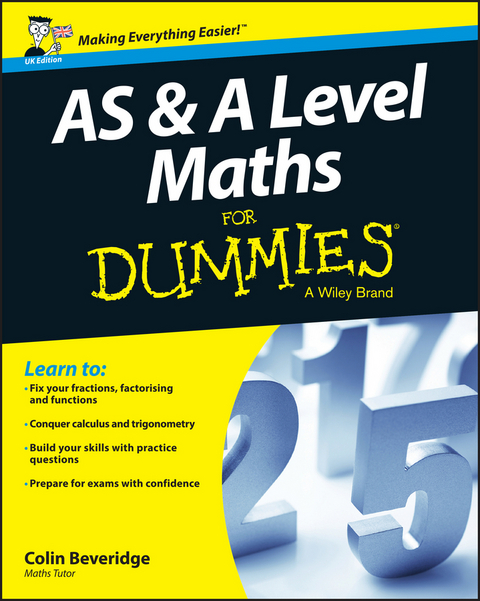
AS and A Level Maths For Dummies (eBook)
John Wiley & Sons (Verlag)
978-1-119-07847-0 (ISBN)
Looking to pass your AS and A level maths? Look no further, AS & A Level Maths For Dummies offers detailed, simple steps for all of the main types of problems you'll face in your exams, offering explanations of how the topics link together, advice on how to remember the key facts and methods, and ways to structure revision, Even if your head is spinning and you don't know where to begin, this fun and friendly guide gives in-depth support on exactly what you need to know,
In the big data and digital age, maths skills have never been more important to career success, AS & A Level Maths For Dummies guides you through the skills needed to pass the exams taken at the end of the first and second year of the course, It begins with the knowledge needed to get a top grade at GCSE, followed by sections on Algebra (functions, graph-sketching, and logarithms), Geometry (coordinate geometry, trigonometry, and working with shapes) and Calculus (differentiation, integration, and differential equations),
- Helps you build the confidence you need to pass your exams
- Serves as an excellent supplement to classroom learning
- Makes difficult maths concepts easy to understand
- Offers in-depth support in a fun and friendly style
If you're an AS & A level student looking to do your very best at exam time, AS & A Level Maths For Dummies makes it easier,
Colin Beveridge is a full-time maths tutor, He has a gift for explaining complex concepts in a lively and fun way, Colin is the author of four For Dummies maths titles,
Pass your AS & A level maths with flying colours Looking to pass your AS and A level maths? Look no further. AS & A Level Maths For Dummies offers detailed, simple steps for all of the main types of problems you'll face in your exams, offering explanations of how the topics link together, advice on how to remember the key facts and methods, and ways to structure revision. Even if your head is spinning and you don't know where to begin, this fun and friendly guide gives in-depth support on exactly what you need to know. In the big data and digital age, maths skills have never been more important to career success. AS & A Level Maths For Dummies guides you through the skills needed to pass the exams taken at the end of the first and second year of the course. It begins with the knowledge needed to get a top grade at GCSE, followed by sections on Algebra (functions, graph-sketching, and logarithms), Geometry (coordinate geometry, trigonometry, and working with shapes) and Calculus (differentiation, integration, and differential equations). Helps you build the confidence you need to pass your exams Serves as an excellent supplement to classroom learning Makes difficult maths concepts easy to understand Offers in-depth support in a fun and friendly style If you're an AS & A level student looking to do your very best at exam time, AS & A Level Maths For Dummies makes it easier.
Colin Beveridge is a full-time maths tutor. He has a gift for explaining complex concepts in a lively and fun way. Colin is the author of four For Dummies maths titles.
Introduction 1
Part I: Getting Started 5
Chapter 1: Moving towards Mathematical Mastery 7
Chapter 2: Setting Yourself Up for Study Success 19
Chapter 3: All the Algebra You Missed 31
Chapter 4: Shaping Up to Graphs and Shapes 53
Part II: Arithmetic and Algebra 71
Chapter 5: With Great Power Comes 73
Chapter 6: Playing with Polynomials 93
Chapter 7: Factors, Remainders and Fractions 111
Chapter 8: Getting Serious about Series 127
Chapter 9: Fiddling About with Functions 153
Part III: Geometry 177
Chapter 10: Coordinating Your Geometry 179
Chapter 11: Making Sense of Circles and Triangles 205
Chapter 12: Taking Trigonometry Further 221
Chapter 13: Making Vectors as Simple as i, j, k 245
Part IV: Calculus 269
Chapter 14: Climbing Slippery Slopes 271
Chapter 15: Touching on Tangents and Turning Points 281
Chapter 16: Integrating in Style 297
Chapter 17: When to Reach for the Rules 315
Chapter 18: Overcoming Evil Questions 339
Part V: The Part of Tens 363
Chapter 19: Ten Classic Mistakes to Avoid 365
Chapter 20: Ten Places to Start When You Don't Know Where to Start 371
Index 377
Chapter 1
Moving towards Mathematical Mastery
In This Chapter
Understanding the overlap with GCSE
Doing advanced algebra
Building on geometry
Diving into calculus
It’s a big step up from GCSE to A level – especially if you’re coming in with a B or a marginal A. The pace is pretty frenetic, and there’s a fair amount of A and A* material from GCSE that’s assumed knowledge at A level. If you’re not especially happy about algebraic fractions or sketching curves, for example, you’re likely to have a bit of catching up to do.
Luckily, this book has a whole part devoted to catching up with the top end of GCSE, as well as the stuff you’ll need to learn completely fresh. In this chapter, I note where the content overlaps with GCSE and introduce you to A level algebra, trigonometry and calculus.
Reviewing GCSE
The good news is that if you’ve got a solid understanding of everything in your GCSE, quite a lot of Core 1 and a fair amount of Core 2 will be old news to you. Possibly less good news is that if you’ve got gaps in your knowledge, you need to fill them in pretty sharpish.
The four key areas where there’s an overlap between the two qualifications are algebra, graphs and powers (all in Core 1) and trigonometry (which comes up a lot in Core 2). There are other bits and pieces, too – your arithmetic needs to be pretty decent in Core 1, where you don’t have a calculator, and parts of Core 2 are likely to test your knowledge of shapes other than triangles – but generally speaking, these are the big four. The first part of this book is all about making sure you’re up to speed with them.
Setting up for study success
Forgive me if you think it’s patronising to tell you how to study – after all, you must have done pretty well with exams to get this far. I go into studying because A level is a much tougher beast than GCSE – it’s possible for a reasonably smart student to coast through GCSE and get a good grade without needing to work too hard; by contrast, it’s unusual to see someone glide through A level. And presumably, if you were finding it straightforward, you wouldn’t be buying books like this to help you through it.
In this kind of scenario, everything you can do to optimise your working environment, your note-taking and your revision translates to quicker understanding and more marks in the exam.
Also, if you’re studying at sixth form, there’s likely to be a bit more going on socially than at secondary school. The more quickly you can absorb your studies, the sooner you can get out to absorb the odd lemonade with your friends. That is what you’re drinking, isn’t it?
All about the algebra
You’ve probably been manipulating algebraic expressions for years by now, and some of it will be second nature. However, just as a checklist, here are some of the topics you need to have under your belt:
- Solving linear equations (such as )
- Expanding quadratic brackets (for example, )
- Factorising and solving quadratics (such as )
- Solving linear and nonlinear simultaneous equations
- Simplifying algebraic fractions
I recap all of these in Chapter 3.
All this algebra isn’t just for the sake of jumbling letters around and feeling super-smug when your answer matches the one in the mark scheme (although that can be a nice motivator). Algebraic competence underpins just about everything in A level. Even in places where you’d normally expect to use only numbers (for example, Pythagoras’s theorem), you may be asked to work with named constants (such as k) instead of given numbers (such as 3).
Grabbing graphs by the horns
Somewhat related to algebra are graphs. You rarely need to draw an accurate graph at A level; it’s far more common to be asked to sketch a graph.
That’s good news: sketching is much quicker and more generously marked than plotting. However, you can no longer rely on painstakingly working out the coordinates and joining them up with a nice curve. Instead, you need to know the shapes of several kinds of graphs you’ve come across at GCSE: the straight line, the quadratic and the cubic graphs as well as the reciprocal and squared-reciprocal graphs.
You’ll frequently be asked to work out where a graph crosses either of the coordinate axes (which is really an algebra question), and you’ll be expected to be on top of curve transformations. I cover all these in Chapters 4 and 10.
Taming triangles and other shapes
Triangles, obviously, are the best shape of all, which is why you spend so much time on SOH CAH TOA, the sine and cosine rules, and finding areas at GCSE.
Oh, and Pythagoras’s theorem. If there were a usefulness scale, Pythagoras’s theorem would be way off it. I can’t think of a more important equation at A level, and you can read about it in Chapter 4.
Those skills are extremely useful in A level maths. Pretty much every Core 2 paper I’ve ever seen has used a triangle somewhere, and triangles frequently crop up in other modules. (If you’re doing Mechanics, having strong trigonometry skills is a massive help.)
It’s not just triangles you need to know about, though. Be sure you know the areas and perimeters of basic two-dimensional shapes like rectangles, trapeziums and circles as well as the surface areas and volumes of three-dimensional shapes such as cuboids and prisms. I recap these shapes in Chapter 15.
Attacking Advanced Algebra
As you’d expect, the algebra you’re expected to do at A level gets a bit more involved than what you did at GCSE. It comes down to learning some new techniques and linking some new notation to ideas you may already have a decent grasp of.
You start with powers and surds, a GCSE topic that sometimes gets glossed over. You’ll need to be fairly solid on these, as they come up over and over again in A level. In later modules, you have a calculator that will happily tell you that the square root of 98 can be written as , but in Core 1, you need to be able to work that out on paper.
You also deal with sequences and series (extending the work you’ve done in the past), solidify the ideas of factorising polynomials, and do some work on functions – one of the most important ideas in maths.
Picking over powers and surds
Working out combinations of powers is one of the most critical skills for A level maths. I wouldn’t say it’s more important than topics like algebra, but a student’s skill here is a strong indicator of how easy a student is going to find A level. If you’re a bit rusty on the power laws, you’re going to have to sort that out in fairly short order.
You also need to be pretty hot on your surds, especially in Core 1, when you’re one calculator short of a pencil case. Throughout your course, you’ll need to work square roots out in simplified surd form or, more generally, in exact form – examiners want to see things like rather than 4.443.
A step up from powers and surds are logarithms, which are handy functions for turning equations with unknown powers into equations with unknown multipliers. For example, without logarithms, is hard to solve (you know the answer is 4-and-a-bit but not necessarily what the bit is), but with logarithms, getting the answer is a simple bit of algebra: , where log(3) and log(100) are just numbers you can get from your calculator.
Lastly, under the ‘powers’ heading, you need to work with one of the most interesting numbers in all of maths, e. It’s a constant (exactly , or roughly ) with the lovely property that if you work out the tangent line of at any point, you find its gradient is equal to .
Sorting out sequences and series
A sequence is simply a list of mathematical objects (often numbers, sometimes expressions). A series is what you get if you add them up.
You probably did some work on sequences in the past (finding the nth term, for instance, or deciding whether a term belonged to a sequence), and that will stand you in good stead. At A level, though, there’s a lot more to it (who would have thought?).
As well as the arithmetic sequences you know and love, there are geometric sequences (where each term is a constant multiple of the one before). There are also explicitly and recursively defined functions, which sound like a horrible wild-card but in fact are quite nice because you’re told precisely how they behave in the question.
And there are binomial expansions, which are a really neat way of expanding expressions like without needing to multiply out huge numbers of brackets. It’s a particularly useful technique when you get to Core 4 and have to expand monsters like and use the result to approximate .
Of course, the binomial expansion is one of many things you do much more often in exams than you ever will in the outside world. (We have machines for that.) However, the idea of approximating things using polynomial series is a powerful tool for doing serious maths if you take the subject beyond A level. Oh, and...
| Erscheint lt. Verlag | 22.2.2016 |
|---|---|
| Sprache | englisch |
| Themenwelt | Geisteswissenschaften |
| Mathematik / Informatik ► Mathematik | |
| Sozialwissenschaften ► Pädagogik ► Bildungstheorie | |
| Schlagworte | a level maths • Algebra • AS & A level maths • AS & A Level Maths For Dummies • AS & A level student • AS and A level maths • AS Level Maths • Bildungswesen • Calculus • Colin Beveridge • Education • Geometry • Lehrpläne / Mathematik • Lehrpläne / Mathematik • Mathematics • Maths • maths concepts • maths exams • maths skills • pass your AS and A level maths • sixth form course |
| ISBN-10 | 1-119-07847-4 / 1119078474 |
| ISBN-13 | 978-1-119-07847-0 / 9781119078470 |
| Informationen gemäß Produktsicherheitsverordnung (GPSR) | |
| Haben Sie eine Frage zum Produkt? |
 EPUB (Adobe DRM)
Kopierschutz: Adobe-DRM
Adobe-DRM ist ein Kopierschutz, der das eBook vor Mißbrauch schützen soll. Dabei wird das eBook bereits beim Download auf Ihre persönliche Adobe-ID autorisiert. Lesen können Sie das eBook dann nur auf den Geräten, welche ebenfalls auf Ihre Adobe-ID registriert sind.
Details zum Adobe-DRM
Dateiformat: EPUB (Electronic Publication)
EPUB ist ein offener Standard für eBooks und eignet sich besonders zur Darstellung von Belletristik und Sachbüchern. Der Fließtext wird dynamisch an die Display- und Schriftgröße angepasst. Auch für mobile Lesegeräte ist EPUB daher gut geeignet.
Systemvoraussetzungen:
PC/Mac: Mit einem PC oder Mac können Sie dieses eBook lesen. Sie benötigen eine
eReader: Dieses eBook kann mit (fast) allen eBook-Readern gelesen werden. Mit dem amazon-Kindle ist es aber nicht kompatibel.
Smartphone/Tablet: Egal ob Apple oder Android, dieses eBook können Sie lesen. Sie benötigen eine
Geräteliste und zusätzliche Hinweise
Buying eBooks from abroad
For tax law reasons we can sell eBooks just within Germany and Switzerland. Regrettably we cannot fulfill eBook-orders from other countries.
aus dem Bereich