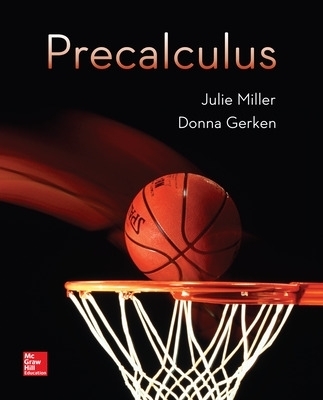
Precalculus
McGraw-Hill Inc.,US (Verlag)
978-0-07-803560-9 (ISBN)
- Titel ist leider vergriffen;
keine Neuauflage - Artikel merken
Julie Miller is from Daytona State College, where she has taught developmental and upper-level mathematics courses for 20 years. Prior to her work at Daytona State College, she worked as a software engineer for General Electric in the area of flight and radar simulation. Julie earned a bachelor of science in applied mathematics from Union College in Schenectady, New York, and a master of science in mathematics from the University of Florida. In addition to this textbook, she has authored several course supplements for college algebra, trigonometry, and precalculus, as well as several short works of fiction and nonfiction for young readers. My father is a medical researcher, and I got hooked on math and science when I was young and would visit his laboratory. I can remember using graph paper to plot data points for his experiments and doing simple calculations. He would then tell me what the peaks and features in the graph meant in the context of his experiment. I think that applications and hands-on experience made math come alive for me and Id like to see math come alive for my students.
Precalculus © 2017Chapter R:Review of PrerequisitesSectionR.1Sets and the Real Number LineSectionR.2Exponents and RadicalsSectionR.3Polynomials and Factoring Obj 8Factor Expressions Containing Negative and Rational ExponentsProblem Recognition Exercises Simplifying Algebraic ExpressionsSectionR.4Rational Expressions and More Operations on RadicalsSectionR.5EquationsSection R.6Complex Numbers and Equations with Complex SolutionsSectionR.7Linear, Compound, and Absolute Value InequalitiesSectionR.8Applications of Equations and InequalitiesChapter 1:Functions and RelationsSection1.1The Rectangular Coordinate System and Graphing UtilitiesSection1.2CirclesSection1.3Functions and RelationsSection1.4Linear Equations in Two Variables and Linear FunctionsSection1.5Applications of Linear Equations and ModelingProblem Recognition Exercises Comparing Graphs of EquationsSection1.6Transformations of GraphsSection1.7Analyzing Graphs of Functions and Piecewise-Defined FunctionsSection1.8Algebra of Functions and Function CompositionChapter 2:Polynomial and Rational FunctionsSection2.1Quadratic Functions and ApplicationsSection2.2Introduction to Polynomial FunctionsSection2.3Division of Polynomials and the Remainder and Factor TheoremsSection2.4Zeros of PolynomialsSection2.5Rational FunctionsProblem Recognition Exercises Polynomial and Rational FunctionsSection2.6Polynomial and Rational InequalitiesProblem Recognition Exercises Solving Equations and InequalitiesSection2.7VariationChapter 3:Exponential and Logarithmic FunctionsSection3.1Inverse FunctionsSection3.2Exponential FunctionsSection3.3Logarithmic FunctionsProblem Recognition Exercises Analyzing FunctionsSection3.4Properties of LogarithmsSection3.5Exponential and Logarithmic EquationsSection3.6Modeling with Exponential and Logarithmic FunctionsChapter 4:Trigonometric FunctionsSection4.1Angles and Their Measure and Special TrianglesSection4.2Trigonometric Functions Defined on the Unit CircleSection4.3Trigonometric Functions Defined on Right TrianglesSection4.4Graphs of the Sine and Cosine Functions Section4.5Graphs of Other Trigonometric FunctionsProblem Recognition Exercises Comparing Graphical Characteristics of Trigonometric FunctionsSection4.6Inverse Trigonometric FunctionsChapter 5:Analytic TrigonometrySection5.1Trigonometric IdentitiesSection5.2Sum and Difference FormulasSection5.3Double-Angle and Half-Angle FormulasSection5.4Product-to-Sum and Sum-to-Product FormulasSection5.5Trigonometric EquationsChapter 6:Applications of Trigonometric FunctionsSection6.1Applications of Right TrianglesSection6.2The Law of SinesSection6.3The Law of CosinesProblem Recognition Exercises Solving Triangles Using a Variety of ToolsSection6.4Harmonic Motion and Combinations of Trigonometric FunctionsChapter 7:Trigonometry Applied to Rectangular and Polar Coordinate Systems and VectorsSection7.1Polar CoordinatesSection7.2Graphs of Polar EquationsProblem Recognition Exercises Comparing Equations in Polar and Rectangular FormSection 7.3Complex Numbers in Polar FormSection7.4VectorsSection7.5Dot ProductChapter 8:Systems of Equations and InequalitiesSection8.1Systems of Linear Equations in Two Variables and ApplicationsSection8.2Systems of Linear Equations in Three Variables and ApplicationsSection8.3Partial Fraction DecompositionSection8.4Systems of Nonlinear Equations in Two VariablesSection8.5Inequalities and Systems of Inequalities in Two VariablesProblem Recognition Exercises Equations and Inequalities in Two VariablesSection8.6Linear ProgrammingChapter 9:Matrices and Determinants and ApplicationsSection9.1Solving Systems of Linear Equations Using MatricesSection9.2Inconsistent Systems and Dependent EquationsSection9.3Operations on MatricesSection9.4Inverse Matrices and Matrix EquationsSection9.5Determinants and Cramer's RuleProblem Recognition Exercises Using Multiple Methods to Solve Systems of Linear EquationsChapter 10:Analytic GeometrySection10.1The EllipseSection10.2The HyperbolaSection10.3The ParabolaProblem Recognition Exercises Comparing Equations of Conic Sections and the General EquationSection10.4Rotation of AxesSection10.5Polar Equations of ConicsSection10.6Plane Curves and Parametric EquationsChapter 11:Sequences, Series, Induction, and ProbabilitySection11.1Sequences and SeriesSection11.2Arithmetic Sequences and SeriesSection11.3Geometric Sequences and SeriesProblem Recognition Exercises Comparing Arithmetic and Geometric Sequences and SeriesSection11.4Mathematical InductionSection11.5The Binomial TheoremSection11.6Principles of CountingSection11.7Introduction to ProbabilityOnline:Chapter 12:Preview of CalculusSection12.1Introduction to Limits through Tables and GraphsSection12.2Algebraic Properties of LimitsProblem Recognition Exercises Using a Variety of Methods to Evaluate LimitsSection12.3Derivatives: The Tangent ProblemSection12.4Integrals: The Area Problem Online:Section A-1Proof of the Binomial TheoremA-2Definition of Conics From a Fixed Point and Fixed Line
| Erscheinungsdatum | 16.02.2016 |
|---|---|
| Verlagsort | New York |
| Sprache | englisch |
| Maße | 216 x 285 mm |
| Gewicht | 2679 g |
| Themenwelt | Mathematik / Informatik ► Mathematik ► Algebra |
| Mathematik / Informatik ► Mathematik ► Analysis | |
| ISBN-10 | 0-07-803560-0 / 0078035600 |
| ISBN-13 | 978-0-07-803560-9 / 9780078035609 |
| Zustand | Neuware |
| Informationen gemäß Produktsicherheitsverordnung (GPSR) | |
| Haben Sie eine Frage zum Produkt? |
aus dem Bereich