Numeracy in Children's Nursing (eBook)
John Wiley & Sons (Verlag)
978-1-118-48861-4 (ISBN)
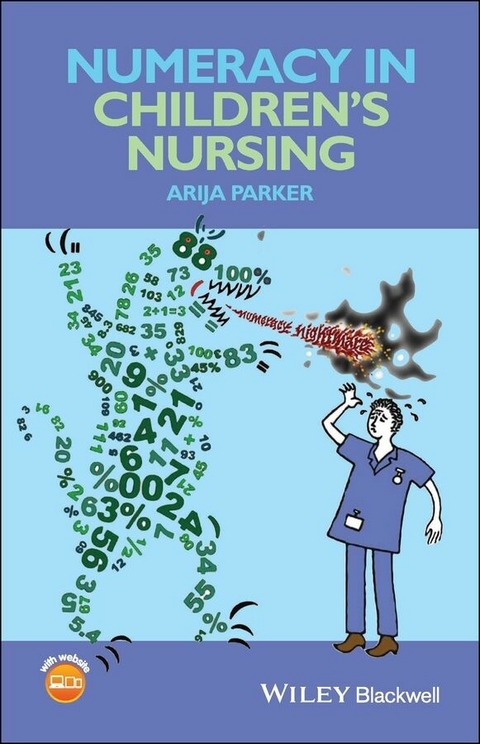
Numeracy in Children's Nursing and Healthcare is a handy, practical book which highlights the importance of numbers, numeracy and calculations in children's nursing practice, instilling nursing students and qualified nurses with confidence and competence when working with numbers and calculating drug doses. This accessible guide covers all aspects of numeracy from basic skills through to complex drug administration, and provides case studies throughout enabling the reader to apply the theory to practice. Each chapter adopts the same accessible and easy-to-follow format, featuring learning outcomes, a case scenario, key numeracy information, hints and tips, activities and exercises, and a glossary of terms.
Arija Parker is Senior Lecturer in the School of Healthat the University of Central Lancashire (UCLAN).
Arija Parker is Senior Lecturer in the School of Healthat the University of Central Lancashire (UCLAN).
NUMERACY IN CHILDREN’S NURSING 3
Contents 7
Contributors 8
Acknowledgements 9
About the companion website 11
GETTING STARTED: HOW TO USE THIS BOOK 12
Chapter 1 THE ROLE OF NUMERACY IN NURSING AND HEALTHCARE PRACTICE 25
CASE SCENARIO 1 26
INTRODUCTION 28
Why read this book? 28
How do we know if we are numerate? 30
The teaching of numeracy skills in pre? and post?registration nursing curricula 31
Clarifying our understanding of what dyscalculia is 34
Learning theories and social context 35
THE LANGUAGE OF MATHEMATICS AND NUMERACY 35
Mathematics versus numeracy – the same or different? 35
Introducing numerical concepts and ideas 36
Why is it useful to know your prime numbers? 43
Numbers and patterns 43
ERRORS IN NUMERACY PRACTICE 45
APPLICATION OF NUMBER TO CASE SCENARIO 46
Assessing pain in children and young people 47
Which pain assessment tool for which age group? 47
CONCLUSION 49
Chapter 2 COUNTING AND MEASURING 51
CASE SCENARIO 2 53
INTRODUCTION 54
SETTING THE CONTEXT 54
COUNTING AND USE OF WHOLE NUMBERS 56
The heart of nursing activity – monitoring vital signs 58
Counting respirations 58
Counting a pulse or heart rate 60
COUNTING AND MEASURING TIME 61
Using am and pm or the 24?hour clock? 62
SI UNITS – WEIGHTS AND MEASURES 62
VOLUME 66
WEIGHT 67
Weight in imperial units 69
SURFACE AREA 71
USE OF SYMBOLS – PI, ANGLES, TIME 72
TEMPERATURE 72
Temperature measurement – Fahrenheit or Celsius? 73
PRESSURE 74
What is Blood Pressure? 74
CHARTING COUNTING AND MEASUREMENT 78
The move beyond TPR/BP alone on a chart to integrate other observations into a system of PEWS 78
CONCLUDING COMMENTS 87
Chapter 3 BASIC NUMERACY SKILLS UNDERPINNING CHILDREN AND YOUNG PEOPLE’S NURSING PRACTICE 89
CASE SCENARIO 3 90
INTRODUCTION 92
Setting the context 93
The numerical operations explained 93
BoDMAS or BiDMAS 106
APPLYING BASIC NUMERICAL OPERATIONS TO THE NURSING OF CHILDREN AND YOUNG PEOPLE 107
Fluid balance – the theory 107
Positive and negative balances 109
What are negative numbers? 113
Skills and competences in relation to managing hydration in children and young people 114
Calculating flow rates 118
OUTCOMES IN RELATION TO TOMMY 120
CONCLUDING COMMENTS 120
Chapter 4 ADVANCING ONWARDS: TAKING THE WHOLE NUMBER APART 121
CASE SCENARIO 4 122
CASE SCENARIO 5 124
INTRODUCTION 126
Setting the context 126
FRACTIONS 127
Adding and subtracting fractions 130
Multiplying and dividing fractions 131
REVISITING DECIMAL NUMBERS 132
How do you turn a fraction into a decimal? 132
Rounding decimals 133
Examples of fractions in nursing practice 133
The language of fractions 137
Calculating body mass index 137
PERCENTAGES 138
How to turn a percentage into a fraction? 139
How to find a percentage of a number? 139
How to turn a percentage into a decimal amount? 140
Examples of percentages in nursing practice: Solutions, lotions and potions. 141
RATIO OR PROPORTION? 145
Ratio 145
Examples of ratios in nursing practice 145
PROPORTION 147
PROBABILITY 147
Numeracy related to case scenarios 148
How is energy intake measured? 149
Basal metabolic rate 149
Energy requirements for growth and development 150
Why is this information important? 151
Outcomes in relation to Edward and Nathan 152
CONCLUDING COMMENTS 153
Chapter 5 PUTTING THE PIECES TOGETHER – A FORMULA FOR CHILDREN’S NURSES 155
CASE SCENARIO 6 156
CASE SCENARIO 7 159
INTRODUCTION 161
Setting the context 162
PHARMACOLOGY AND CHILDREN AND YOUNG PEOPLE: HOW MEDICINES WORK 163
Why do we need to understand this process? 164
The prescription chart 167
The rights 168
The language of prescription charts 169
THE NUMBERS – RIGHT DOSE AND RIGHT TIME 172
What is a formula? 172
CONCLUDING COMMENTS 183
Chapter 6 ADMINISTERING MEDICINES AND MANAGING NUMBERS IN MORE COMPLEX SETTINGS – THE PHARMACIST AND NEONATAL NURSING PERSPECTIVES 185
CASE SCENARIO 8 186
INTRODUCTION 188
Why are children and neonates different? 189
Bobby, the nurse and the pharmacist 191
Why mistakes happen revisited with emphasis on the neonatal perspective 194
Off?label/not licensed for neonatal use 197
Neonatal Nursing perspectives 197
The practicalities of caring and making nursing decisions for a neonate – the focus on numbers 199
Maintenance fluid 200
Dilution fluid 200
PHYSIOLOGY AND NUMERACY RELATED TO BOBBY 201
Intravenous medication – the theory 201
Displacement values defined 202
Fluid management – building on previous knowledge 204
Calculating morphine requirements 206
Calculating Dopamine requirements 209
The numbers related to ventilation 211
Outcomes in relation to Bobby 212
CONCLUDING COMMENTS 213
Chapter 7 CHILD DEVELOPMENT AND NUMBER SENSE 215
CASE SCENARIO 9 216
INTRODUCTION 218
What is diabetes? 219
Key principles of type 1 diabetes management with a focus on numeracy skills 220
Child development and number sense 224
What do we mean by growth and development? 225
Milestones en route to healthy growth and development 225
Child Development in relation to acquisition of numerical skills 227
Preschool development 227
Middle childhood development 234
Primary Key Stage 1 235
Arterial blood gases 241
Adolescent development 242
Secondary Key Stage 3 242
Pi as he moves into adolescence and on to adulthood 243
CONCLUDING COMMENTS 244
Chapter 8 WHERE DO I GO FROM HERE? 245
Answers 251
Appendix: FAMOUS MATHEMATICIANS 261
References 265
Bibliography 269
Index 271
EULA 278
| Erscheint lt. Verlag | 28.9.2015 |
|---|---|
| Sprache | englisch |
| Themenwelt | Mathematik / Informatik ► Mathematik |
| Medizin / Pharmazie ► Pflege ► Kinderkrankenpflege | |
| Schlagworte | Ausbildung u. Perspektiven i. d. Krankenpflege • calculations • Children's Nursing • drug administration • Krankenpflege • Krankenpflege in der Pädiatrie u. Neonatologie • Krankenpflege in der Pädiatrie u. Neonatologie • Maths • medicines management • Neonatal Nursing • numeracy • nursing • Nursing Children & Young People • Nursing Education & Professional Development • Paediatric • Säuglingspflege • Säuglingspflege • Student |
| ISBN-10 | 1-118-48861-X / 111848861X |
| ISBN-13 | 978-1-118-48861-4 / 9781118488614 |
| Informationen gemäß Produktsicherheitsverordnung (GPSR) | |
| Haben Sie eine Frage zum Produkt? |
 PDF (Adobe DRM)
Kopierschutz: Adobe-DRM
Adobe-DRM ist ein Kopierschutz, der das eBook vor Mißbrauch schützen soll. Dabei wird das eBook bereits beim Download auf Ihre persönliche Adobe-ID autorisiert. Lesen können Sie das eBook dann nur auf den Geräten, welche ebenfalls auf Ihre Adobe-ID registriert sind.
Details zum Adobe-DRM
Dateiformat: PDF (Portable Document Format)
Mit einem festen Seitenlayout eignet sich die PDF besonders für Fachbücher mit Spalten, Tabellen und Abbildungen. Eine PDF kann auf fast allen Geräten angezeigt werden, ist aber für kleine Displays (Smartphone, eReader) nur eingeschränkt geeignet.
Systemvoraussetzungen:
PC/Mac: Mit einem PC oder Mac können Sie dieses eBook lesen. Sie benötigen eine
eReader: Dieses eBook kann mit (fast) allen eBook-Readern gelesen werden. Mit dem amazon-Kindle ist es aber nicht kompatibel.
Smartphone/Tablet: Egal ob Apple oder Android, dieses eBook können Sie lesen. Sie benötigen eine
Geräteliste und zusätzliche Hinweise
Buying eBooks from abroad
For tax law reasons we can sell eBooks just within Germany and Switzerland. Regrettably we cannot fulfill eBook-orders from other countries.
aus dem Bereich