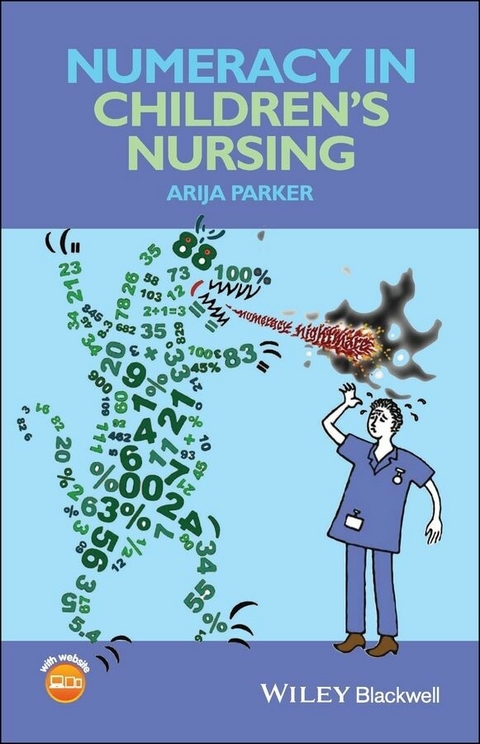
Numeracy in Children's Nursing (eBook)
John Wiley & Sons (Verlag)
978-1-118-48860-7 (ISBN)
Arija Parker is Senior Lecturer in the School of Healthat the University of Central Lancashire (UCLAN).
CONTRIBUTORS vi
ACKNOWLEDGEMENTS vii
ABOUT THE COMPANION WEBSITE ix
GETTING STARTED: HOW TO USE THIS BOOK x
1 THE ROLE OF NUMERACY IN NURSING AND HEALTHCARE PRACTICE 1
2 COUNTING AND MEASURING 27
3 BASIC NUMERACY SKILLS UNDERPINNING CHILDREN AND YOUNG PEOPLE'S NURSING PRACTICE 65
4 ADVANCING ONWARDS: TAKING THE WHOLE NUMBER APART 97
5 PUTTING THE PIECES TOGETHER - A FORMULA FOR CHILDREN'S NURSES 131
6 ADMINISTERING MEDICINES AND MANAGING NUMBERS IN MORE COMPLEX SETTINGS - THE PHARMACIST AND NEONATAL NURSING PERSPECTIVES 161
Gerard Donaghy and Lisa McCormack
7 CHILD DEVELOPMENT AND NUMBER SENSE 191
8 WHERE DO I GO FROM HERE? 221
ANSWERS 227
APPENDIX: FAMOUS MATHEMATICIANS 237
REFERENCES AND BIBLIOGRAPHY 241
INDEX 247
CHAPTER 1
THE ROLE OF NUMERACY IN NURSING AND HEALTHCARE PRACTICE
LEARNING FOCUS
The Role of Numeracy in Nursing
The broad focus of this chapter is to define what numeracy is and where numeracy skills are needed in healthcare settings. There will be a particular focus on nursing practice and, more specifically, on numeracy skills to support children and young people’s nursing.
LEARNING OUTCOMES
By the end of this chapter you should be able to:
- Identify why you need to read this book and why it is important to your practice
- Define what numeracy/mathematics are
- Have a conceptual understanding of the problems that adults, and so by default nurses have in relation to the use of number
- Use place value and the denary system
- Reflect on what you would like to achieve by working through this book and companion website having completed the diagnostic assessment which precedes this chapter
CASE SCENARIO 1
Una Venn (Age 4) is visiting the hospital for a preoperative visit and assessment prior to admission for day case surgery in the following week for ENT surgery (tonsillectomy, adenoidectomy and insertion of grommets). She is accompanied by her mother, Mrs. Venn and little brother, Jack (1 year).
Una gets to visit ENT theatre 1 together with other children who will be coming into hospital for various day case surgical procedures over the coming week. Both Mrs. Venn and Una have the documentation explained to them, including a Pain Assessment Chart. The nurse, who will be caring for Una, carries out a set of baseline observations and weighs Una and then gives them both a chance to ask questions. Mrs. Venn is also advised about pain management in hospital, postoperatively and on discharge. The nursing staff on Gamma Ward use the Arch Mede Hospital Pain Assessment Tool for children. (The Arch Mede Pain assessment too is a fictitious tool just for use to illustrate numeracy issues in this book. It is adapted from Baker and Wong (1983; 1988) and numerous other numerical, visual and colour analogue scales and has a number focused theme.)
She had some blood tests, including a full blood count (FBC), performed in clinic the week before and the results are included in the table below. Mum is informed of the result and reassured that all is fine in preparation for admission to hospital and theatre next week.
Una had a FBC performed because she has been unwell recently and looked pale and anaemic when seen by the ENT doctor in clinic. A FBC is not routinely performed as part of a preoperative assessment.
| Hospital number | AMH2014-01 |
| Ward name/number | Gamma Ward 3 (children’s day case surgical unit) |
| Temperature | Pulse | Blood pressure | Respirations | CRT | Pain score | PEWS score |
| 37°C | 106 bpm | Not recorded | 26 per minute | 1–2 seconds | 0 | 0 |
| Full blood count | Una’s result | Normal range |
| Haemoglobin | 13.3 g/dL | 13.8 g/dL |
| White cell count | 7 × 10⁹/L | 4–12 × 109/L |
| Platelets | 255 × 109/L | 100–300 × 109/L |
INTRODUCTION
This chapter will explore the context of numeracy practice in nursing in general and children and young people’s nursing more specifically, define what is numeracy/mathematics and introduce the beginnings and basics of numeracy language including place value and the use of zero.
Why read this book?
The first question to ask is why are you reading this book and why do we need yet another book on numeracy for healthcare, nursing and children’s nursing in particular, especially when there are already many other very good numeracy text books available.
You only need to look at the unfortunately regular news headlines lambasting nurses for their poor numerical abilities, which lead to serious prescription and drug administration errors. As a result we need to sit up and take note of the fact that we need to be constantly updating and developing our numeracy skills however numeracy competent we may feel we are. Whilst competence is needed for all fields of nursing, with the nursing of children and young people – where we care for neonates to adolescent patients – being accurate, safe and competent in numeracy practice is of vital importance. In addition, the numeracy subset of skills for this particular group of patients also serves to offer more challenges to numerical ability.
So, to delve a bit more deeply beyond media headlines alone to more research-based evidence, the National Patient Safety Agency (2007a) found that the most serious errors were caused by errors in medicine administration (41%) and prescribing (32%). Medication errors with children were reported from all stages of the medication process though the majority were from the part involving administration of the medicine itself (56%). The main causes are listed below:
- Prescribing errors – where medicines prescribed as volume of liquid rather than actual dose and also calculation errors, that is, 5 mL instead of 250 mg
- Dispensing errors – due to labelling errors
- Administration – involving, most commonly, intravenous drug errors though also giving a drug like paracetamol when previous dose given was not recorded, a drug being given to the wrong patient or giving the wrong amount, that is, millilitre instead of milligram
Additionally, there is a whole list of errors including wrong dose, strength or frequency errors, weighing scale errors and weight in pounds not kilograms. This is why this book has a focus on all aspects of numeracy, not just that related to medication administration. The most common medicines involved are paracetamol, gentamicin and morphine, which are all medicines that are commonly given to children and young people and are used as examples in Chapter 6, when focusing in on the needs of our neonatal patients. Here is the justification for reading and learning from a book that has a focus on the whole range of basic numeracy skills with a focus on the particular needs of children and young people.
So why do nurses who care for children make numerical mistakes? Whilst a lack of understanding of the basics could be one reason for the poor numeracy skills of nursing students, registered children’s nurses and the nursing population in general, there are other issues that might explain why there is a deficit in these skills. There is a commonly held perception, that is common in British people, not only nurses, of ‘I can’t do maths’, which may be a cultural factor though could also be due to lack of confidence, dyscalculia and maths anxiety. This is well reported in the literature including Pozehl (1996) who found that nursing students demonstrated higher levels of maths anxiety than other students. Whilst, anecdotally, it would appear that we do not have nurses who have dyscalculia working in clinical areas, probably because of a Grade C pass in maths GSCE as an entry gate to programmes of nurse training, there are many prospective nursing students who spend many years attempting to meet this entry gate to the profession by repeating courses and redoing the examinations until they pass and meet the entry criteria. Whilst they have the ‘certificate’ this does not mean that they have confidence in their numerical ability. They then spend the next 3 years of the course and beyond worrying about every numeracy test and assessment that comes their way. Increasingly now students have to pass a numeracy assessment as part of the recruitment process both to get entry onto a nursing programme and then to gain employment on registration. From a professional perspective there are also the ethical and moral issues to think about if you are practising without numerical proficiency.
It could also be argued that even the most proficient nurse mathematician still has these feelings of anxiety when faced with tests, so for all who are reading and utilising this book to improve their numeracy skills, the message of ‘practice, practice, practice’ will form the basis of advice offered. Whilst the message so far has been very serious, it is really important to emphasise that having some fun with numbers is the best way to learn, which is the approach this book would like to take by also looking at how children learn about numbers.
How do we know if we are numerate?
Numeracy is ‘of or relating to numbers’, where to be numerate ‘is the ability to use numbers especially in arithmetical operations’. The ability to be numerate is clearly linked to literacy which is the ‘ability to read and write and the ability to use language proficiently’ (Collins English Dictionary, 1999). This is reflected in the famous quotation as below:
[The universe] cannot be read until we have learnt the language and become familiar with the characters in which it is written. It is written in mathematical language, and the letters are triangles, circles and other...
| Erscheint lt. Verlag | 16.9.2015 |
|---|---|
| Sprache | englisch |
| Themenwelt | Mathematik / Informatik ► Mathematik |
| Medizin / Pharmazie ► Pflege ► Kinderkrankenpflege | |
| Schlagworte | Ausbildung u. Perspektiven i. d. Krankenpflege • calculations • Children's Nursing • drug administration • Krankenpflege • Krankenpflege in der Pädiatrie u. Neonatologie • Krankenpflege in der Pädiatrie u. Neonatologie • Maths • medicines management • Neonatal Nursing • numeracy • nursing • Nursing Children & Young People • Nursing Education & Professional Development • Paediatric • Säuglingspflege • Säuglingspflege • Student |
| ISBN-10 | 1-118-48860-1 / 1118488601 |
| ISBN-13 | 978-1-118-48860-7 / 9781118488607 |
| Informationen gemäß Produktsicherheitsverordnung (GPSR) | |
| Haben Sie eine Frage zum Produkt? |
 EPUB (Adobe DRM)
Kopierschutz: Adobe-DRM
Adobe-DRM ist ein Kopierschutz, der das eBook vor Mißbrauch schützen soll. Dabei wird das eBook bereits beim Download auf Ihre persönliche Adobe-ID autorisiert. Lesen können Sie das eBook dann nur auf den Geräten, welche ebenfalls auf Ihre Adobe-ID registriert sind.
Details zum Adobe-DRM
Dateiformat: EPUB (Electronic Publication)
EPUB ist ein offener Standard für eBooks und eignet sich besonders zur Darstellung von Belletristik und Sachbüchern. Der Fließtext wird dynamisch an die Display- und Schriftgröße angepasst. Auch für mobile Lesegeräte ist EPUB daher gut geeignet.
Systemvoraussetzungen:
PC/Mac: Mit einem PC oder Mac können Sie dieses eBook lesen. Sie benötigen eine
eReader: Dieses eBook kann mit (fast) allen eBook-Readern gelesen werden. Mit dem amazon-Kindle ist es aber nicht kompatibel.
Smartphone/Tablet: Egal ob Apple oder Android, dieses eBook können Sie lesen. Sie benötigen eine
Geräteliste und zusätzliche Hinweise
Buying eBooks from abroad
For tax law reasons we can sell eBooks just within Germany and Switzerland. Regrettably we cannot fulfill eBook-orders from other countries.
aus dem Bereich